Codex in Practice: A Complete Guide to Enterprise-Grade Agent Skills Development

A Bilibili Codex course covers installation through enterprise Agent development, serving as a knowledge map rather than a quick mastery path.
The article reviews a Bilibili Codex practical course claiming to be the most comprehensive, covering core capabilities, CLI interaction, slash commands, agents.md architecture, MCP protocol, multi-agent collaboration, plugin distribution, and an intelligent customer service project in two hours. It argues the value lies in systematically outlining an enterprise deployment framework—with agents.md, MCP, and multi-agent collaboration as key differentiators—while cautioning that true mastery still requires documentation and hands-on practice.
A course on Bilibili claims to be the "most comprehensive and detailed" Codex practical course available, promising to walk you through the entire journey from installation to Agent development in just two hours. For developers exploring how to put AI coding tools into production, the value of this kind of tutorial isn't in "quick mastery"—it's in its attempt to systematically cover the key aspects of Codex in enterprise scenarios.
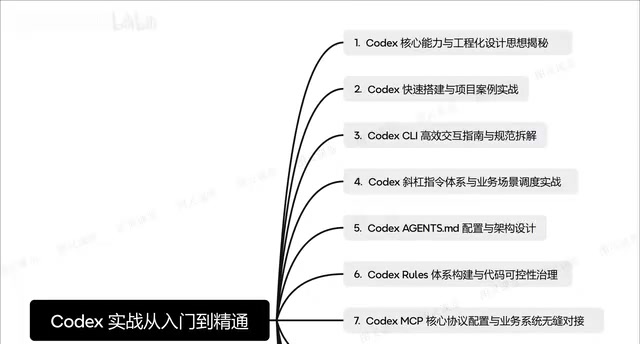
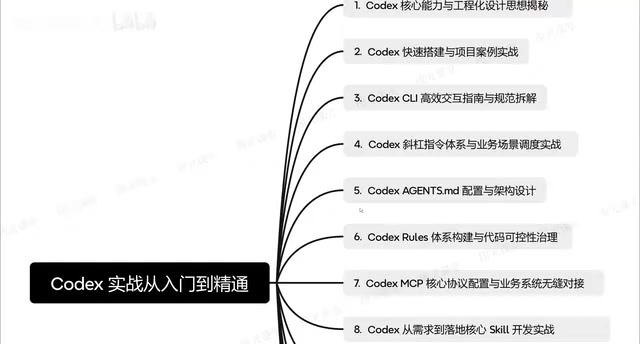
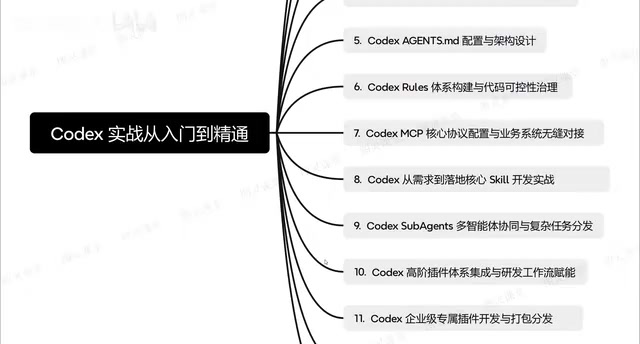
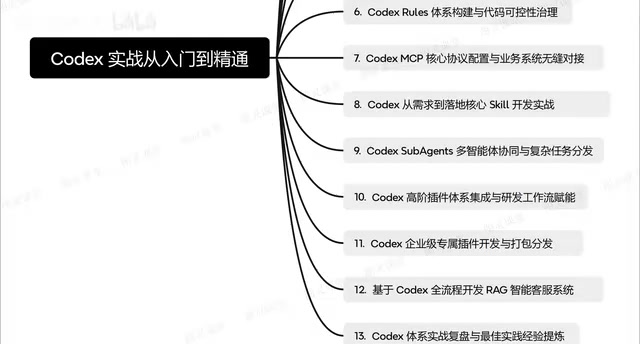
Judging from the syllabus, the course covers a remarkably broad range: Codex core capabilities, engineering design philosophy, CLI interaction conventions, the slash command system, agents.md configuration architecture, MCP protocol integration, multi-agent collaboration, plugin development and distribution, and a complete hands-on intelligent customer service system. This "from beginner to enterprise deployment" narrative structure hits a real pain point in learning AI coding tools today: most materials stop at "how to use it" and rarely explain "how to use it well within teams and business systems."
Codex Core Capabilities and Engineering Thinking
The course opens with a focus on Codex's core capabilities and engineering design philosophy. This matters because many developers still think of AI coding tools as "code completion," when the real value of tools like Codex lies in understanding project context, executing multi-step tasks, and adapting to different engineering standards through configuration.
The phrase "engineering design philosophy" is worth noting. It suggests the course won't just teach "how to run commands" but will also cover how to embed Codex into existing development workflows. According to the course description, it later walks through a from-scratch project case study—a project-based teaching approach that makes it easier for learners to build holistic understanding than simply listing features.
CLI Interaction and the agents.md Configuration System
The third, fourth, and fifth sections cover the CLI efficiency guide, the built-in slash command system, and agents.md configuration and architecture design respectively. These three build on each other: first mastering efficient command-line operations, then understanding how the instruction system integrates with business scenarios, and finally defining Agent behavior boundaries and collaboration patterns through agents.md.
The agents.md architecture design is one of the more in-depth parts of this course. In real enterprise applications, an Agent's performance depends heavily on the quality of its configuration file—how prompts are organized, how tool permissions are divided, how context is managed—all of which require a reusable architectural approach. The course explicitly promises to cover "how to write good agents.md files," and if the content is solid, this will be highly valuable for teams putting it into practice.
agents.md is essentially an Agent behavior configuration specification in the form of a Markdown file, used to declare project-level context, constraints, and collaboration rules to AI coding tools. Compared with traditional configuration files (such as JSON/YAML), the Markdown format has the advantage of being highly readable and easy to version-control and review as a team. In agents.md, you can typically define: project tech stack and code standards, common commands and build processes, the Agent's role and behavioral boundaries, tool permission scope, and handling conventions for specific tasks. Multiple AI coding tools (such as Cursor's .cursorrules, Claude Code's CLAUDE.md, etc.) have similar mechanisms, and agents.md can be seen as a generalized evolution of this idea. The key to writing good agents.md: concise information rather than piling things on, executable rules rather than vague descriptions, and clear structural layering so the Agent can retrieve what it needs on demand.
MCP Protocol and Multi-Agent Collaboration
The seventh section covers Codex's MCP core protocol configuration and how to adapt business systems for seamless integration. MCP (Model Context Protocol) is the key protocol connecting AI models with external tools and data sources. Understanding how to configure it means Agents can go beyond pure code generation and truly connect to enterprise business systems.
The ninth section ventures into multi-agent collaboration and complex task distribution. This is a frontier direction in AI application development today—a single Agent has capability boundaries, while multiple Agents working in coordination can handle more complex tasks. The course claims to cover the multi-agent collaboration mechanism of Codex Sub Agents. This content has a relatively high technical bar and is a key dividing line between "beginner tutorials" and "enterprise-grade tutorials."
MCP (Model Context Protocol) is a protocol standard proposed and open-sourced by Anthropic in late 2024. Its core goal is to define a unified communication interface between AI models and external data sources and tools. You can think of MCP as "USB-C for AI": models discover available tools, invoke them, and receive structured results in a standardized way, without writing a separate adapter layer for each external system. MCP uses a client-server architecture, where the Host (an AI application like Codex) manages connections, the Client communicates with individual MCP Servers, and the Server encapsulates specific capabilities (such as database queries, file system access, API calls). This design allows the same MCP Server to be reused across different AI applications, and enables enterprises to encapsulate internal systems as MCP Servers and connect them uniformly to various AI tools—avoiding duplicate development and vendor lock-in.
Multi-agent collaboration refers to a system architecture in which complex tasks are decomposed and then executed and coordinated by multiple Agents with different specialties. Common collaboration patterns include: the orchestrator-worker pattern (a master Agent handles task planning and distribution while multiple sub-Agents execute specific subtasks), the debate/review pattern (multiple Agents propose solutions to the same problem and cross-evaluate them), and the pipeline pattern (Agents relay tasks in sequence). Codex Sub Agents is one such task distribution mechanism, where the main Agent can delegate subtasks to sub-Agents with independent contexts—avoiding overloading a single context window while improving parallel processing capacity. The core challenges of multi-agent systems lie in: the reasonableness of task decomposition, the design of inter-Agent communication protocols, result aggregation and conflict resolution, and controlling overall cost and latency.
Plugin Development and Enterprise Project Practice
The latter half of the course shifts to the plugin system: advanced plugin integration, research and development workflow integration, scheduled development of enterprise-specific plugins, and plugin packaging and distribution. Pluginization is a common requirement for enterprise AI tool deployment—teams need to encapsulate general Codex capabilities into dedicated tools that conform to their own business standards and can be distributed externally or internally. Including these aspects in the syllabus shows that the course is indeed oriented toward engineering deployment rather than mere feature demonstrations.
The final hands-on section is a from-scratch intelligent customer service system development, covering the full development process and project retrospective. Intelligent customer service is a typical Agent application scenario, involving intent understanding, multi-turn dialogue, knowledge base integration, and more. Using it as a capstone project ties together the configuration, protocol, plugin, and multi-agent knowledge points covered earlier.
A Realistic View of "Mastery in Two Hours"
It's worth being realistic: a two-hour video can hardly make a complete beginner truly "master" enterprise-grade Agent development. The syllabus covers a lot of ground, but the depth of each section is necessarily limited. A more reasonable expectation: this course can serve as a knowledge map that helps developers build a complete framework understanding of Codex enterprise applications, while in-depth practice still needs to be digested with official documentation and real projects.
For developers who already have some experience with AI coding tools, the agents.md architecture design, MCP protocol integration, and multi-agent collaboration sections may be the most valuable; for those new to Codex, the installation/configuration and CLI interaction sections are a necessary starting point. If the course's accompanying materials include configuration templates and project code, its practical usability will be significantly enhanced.
Overall, the emergence of systematic tutorials like this reflects a trend: AI coding tools are transforming from "productivity toys" for individual developers into formal components of enterprise R&D workflows, and a distinct body of knowledge is forming around their configuration standards, protocol integration, and team collaboration methodologies.
One-line Summary
A Bilibili Codex practical course covers the full chain from installation to enterprise-grade Agent development in two hours, positioned as a knowledge map rather than a quick mastery path.
Paragraph Summary
The article reviews a Codex practical course on Bilibili billed as the "most comprehensive and detailed," which uses two hours of video to cover Codex core capabilities, CLI interaction, slash commands, agents.md configuration architecture, MCP protocol integration, multi-agent collaboration, plugin development and distribution, and a hands-on intelligent customer service system. The article argues that the value of such tutorials lies not in quick mastery but in systematically outlining a complete framework for deploying Codex in enterprise scenarios—with agents.md architecture design, MCP protocol integration, and multi-agent collaboration being the key sections that distinguish beginner from enterprise-grade content. The author also cautions that two hours is far from true mastery, and a more reasonable expectation is to treat it as a knowledge map, with in-depth practice still requiring official documentation and real projects.
Related articles

Non-Coding Dad Builds 3D Earth Toy with Claude Code, Unexpectedly Goes Viral in Classrooms
A non-coding father used Claude Code to build My Earth Toy, a 3D interactive Earth with 830+ landmarks, 470+ animals, and 180+ vehicles—now used in classrooms worldwide. Discover how AI coding lowers the barrier to creation.

Meta, Google, and TikTok Sue California Attorney General: The Battle Over Youth Social Media Law
Meta, Google, and TikTok jointly sue the California Attorney General to block a state law restricting social media use by minors under 16. This article analyzes the lawsuit's background, the law's core provisions, and its potential impact on tech industry regulation.

T-Mobile Parent Company CEO on Musk's Telecom Ambitions: Welcome, But You'll Need $200 Billion
Deutsche Telekom CEO Tim Höettges responds to Musk's SpaceX Starlink Mobile plan, saying "welcome to the party" but questioning feasibility—estimating at least $200 billion needed to become a major U.S. carrier.