Genie One Update: Turning AI Conversations into Reusable Workflows

Genie One upgrades from a Q&A tool to a full enterprise AI workflow platform with four new capabilities.
Genie One's latest update extends the value of conversational AI beyond just getting answers. Four new capabilities address different stages of the work cycle: conversation-to-document for output preservation, Genie Agents for reusable process automation, Ontology snippets and file uploads for richer enterprise context, and MCP tool integration for real action execution. A new desktop client rounds out the update. Together, these move Genie One toward a complete enterprise AI productivity platform.
From "Getting Answers" to "Putting Them to Work"
In the enterprise AI assistant space, delivering accurate answers is no longer the only benchmark that matters. The real value lies in transforming a single conversation's insights into something shareable, reusable, and actionable. Genie One's latest round of feature updates is built around exactly this idea — moving beyond a tool that simply "answers questions" and bringing the entire workflow into one unified space.
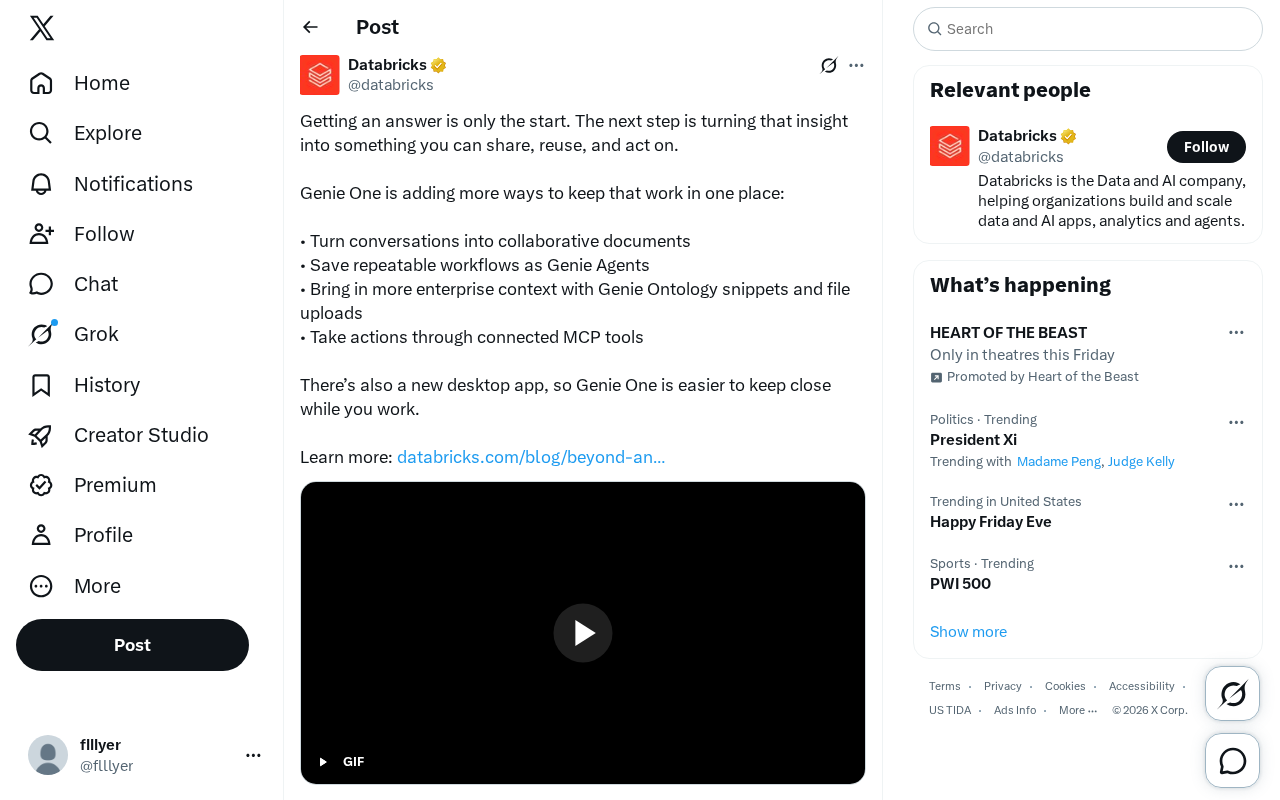
According to Genie One's official announcement, the team articulated a clear guiding principle: "Getting the answer is just the start — the next step is turning that insight into something you can share, reuse, and act on." This captures a genuine pain point in enterprise AI adoption: many conversational AI tools stop at the Q&A layer, leaving users to manually organize results and copy-paste content into other documents — wasting insights in transit.
Four Core Capabilities: Keeping Your Work in One Place
This update is organized around the goal of "keep that work in one place," introducing capability expansions across four areas.
Conversations to Collaborative Documents
The first capability converts conversations directly into collaborative documents. Once a user has extracted valuable conclusions from interacting with Genie One, they can turn those results into a document with a single click — enabling teammates to co-edit and reference it. This solves the "nowhere to put the answer" problem, making conversation outputs shareable and persistent.
Genie Agents: Saving Reusable Workflows
The second capability lets users save repeatable workflows as Genie Agents. For the many standardized tasks that exist in enterprise environments, users no longer need to describe their requirements from scratch each time. Instead, mature processes can be packaged into an Agent and called directly whenever needed. In essence, this converts a one-off prompt experience into a continuously reusable automation asset.
Richer Enterprise Context
The third capability focuses on context depth. Genie One now supports injecting more enterprise-specific background information into conversations via two methods: Genie Ontology snippets and file uploads. For enterprise users, the quality of an AI's responses depends heavily on its understanding of internal data and business context — this capability directly determines how useful the output actually is.
"Ontology" is a classic concept in knowledge engineering, referring to a formal descriptive system of entities, relationships, and rules within a given domain. In enterprise AI scenarios, ontologies help models understand company-specific business terminology, organizational structures, and data relationships — for example, "when we say 'key account,' we mean accounts with annual contract value over $1M" or "'conversion rate' is defined differently by the sales and marketing teams." The Ontology snippets referenced by Genie One represent a lightweight implementation of this idea: rather than building a full knowledge graph, users inject key business definitions and contextual notes as fragments into the conversation context. This allows the model to accurately align with internal semantics when responding, avoiding misinterpretation of specialized questions through generic understanding. This mechanism differs from RAG (Retrieval-Augmented Generation) in that it emphasizes structured semantic calibration rather than document retrieval.
Taking Action via MCP Tools
The fourth capability enables real-world actions through connected MCP (Model Context Protocol) tools. This means Genie One doesn't just offer suggestions — it can interface with external tools via a standardized protocol, turning "saying" into "doing." MCP, a connection standard that has generated significant industry buzz recently, is used here to bridge the execution gap between AI and actual business systems.
MCP (Model Context Protocol) is an open-source standardized protocol proposed by Anthropic in late 2024, designed to address the fragmented integration between AI models and external tools and data sources. Previously, each AI application that wanted to connect to calendars, databases, code repositories, or other external systems required custom-built interfaces — expensive to develop and difficult to maintain. MCP's approach is analogous to the USB standard: as long as a tool implements an MCP Server and the AI implements an MCP Client, the two can exchange context and capabilities in a plug-and-play fashion. Major platforms including GitHub, Slack, and PostgreSQL have already released official or community MCP Servers. For enterprise users, MCP's value is clear: AI is no longer limited to outputting text recommendations — it can directly trigger ticket creation, data queries, code commits, and other real business actions, truly closing the loop from "conversation" to "execution."
A New Desktop Client
Beyond the functional expansions, Genie One has also launched a brand-new desktop application. According to the team, the desktop app makes Genie One "easier to keep close while you work."
This seemingly minor addition actually reflects a deep understanding of how work happens. Enterprise users work continuously throughout the day — if an AI assistant only lives in a browser tab, it's easy to switch away from and forget. A persistent desktop entry point significantly lowers the friction of reaching for AI, helping it genuinely integrate into everyday workflows.
From Q&A Tool to Work Platform
Taken together, this round of updates reveals a clear product direction for Genie One: it is evolving from a "conversational Q&A tool" into a full-cycle work platform covering the complete loop of "capturing insights → preserving outputs → reusing processes → executing actions."
Conversation-to-document solves output preservation. Genie Agents solve process reuse. Ontology snippets and file uploads solve context supply. MCP tools solve action execution. The desktop app solves access. These pieces fit together to form a picture of what an enterprise-grade AI productivity platform should look like.
It's worth noting that this article is based on Genie One's brief official announcement. The actual experience, performance, and differentiation from competing products still need to be validated through real-world use. Interested users can visit official channels for more details.
Related articles

Chain of Thought Isn't Just for AI: How Humans Can Use CoT to Improve Thinking Quality
Chain of Thought isn't just a prompt trick for large models. Starting from a Hacker News discussion, this article analyzes why CoT works for human thinking too, breaks down actionable ways to transfer it, and highlights the key differences between human CoT and machine CoT.
Cloudflare Teams Up with OpenAI: Closi…
Cloudflare Teams Up with OpenAI: Closing the Loop from Vulnerability Discovery to Defense with AI
Cloudflare uses OpenAI Daybreak to investigate security vulnerabilities and generate reviewable remediation plans, while developers use Codex to boost coding efficiency and quality.

Orca Multi-Agent Orchestration in Practice: A Guide to Parallel Collaboration with Claude and Codex
Orca is Stable AI's free open-source agent workbench supporting 34 agents like Claude Code and Codex in parallel. Learn its Git worktree isolation, multi-model orchestration, and mobile management.