Genie Ontology in Practice: How to Build Business Context Layer by Layer to Improve AI Q&A Quality

Genie Ontology works on day one, but AI Q&A quality is determined by how well you build business context layer by layer.
This article examines the practical methodology behind Databricks Genie Ontology, arguing that the tool itself isn't the bottleneck — output quality depends on the depth of the underlying business context. The author breaks the build path into six progressive stages: strengthening the data foundation, enriching metadata, modeling critical business semantics, curating trusted assets, governing access, and continuously evaluating and improving. Rather than attempting full coverage at once, the recommended approach is to start with a single high-value business domain and expand from there. The broader takeaway: as model capabilities commoditize, the real enterprise AI moat lies in building structured, trustworthy semantic assets.
Genie Ontology: Works Out of the Box, But Quality Depends on Business Context
A recurring misconception in enterprise AI deployments is the assumption that standing up an intelligent Q&A system will immediately yield accurate answers. Genie Ontology's design philosophy offers a more pragmatic answer — it can indeed "work on day one," but the quality of those answers depends entirely on the strength of the underlying business context.
In other words, the tool itself isn't the bottleneck. What truly determines output quality is the semantic foundation you feed it. This principle applies broadly to any team building an enterprise-grade semantic layer or knowledge graph.
Building Layer by Layer: A Practical Path Forward
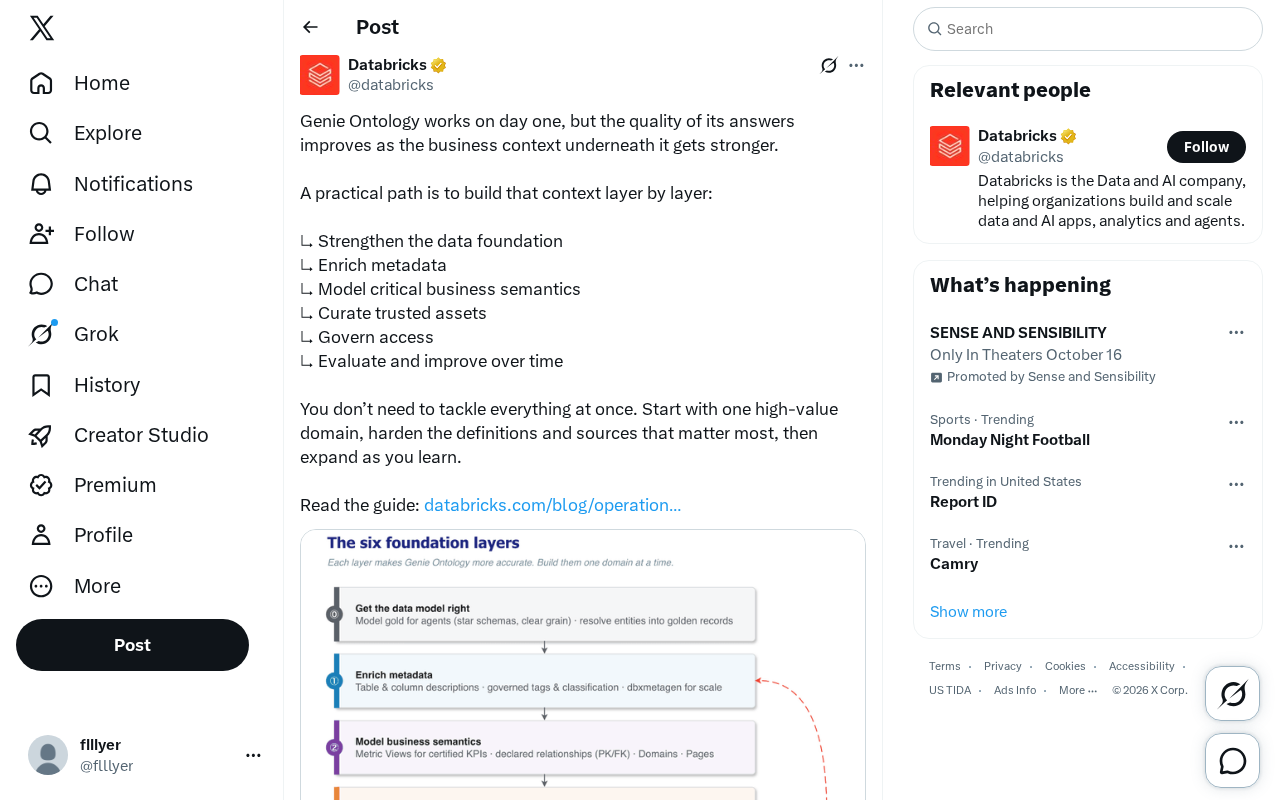
Based on the original presentation, building this context layer shouldn't be approached as a one-shot effort — it should be developed incrementally. The entire path can be broken down into six progressive stages:
Strengthen the Data Foundation
All semantic capabilities rest on reliable data. If the underlying data is messy, incomplete, or inconsistently defined, even the most sophisticated ontology modeling above it will struggle to produce trustworthy answers. The data foundation is the bedrock of the entire system.
Enrich Metadata
Metadata is what allows machines to "understand" data. The more complete the information — table names, field descriptions, lineage, update frequency — the less likely the AI is to misinterpret user intent. The richness of your metadata directly affects how well the system grasps context.
Model Critical Business Semantics
This is the leap from "data" to "knowledge." Core enterprise concepts — such as "active user," "valid order," or "net revenue" — carry specific business definitions. Explicitly modeling these semantics into the ontology is what prevents the AI from delivering answers that are literally correct but business-wrong.
What is an Ontology here? In the context of enterprise knowledge graphs, an ontology is a semantic modeling tool: it formally describes concepts within a domain, the relationships between them, and governing rules. Unlike a standard data dictionary, an ontology doesn't just define "an active user is an account with a login in the past 30 days" — it also captures hierarchical and inferential relationships, such as "paying users are a subset of active users." This is why modeling business semantics into an ontology enables the AI to perform semantic retrieval over a reasoning-capable knowledge structure, rather than simple string matching — dramatically reducing the likelihood of answers that are technically correct but contextually wrong.
Curate Trusted Assets
Not all data assets are equally reliable. Through deliberate curation — flagging validated, trustworthy tables and metrics — the system can be guided to prioritize high-quality sources and reduce noise.
What does "curating trusted assets" mean in practice? At its core, this is about introducing a human endorsement mechanism at the Data Catalog layer. Common approaches include: having a data governance committee certify core metrics tables, tagging fields with "golden record" labels, and maintaining calculation-logic documentation for key metrics. When the AI retrieves data, it can be routed preferentially to certified assets, with the source and certification status surfaced transparently in the answer — allowing business users to judge answer reliability for themselves. This step aligns closely with the "data product" concept in Data Mesh: whoever produces the data is responsible for guaranteeing its quality and trustworthiness.
Govern Access
In enterprise environments, data security and compliance are non-negotiable. Access governance ensures that different roles can only see data within their permitted scope — protecting sensitive information while keeping answers within compliance boundaries.
Evaluate and Improve Over Time
Building isn't the finish line. By continuously evaluating answer quality, teams can identify weak spots, iteratively refine definitions and sources, and create a positive feedback loop.
Don't Overreach: Start with One High-Value Domain
The most actionable piece of advice from this framework is this — don't try to solve everything at once.
The right approach is to choose a single high-value business domain as your starting point, sharpen the most critical definitions and data sources within it, and then expand to other domains as you accumulate experience.
This "start narrow, expand broadly" strategy has several clear advantages: it lowers the barrier to entry so teams can see results quickly; it validates the methodology at small scale before committing to a full rollout; and it builds trust with business stakeholders through real-world use cases, paving the way for broader adoption.
Implications for Enterprise AI Deployment
The philosophy behind Genie Ontology reflects a growing consensus in enterprise AI: models and tools are commoditizing rapidly, and the true competitive moat lies in structured, trustworthy business context.
Regardless of which vendor's semantic layer product you use, the chain of "data foundation → metadata → business semantics → trusted assets → access governance → continuous evaluation" is worth adopting as a reference framework. It reminds technical teams that rather than chasing the latest model capabilities, the more durable investment is in building solid semantic assets at the foundation — that's the fundamental path from AI that "works" to AI that works well.
For teams currently evaluating or deploying enterprise AI Q&A systems, this layer-by-layer approach provides a clear and actionable starting point.
What is a Semantic Layer? A semantic layer is an abstraction layer sitting between raw data storage and end-user analytics or AI applications. It maps physical table structures to business-understandable conceptual models and unifies metric definitions — so that when different tools query "monthly active users," they all apply the same calculation logic rather than each writing different SQL. Genie Ontology is Databricks' semantic layer product built into its Lakehouse architecture, allowing users to ask questions in natural language and receive semantically validated data answers. The core value of a semantic layer is: model once, reuse everywhere — preventing metric definitions from drifting inconsistently across dozens of downstream reports. This is precisely why the article identifies it as a key competitive differentiator in enterprise AI.
Related articles

A Single Prompt Triggers a Global PHP Security Storm: Is AI a Savior or a Hidden Risk?
A single AI prompt triggered a global PHP security crisis affecting Wikipedia and the Internet Archive. This article reviews the incident, analyzes the OpenAI-Amazon controversy, and explores the security paradox of lowered vulnerability discovery barriers in the AI era and developer response strategies.

When AI Is Taken Away: How Reliance on Shortcuts Undermines Your Problem-Solving Resilience
A study of 1,222 people found that after using AI to answer questions, once AI was removed, people gave up on more problems than a control group that never used AI. The article analyzes the impact of AI reliance on learning resilience and metacognition, and explores design implications for AI learning tools.

Carta and NewView Partner to Let Startup Employees Cash Out Equity Early
Carta and NewView Capital partner to simplify startup tender offers, helping employees sell equity early. Analysis of the mechanism, liquidity pain points, and impact.