Genspark VS Manus Real-World Comparison: Who Wins in 5 Key Scenarios?

Genspark excels at visual generation while Manus dominates deep analysis—choose by task type.
Through real-world testing across five scenarios—poster design, PPT creation, research analysis, data analysis, and website development—Genspark delivers superior output quality and layout for visual generation tasks (posters, PPTs), while Manus clearly leads in deep research, data analysis, and website development with more substantial data support and greater efficiency. Manus also offers a more generous credit system. The recommendation is to use both platforms based on task type.
Competition in the 2025 AI Agent space is heating up. Genspark and Manus, two highly anticipated AI agent platforms, both claim to compress hours of work into just minutes. But when faced with these two options, which one should users actually choose?
AI Agents are one of the hottest technology trends in artificial intelligence for 2024-2025. Unlike traditional chat-based AI (such as ChatGPT's basic conversation mode), AI Agents possess autonomous planning, tool invocation, and multi-step task execution capabilities—they don't just understand your needs, they automatically break down tasks, call upon search engines, code executors, file generators, and other tools to deliver a complete deliverable. Tech giants like OpenAI, Google, and Anthropic are all investing heavily in Agent capabilities, while Genspark and Manus represent innovative forces at the vertical application layer, packaging the capabilities of underlying large models into productivity tools for end users.
This article is based on in-depth real-world testing across five scenarios: poster design, PPT creation, research analysis, data analysis, and website development. We evaluate from four dimensions—credit consumption, completion time, output quality, and visual layout—to give you a clear answer.
Genspark vs Manus Credit Systems: Who's More Generous?
Before diving into the evaluation, let's understand the "ammunition" of both platforms—their credit systems.
The Credit System is a billing model commonly adopted by AI Agent platforms, essentially quantifying the underlying computational resource consumption. Each time a task is executed, the platform needs to call large language models for reasoning, invoke search APIs to retrieve information, run code sandboxes to generate files, and so on—all of which incur real computational costs. Compared to fixed monthly subscriptions, a credit system is more flexible, allowing users to pay only for the computing power they actually use. Credit consumption varies enormously across tasks—simple text generation might require only a few credits, while complex tasks involving multiple rounds of searching, code execution, and file rendering can consume hundreds. Understanding the credit mechanism is crucial for planning your usage strategy wisely.
Genspark gives 200 free credits per day, refreshing on a 24-hour cycle (you must wait a full 24 hours after depletion). Credits don't stack. Referrals earn both parties 1,000 credits, but the cap is only 5 people (maximum 5,000 credits), and only paid members can participate in referrals. Gifted credits expire after 3 months. Overall, it's fairly restrictive.
Manus gives 300 free credits per day, refreshing at a fixed time point (more predictable), plus 1,000 credits upon registration. Rating responses after task completion can earn additional credits. Referrals earn both parties 500 credits, with no apparent limit on referral numbers.

From a credit system perspective, Manus is clearly more generous. But more credits doesn't mean better results—the five real-world tests below are what truly matter.
Scenario 1: Poster Design — Genspark Has Stronger Visual Fundamentals
Test Task: Design a poster for an AI schedule management theme, requiring a white-blue color scheme, showcasing an AI calendar, the slogan "Give Time Back to Yourself," and a free download button at the bottom.
| Evaluation Dimension | Genspark | Manus |
|---|---|---|
| Credits Used | 105 | 21 |
| Completion Time | ~1.5 minutes | ~1.5 minutes |
| Quality Accuracy | ⭐⭐⭐⭐ | ⭐⭐ |
| Visual Layout | ⭐⭐⭐⭐ | ⭐⭐ |
Poster and PPT generation involves multimodal generation technology in the AI field. Platforms typically combine large language models (responsible for content planning and layout) with image generation models (such as DALL-E, Stable Diffusion, Midjourney API, etc.) to complete visual tasks. Genspark's advantage in visual tasks likely stems from its integration of more specialized image generation models and deeper optimization of visual layout through Prompt Engineering.
Although Genspark consumed more credits, its output quality was noticeably higher. The most critical issue: the prompt was given in Chinese, but Manus independently converted the content to English. The "Free Download" text at the bottom appeared garbled, and the positions of the theme and slogan were mixed up. This actually reflects a common challenge in current AI when handling Chinese text rendering—most image generation models are trained primarily on English data, and the higher stroke complexity of Chinese characters makes them prone to garbling or distortion. Genspark's poster was clean and crisp overall, with clear information hierarchy, indicating better adaptation for Chinese visual generation.
Conclusion: For poster design, Genspark's credits are well spent.
Scenario 2: PPT Creation — Genspark Feels More Professional
Test Task: Create a 4-page PPT on "How Professionals Can Use AI to Boost Work Efficiency," including key data and latest trends.
Genspark took about 4.5 minutes, Manus about 5 minutes—comparable speeds. But the actual results differed significantly:
- Genspark produced a highly professional PPT with well-coordinated charts, tables, and layouts, maintaining a unified visual style
- Manus used too many colors, making the design somewhat flashy and less professional
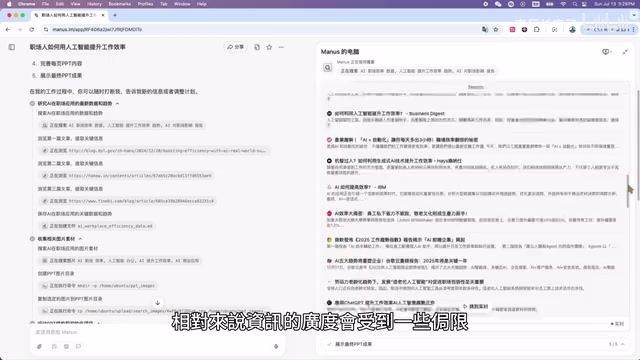
More noteworthy is the difference in source materials. Genspark not only referenced Chinese materials but also pulled data from overseas platforms like Microsoft, McKinsey, KPMG, and Slack, providing broader information coverage. Manus's sources were primarily concentrated on Chinese websites and reports, offering relatively limited information dimensions. This difference likely relates to the underlying search strategies of the two platforms—Genspark appears to enable broader multilingual search by default, while Manus may tend to limit search scope based on the user's language preference.
In terms of credits, Genspark used 178 while Manus used 96.
Conclusion: For visual generation tasks, Genspark burns more credits but delivers superior content quality and visual layout.
Scenario 3: Research Analysis — Manus Excels at In-Depth Reports
Test Task: Research the property investment value of Brisbane, Australia (host city of the 2032 Olympics), covering market conditions, rental analysis, infrastructure, population growth, land supply and demand, natural disasters, government policies, and other dimensions.
This task begins to reveal the core differences between the two platforms:
Genspark (4 minutes, 155 credits): The report opens with a summary, analyzes each dimension as requested, and concludes with risk points and investment strategies. Complete structure, solid but unremarkable.
Manus (5 minutes, 281 credits): Also opens by reviewing investment requirements and listing a core framework, but the key difference is—Manus attaches detailed data support after each research conclusion, pulling data from multiple authoritative real estate platforms, with each point repeatedly expanded and substantiated.
Manus's advantage in research tasks relies fundamentally on RAG (Retrieval-Augmented Generation) technology. Simply put, the AI doesn't fabricate information from thin air—it first retrieves relevant materials through search engines or specialized databases, then analyzes and summarizes based on the retrieved content. Manus likely employs a more aggressive retrieval strategy—calling more data sources and conducting more rounds of information verification and cross-referencing. This "deep retrieval + multi-source verification" approach consumes more computing power (reflected in higher credit consumption) but significantly improves report credibility and data support. This also explains why Manus's credit consumption for research tasks is nearly double Genspark's (281 vs 155).
In terms of report quality, Manus's deep analysis capabilities begin to show their advantage. Although it consumed more credits, the principle of "you get what you pay for" is validated here.
Conclusion: When deep research is needed, Manus's data support and analytical depth are more convincing.
Scenario 4: Data Analysis — Manus Dominates Completely
Test Task: Analyze a dataset on "Exercise Time vs. Stress Levels," identify key trends and correlations, generate scatter plots and line charts, and integrate content from a related research paper.
This is a high-complexity comprehensive task, and the results differ dramatically:

| Evaluation Dimension | Genspark | Manus |
|---|---|---|
| Credits Used | 200 | 78 |
| Completion Time | Over 15 minutes (incomplete) | 7 minutes |
| Content Quality | Redundant, contains hard-to-understand formulas | Concise, professional, logically clear |
| Layout Clarity | Clear | Clear |
When AI Agents process data analysis tasks, they typically launch a Code Sandbox in the background, automatically writing Python code to read data, perform statistical calculations, and generate visualizations. The common tech stack includes Pandas (data processing), Matplotlib and Seaborn (data visualization), SciPy (statistical analysis), and others. The performance gap between the two platforms on this task largely reflects their different code generation strategies and output presentation philosophies.
Genspark showed clear efficiency issues on this task—running for over 15 minutes while still reading the research paper, ultimately failing to complete within a reasonable timeframe. Manus produced results in just 7 minutes, focusing on core takeaways without redundant information, delivering a more organized analysis report.
By comparison, Genspark listed numerous formulas and coefficients that average users can't understand (such as Pearson correlation coefficients, regression equations, p-values, and other statistical indicators). These have reference value for data scientists but offer greatly diminished practicality for general users. Manus instead focused on conclusion-oriented output, encapsulating technical details behind the scenes and presenting only insights that users can understand—this difference in design philosophy directly impacts user experience.
Conclusion: For data analysis, Manus leads comprehensively in speed, credit consumption, and content quality.
Scenario 5: Website Development — Manus Delivers a More Complete Experience
Test Task: Based on YouTube channel content, develop a public-facing AI education website that analyzes channel content, identifies user interests, and integrates them into the site.
When AI Agents generate websites, they typically write HTML, CSS, and JavaScript code automatically. Some advanced platforms also use frontend frameworks like React or Vue. The generated websites are essentially static pages or lightweight Single Page Applications (SPA), suitable for showcase websites but lacking complex backend functionality (such as user login, database interactions, etc.).
Genspark (5 minutes, 200 credits): Generated a relatively simple website containing sections for channel introduction, latest videos, AI tool recommendations, etc. But overall it looked like a simple template was applied, lacking visual impact, with poor text readability on the homepage.
Manus (20 minutes, 620 credits): While taking longer and consuming more credits, the produced website was significantly richer. The homepage features a blue tech-themed background clearly showcasing the channel's theme, containing modules for channel introduction, popular videos, AI tool library (categorized by function with one-line descriptions), learning resources, recommended learning paths, FAQ, market news, email subscription, and more—essentially a one-stop service website. The 20-minute completion time and 620 credits suggest Manus likely executed more rounds of code generation, preview, and correction cycles—this "self-iteration" capability is a hallmark of advanced AI Agents, reviewing and optimizing output like a real developer would.

However, both platforms have issues: some of Manus's links aren't clickable, the logo is too small, and some data fields remain unfilled; Genspark's pages are overly simple. These problems reflect common limitations in current AI code generation—AI excels at generating structure and styling but still falls short in handling dynamic interactions and real data population. But in terms of overall browsing experience and content richness, Manus comes out ahead.
Conclusion: For website development, Manus offers better ROI and suits users who need a complete website.
Genspark vs Manus Pricing Plans Comparison
Genspark's overall pricing is cheaper with more credits, and it supports multiple image and video generation models—which explains its advantage in visual generation tasks. Manus offers a Basic tier plan, making it more suitable for light users getting started.
Final Verdict: No "Best"—Only "Best Fit"
Based on comprehensive testing across five scenarios, each platform has clear strengths:
Choose Genspark for:
- Visual generation tasks like posters and PPTs
- Lightweight usage with emphasis on visual quality
- Tasks not requiring particularly deep research analysis
- Budget-sensitive users seeking cost-effectiveness
Choose Manus for:
- In-depth research and data analysis
- Professional reports requiring solid data support
- Complex website development
- Processing large-scale data and multi-source information integration
Of course, the most practical approach is to choose the right tool based on the specific task. Assign visual tasks to Genspark and analytical tasks to Manus—using both in combination maximizes efficiency. After all, in the AI era, tools aren't the goal; getting work done efficiently is.
Key Takeaways
- For visual generation tasks (posters, PPTs), Genspark performs better with more professional output quality and layout, though at higher credit cost
- For deep research and data analysis, Manus clearly leads with more substantial data support, more logical analysis, and faster processing
- Regarding credit systems, Manus is more generous (300 daily credits + 1,000 upon registration), while Genspark has more restrictions (200 daily credits, 24-hour refresh)
- For website development, Manus takes longer and costs more credits, but delivers far superior content richness and overall experience compared to Genspark
- Both platforms have distinct strengths—choose based on task type: Genspark for lightweight visual tasks, Manus for deep analytical work
Related articles
 Product Reviews
The Programmer's Desk Setup Guide: Building a Workspace That Feels Like Home
Discover how programmers build productive, comfortable workspaces. From multi-monitor setups to ergonomic design, explore the desk philosophy that drives focus and flow.
 Product Reviews
Qoder vs Cursor Real-World Comparison: Which $20/Month AI IDE Is Better?
Hands-on comparison of Qoder vs Cursor AI IDEs: Agent autonomy, human interaction count, and architecture decisions. Qoder needed only 2 interactions vs Cursor's 8.
 Product Reviews
Cursor Cloud Agent Demo: Eliminating Bottlenecks Across the Entire Software Development Lifecycle
Deep analysis of Cursor's Cloud Agent demo showing how cloud VMs, automated test artifacts, and a full-chain control plane systematically eliminate human bottlenecks across the software development lifecycle.