GenST: Predicting Spatio-Temporal States for Unobserved Nodes with Large Language Models

GenST uses LLM semantic features to replace missing historical data for zero-shot spatio-temporal prediction at unobserved nodes.
Traditional spatio-temporal models fail when nodes have no historical observations. GenST reframes this as a conditional generation task on spatio-temporal graphs: a fine-tuned LLM extracts high-dimensional semantic features from node descriptions (functional zone type, road network structure, etc.) to substitute for missing time-series signals. The two-stage architecture combines a spatio-temporal VAE for latent space compression with a generative Transformer for conditional reconstruction, guided by semantic features, geographic coordinates, and neighborhood context. Zero-shot experiments across six traffic and two non-traffic datasets show GenST significantly outperforms baselines, validating semantic knowledge as an effective substitute for scarce observational data.
When Sensors Don't Reach, How Do You Predict?
Spatio-temporal forecasting sits at the core of logistics scheduling, urban planning, and intelligent transportation systems. But there's an unavoidable challenge in practice: due to deployment costs and maintenance constraints, sensor networks rarely achieve full spatial coverage. In other words, many critical nodes have no sensors at all — and therefore no historical observation data whatsoever.
Researchers have defined the problem of predicting states at such nodes as FUNS (Forecast Unobserved Node States). Traditional spatio-temporal prediction models rely heavily on historical observations. The moment they encounter a node with zero prior data, they tend to break down entirely — because their modeling logic is built on the assumption of "inferring the future from the past." For a brand-new, never-monitored intersection or area, that logic simply has nowhere to start.
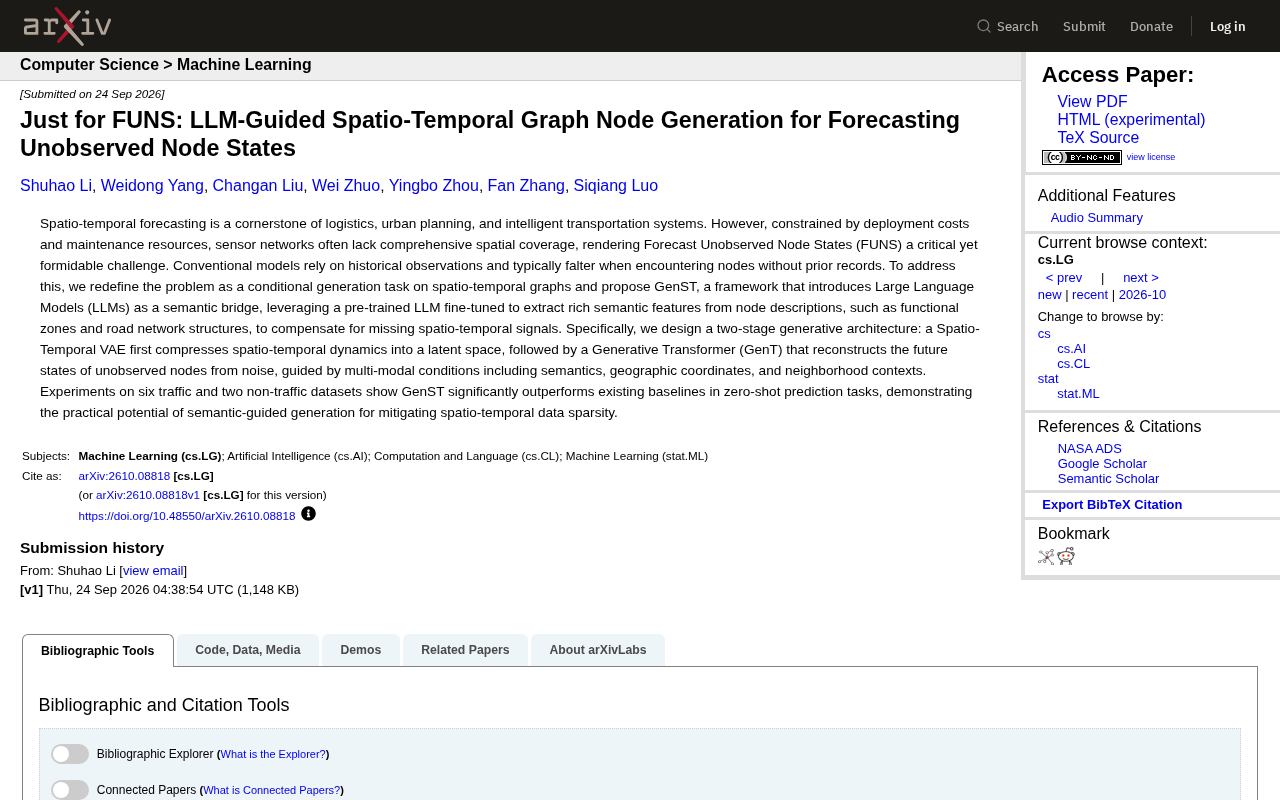
This arXiv paper — with the playful title Just for FUNS — proposes a fresh approach: reframing FUNS as a conditional generation task on spatio-temporal graphs, and introducing a large language model (LLM) as a semantic bridge to compensate for missing spatio-temporal signals with semantic information.
GenST's Core Idea: Let LLMs Fill in the Missing Signal
The framework proposed in the paper is called GenST. Its key innovation is to stop trying to mine information from non-existent historical data, and instead leverage the semantic descriptions of the nodes themselves.
Every node carries rich contextual information — what functional zone it belongs to (commercial, residential, industrial), the surrounding road network structure, and its geographic coordinates. This information is accessible even without any sensors. GenST uses a fine-tuned pretrained LLM to extract high-dimensional semantic features from these node descriptions, serving as a critical basis for prediction.
The elegance of this design is clear: an intersection located in a commercial hub connected to multiple arterial roads — even if never monitored — can have its traffic patterns inferred by analogy with semantically similar nodes. The LLM acts here as a "semantic translator," converting textual descriptions into conditional signals that the model can use.
A Two-Stage Generative Architecture
GenST employs a two-stage generative architecture, drawing on well-established paradigms from recent advances in generative modeling.
Stage One: Spatio-Temporal VAE Compression
A Spatio-Temporal VAE (Variational Autoencoder) first compresses spatio-temporal dynamics into a latent space. This step abstracts complex, high-dimensional spatio-temporal evolution patterns into compact latent variable representations, providing a structured operational space for subsequent generation.
A Variational Autoencoder (VAE) is a generative deep learning model composed of an encoder and a decoder. The encoder maps high-dimensional inputs to a low-dimensional probability distribution (typically parameterized as the mean and variance of a Gaussian), while the decoder reconstructs the original input from sampled latent variables. Unlike standard autoencoders, a VAE's latent space is continuous and interpolable, making it naturally suited for generation — samples can be drawn from anywhere in the latent space to produce plausible new outputs. In GenST's context, the "spatio-temporal" extension means the encoder must handle not just individual time series, but simultaneously capture spatial dependencies across multiple nodes and their temporal evolution, compressing the entire graph's dynamics into structured latent variables. This gives the subsequent GenT stage a meaningful operational space: rather than synthesizing directly in raw data dimensions, inference happens in a semantically richer latent representation layer, which the decoder then restores into usable spatio-temporal state sequences.
Stage Two: Generative Transformer Reconstruction
GenT (Generative Transformer) then reconstructs the future states of unobserved nodes starting from noise. This reconstruction is not blind generation — it is guided by multi-modal conditioning signals, including:
- Semantic features: extracted by the LLM from node descriptions
- Geographic coordinates: spatial location information of the node
- Neighborhood context: the states and relationships of surrounding nodes
Constrained jointly by these conditions, GenT can generate reasonable future state predictions for a node that is effectively "starting from scratch." This logic of generating structured outputs from noise is consistent with the approaches of diffusion models and generative Transformers, cleverly transplanted into the spatio-temporal graph forecasting setting.
Experimental Results: Validation Across Eight Datasets
The research team evaluated GenST on six traffic datasets and two non-traffic datasets, with a focus on zero-shot prediction performance.
Results show that GenST significantly outperforms existing baseline methods. Zero-shot here means the model must make predictions with absolutely no historical data from the target node — precisely the weakest point of traditional approaches. GenST's clear advantage in this scenario demonstrates that semantically guided generation can effectively alleviate the problem of sparse spatio-temporal data.
Notably, the experiments extend beyond the traffic domain to include two non-traffic datasets, hinting at the method's generalizability — as long as nodes carry describable semantic attributes, this framework has the potential to transfer to other applications.
Zero-shot prediction is an important paradigm in transfer learning, where a model encounters categories or entities at inference time that it has never seen during training, yet can still make reasonable predictions by leveraging indirect information such as semantic descriptions, attribute vectors, or knowledge graph relationships. The concept gained widespread attention initially in image classification — for example, a model that has never seen a photo of a "zebra" can still identify one through attribute descriptions like "has stripes, four legs, resembles a horse." In spatio-temporal forecasting, the zero-shot challenge is more complex: not only are category labels for the target node missing, but so is its complete time series history. The model must simultaneously solve "what does this node resemble?" and "how will it change in the future?" GenST addresses this by combining LLM semantic features with graph-structured neighborhood information, essentially constructing an "attribute vector" for zero-shot nodes that enables the model to transfer predictive capability from observed nodes via semantic similarity.
Significance and Outlook
GenST's value lies not just in being a new model, but in providing a new paradigm for addressing sparse data problems.
Traditional "data-driven" prediction hits a wall when confronted with data-free nodes, while GenST demonstrates that semantic knowledge can serve as a substitute for data. Given the real-world constraints of high sensor deployment costs and the impossibility of full coverage, this approach has strong practical implications — cities don't need to install sensors at every intersection; as long as sufficient semantic descriptions are provided, the model can produce usable predictions.
Of course, this work remains an early-stage exploration. The quality of semantic features extracted by LLMs, the degree of dependence on node descriptions, and robustness in larger-scale real-world deployments all require further validation. But it clearly points in a direction: combining the semantic comprehension capabilities of large language models with spatio-temporal modeling opens new possibilities for intelligent transportation and urban computing.
Related articles

Chain of Thought Isn't Just for AI: How Humans Can Use CoT to Improve Thinking Quality
Chain of Thought isn't just a prompt trick for large models. Starting from a Hacker News discussion, this article analyzes why CoT works for human thinking too, breaks down actionable ways to transfer it, and highlights the key differences between human CoT and machine CoT.
Cloudflare Teams Up with OpenAI: Closi…
Cloudflare Teams Up with OpenAI: Closing the Loop from Vulnerability Discovery to Defense with AI
Cloudflare uses OpenAI Daybreak to investigate security vulnerabilities and generate reviewable remediation plans, while developers use Codex to boost coding efficiency and quality.

Orca Multi-Agent Orchestration in Practice: A Guide to Parallel Collaboration with Claude and Codex
Orca is Stable AI's free open-source agent workbench supporting 34 agents like Claude Code and Codex in parallel. Learn its Git worktree isolation, multi-model orchestration, and mobile management.