GEOHunter Reveals: How Generative Engine Optimization Networks Manipulate AI Answers
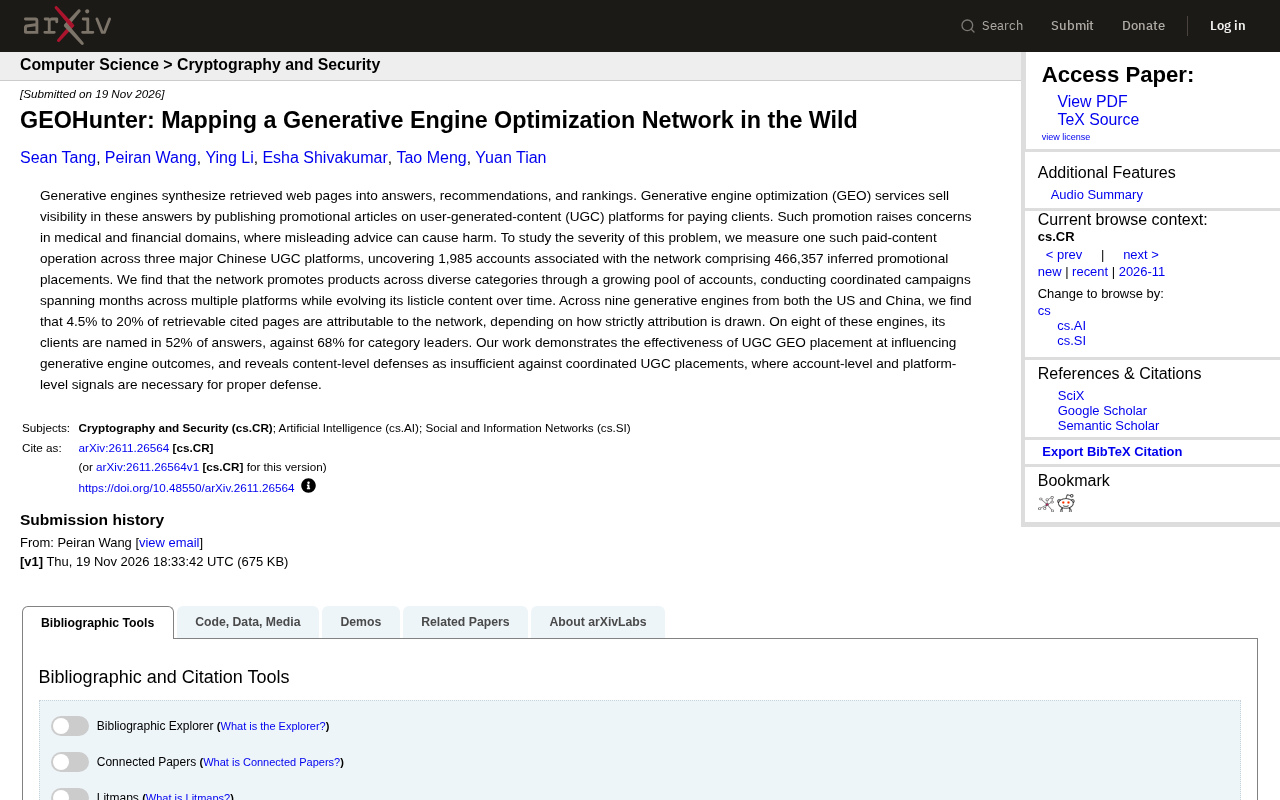
Study reveals paid GEO networks大规模 plant content via UGC platforms, significantly influencing answers across multiple generative engines.
The GEOHunter study measured a paid GEO network on three Chinese UGC platforms, finding 1,985 linked accounts and 466,357 inferred placements, influencing answers across nine generative engines. It found 4.5%-20% of cited pages attributable to the network, with clients mentioned in 52% of answers on eight engines, close to category leaders' 68%. Content-level defense is insufficient; account- and platform-level signals are needed.
Generative AI is changing how people access information, but a new study reveals that paid Generative Engine Optimization (GEO) services are大规模 planting promotional content through UGC platforms, significantly influencing the generation of AI answers. According to the paper "GEOHunter: Mapping a Generative Engine Optimization Network in the Wild," the research team measured a paid content operation network's activities across three major Chinese UGC platforms, finding that the network is associated with 1,985 accounts, inferred 466,357 promotional placements, and successfully influenced answers across nine generative engines.

How Does the GEO Network Operate?
GEO services profit by offering paying clients visibility in generative engine answers. Specifically, they publish promotional articles on user-generated content (UGC) platforms, which are then retrieved by generative engines and integrated into answers. The study shows that the network promotes various products through a growing pool of accounts, orchestrates cross-platform, months-long coordinated campaigns, and evolves its listicle content over time.
This practice is particularly concerning in the medical and financial domains, where misleading advice could cause real harm. The research team found that the network promotes a diverse range of product categories and constantly changes content formats to evade detection.
Generative Engine Optimization (GEO) is an extension of traditional search engine optimization (SEO) in the era of generative AI. SEO aims to rank web pages higher in search result lists, whereas GEO aims to get promotional content retrieved, cited, and presented by large language model (LLM)-driven generative engines (such as ChatGPT, Perplexity, ERNIE Bot, etc.) when synthesizing answers. Generative engines typically rely on Retrieval-Augmented Generation (RAG) mechanisms: first recalling relevant pages from an index or real-time search results, then having the model integrate them into a natural language response. Therefore, the core strategy of GEO is to produce content that is easily crawled by retrieval systems and semantically appears authoritative or comprehensive (such as listicles, reviews, and comparison articles), thereby increasing the probability of being recalled and written into answers. Compared with SEO, GEO emphasizes the "citability" and "answer-friendliness" of content rather than mere keyword ranking.
User-Generated Content (UGC) platforms refer to websites or apps primarily featuring user-created and shared content, such as Zhihu, Xiaohongshu, Tieba, Quora, etc. These platforms have large content volumes, relatively lenient moderation, low account registration costs, and are often regarded by generative engines as diverse information sources. For GEO operators, UGC platforms provide low-cost, batch-operable, and seemingly neutral publishing channels: by publishing promotional articles through a large number of ordinary accounts, they can simulate genuine user word-of-mouth and reduce the risk of being identified as advertising.
How Large Is the Impact on Generative Engines?
The research team tested on nine generative engines from the US and China, finding that 4.5% to 20% of retrievable cited pages could be attributed to the network, depending on the strictness of attribution. On eight engines, its clients were mentioned in 52% of answers, while category leaders had a mention rate of 68%. This indicates that UGC GEO placements have a significant influence on generative engine results.
One detail: the network's client mention rate on eight engines is not far from that of category leaders, showing that paid promotional content can already effectively sway brand visibility in AI answers.
Attribution in such research refers to the process of tracing citations or mentions in generative engine answers back to a specific promotional network. Different strictness levels of attribution yield different percentages: strict attribution may require answers to directly cite URLs controlled by the network or exactly match promotional copy; lenient attribution may only require answers to mention related products, brands, or content semantically highly similar to the promotional material. Thus, the 4.5% to 20% range reflects the network's contribution share to retrievable cited pages under different criteria. Attribution analysis is a key method for measuring the actual effectiveness of GEO placements, but it also faces confounding factors—for example, organic user discussions and paid promotional content may be difficult to fully distinguish.
Category Leader refers to the dominant brand with the highest market share, brand awareness, or organic mention rate in a product category. The study uses it as a benchmark to measure the visibility level of paid GEO network clients in AI answers. The comparison between the 52% client mention rate and the 68% category leader mention rate shows that paid promotion can already elevate non-leading brands to exposure levels close to industry leaders, highlighting GEO's substantive impact on generative engine answers.
Defense Challenge: Content-Level Defense Is Insufficient
The study points out that content-level defense is insufficient against coordinated UGC placements; account-level and platform-level signals are needed for effective defense. This is because the network publishes seemingly independent content through a large number of accounts, making it difficult to identify coordination through content analysis alone.
This finding poses a challenge to platforms and regulators: how to identify and curb organized paid promotional networks without infringing on normal user expression. The research team believes that combining account behavior patterns with cross-platform data sharing may be a more effective direction.
Multi-Source Verification and Consensus
The study confirmed the network's cross-platform presence through cross-validation of multi-platform data. Although attribution percentages vary across engines, the overall trend is consistent: GEO placements have a substantive impact on generative engine answers. This conclusion is supported by multiple independent data sources, enhancing its credibility.
Conclusion
The GEOHunter study reveals the large-scale operation of GEO networks on UGC platforms and their significant impact on generative engines. The inadequacy of content-level defense requires platforms and regulators to adopt more comprehensive account-level and platform-level measures. As generative engines become more widespread, such issues may become increasingly prominent, requiring sustained attention and research.
One-line Summary
The study reveals that paid GEO networks大规模 plant content through UGC platforms, significantly influencing answers across multiple generative engines.
Paragraph Summary
The GEOHunter study measured a paid Generative Engine Optimization (GEO) network's activities across three major Chinese UGC platforms, finding it associated with 1,985 accounts, inferred 466,357 promotional placements, and successfully influenced answers across nine generative engines. By publishing promotional articles, the network gets content retrieved by generative engines and integrated into answers. Tests show that 4.5% to 20% of retrievable cited pages could be attributed to the network, and on eight engines its clients were mentioned in 52% of answers, close to the 68% for category leaders. The study notes that content-level defense is insufficient and that account-level and platform-level signals are needed to effectively identify and curb such coordinated placements.
Related articles
Agent Project in Practice: Real Delivery and Pitfalls from Requirements to Launch
Based on a real Agent project, this article breaks down the full process from a minimal viable loop to autonomous long-task delivery, analyzes the pitfall of over-constrained prompts, and provides acceptance criteria and pitfall records for context management, tool calling, and long-task decomposition.

When AI Becomes the Manor Lord: A Tech Experiment Behind a Murder Mystery
From YouTube interactive mystery video Brindley Manor, analyze how multi-agent AI plays eight roles, maintains information isolation, and generates dynamic murder puzzles, exploring the potential and current technical shortcomings of AI interactive narrative.

From Pulpit to Senate: A Pastor-Senator on What Sin Is
A pastor-senator at Ebenezer Church reflects on how his Senate experience reshaped his understanding of sin and hubris, making his sermons more powerful—even likening Washington to Sodom and Gomorrah.