Geopolitical Risk Escalation: Western Companies Relying on Chinese Models Face a Test

Western companies relying on Chinese open-source models face structural risks and need to build migratability in advance.
Starting from a tweet, the article systematically analyzes the structural risk for Western companies that build their business on "using or reselling Chinese models." Choosing Chinese open-source models is a rational decision for cost and flexibility, but once geopolitics changes the business environment, this dependence shifts from an advantage to a burden. Risk is transmitted through three paths: accumulating compliance and regulatory uncertainty, hidden supply chain breakpoints amplifying technical debt, and trust discounts from customers and capital markets affecting deals and valuations. Companies that directly resell model capabilities are most vulnerable, while teams with a multi-model abstraction layer are most resilient. The pragmatic strategy is to build "migratability": continuously evaluate alternative models, decouple the invocation layer from business logic, and clearly specify upstream change clauses in contracts.
An Overlooked Risk Exposure
A tech observer raised a thought-provoking question on social media: if geopolitical risk continues to climb, what will happen to those Western companies that have built their entire business on "using or reselling Chinese models"? The short tweet offered no answer, but it hit on a structural risk that is rapidly expanding yet rarely systematically assessed.
For some time now, the ecosystem around Chinese open-source models has flourished rapidly. For many Western startups, directly calling or redistributing these models is the shortest path to lowering costs and shipping quickly. But the price of this shortcut may be far higher than the API fees on the books.
The Business Logic of Technical Dependence
Choosing Chinese models as a business foundation is essentially a rational decision. Open-source weights can be deployed locally, inference costs are controllable, and the freedom for fine-tuning and secondary development is higher than some closed-source options. For small and medium teams with limited budgets that need to validate products quickly, this is almost the default option.
The problem is that the premise of "rational" is that the business environment remains stable. Once the model's country of origin becomes the focus of geopolitical contention, this dependence shifts from a cost advantage to a compliance burden. The more successful the business and the larger the scale, the greater the exposure.
Three Transmission Paths of Risk
Compliance and Regulatory Uncertainty
The models themselves may be constrained by export controls, cross-border data flow rules, or procurement restrictions. If Western companies embed Chinese models into products aimed at government, financial, or critical infrastructure sectors, the scrutiny pressure will rise significantly. Compliance costs do not appear all at once; they accumulate gradually as policies tighten.
Export Controls and Open-Source Weights: The U.S. Department of Commerce Bureau of Industry and Security (BIS) export control rules (EAR) in principle cover all U.S.-origin technology and some foreign direct products, and whether open-source models constitute an "export" has long been disputed. Since 2024, U.S. discussions on exporting advanced AI model weights have noticeably intensified, with some legislative proposals attempting to add high-performance model weights to control lists. For Western companies, even if the model weights themselves are not controlled, the chips and cloud services used for training may also become grounds for tracing, causing compliance reviews to expand from "model origin" to "full-chain traceability."
Cross-Border Data Flow Rules: GDPR, U.S. state privacy laws, and China's Data Security Law and Personal Information Protection Law set different thresholds for data出境 (data leaving the territory). If Western companies send user data back to Chinese model service providers for inference or fine-tuning, they may simultaneously trigger compliance obligations in both jurisdictions. The EU AI Act's supply chain transparency requirements for "high-risk" scenarios further amplify this risk.
Hidden Breakpoints in the Supply Chain
Open-source weights may seem like "download and own," but continuous maintenance, security patches, and version iterations still depend on upstream. Once upstream updates slow or access is restricted, technical debt in downstream products will rapidly amplify. For a team that has deeply integrated a model into its product, migration is not as simple as swapping an API.
What Exactly Does the "Upstream" of an Open-Source Model Mean: Distribution of open-source weights typically relies on platforms like GitHub and Hugging Face, but continuous maintenance involves model card updates, safety alignment patches, inference framework adaptation (such as vLLM, TensorRT-LLM), and tokenizer and license changes. The release cadence of many Chinese model teams on these platforms is influenced by domestic policies and resource allocation. Once updates slow, downstream teams will be forced to maintain branches themselves, and delays in fixing security vulnerabilities may last months.
License and Redistribution Risk: Some Chinese open-source models use custom licenses (e.g., requiring source attribution, restricting commercial redistribution, or reserving termination rights), which differ materially from permissive licenses like Apache 2.0. Companies reselling model capabilities that fail to review license terms clause by clause may encounter legal challenges during the scale-up phase.
Trust Discount from Customers and Capital Markets
Enterprise customers are increasingly focused on the origin transparency of the technology stack when procuring. Capital providers will likewise press on supply chain risk during due diligence. This trust discount is difficult to quantify, yet it genuinely affects deal cycles and valuations.
Who Is Most Vulnerable
Companies that directly resell Chinese model capabilities are hit first—their core product is the model itself, and migration means reconstructing the business model. Next are application-layer companies that use Chinese models as their sole inference backend, where replacement costs are high and the time window is tight.
Teams that designed a multi-model abstraction layer from the start are relatively at ease. Multi-backend adaptation and pluggable inference routing may look like over-engineering in normal times, but when risk arrives, they are the cheapest insurance.
Model Abstraction Layer: Refers to an adaptation middleware layer inserted between application logic and specific model APIs, typically including a unified inference interface, routing policies, prompt template management, and fallback mechanisms. Its value lies in reducing "switching models" from a code-level refactor to a configuration-level switch, enabling teams to complete backend replacement in hours rather than weeks. Tools like LangChain and LiteLLM lower the barrier to building one, but a truly effective abstraction layer requires continuous maintenance of evaluation baselines for each candidate model; otherwise, the risk of performance drops after switching still exists. For Western companies relying on Chinese models, this layer is the lowest-cost hedge against geopolitical risk.
Preparation Worth Doing in Advance
For teams already deeply dependent, the pragmatic approach is not panic migration but building "migratability": maintaining continuous evaluation of at least one alternative model family, decoupling the model invocation layer from business logic, and clearly specifying response clauses for upstream changes in contracts.
For teams that have not yet made a choice, geopolitical factors should be incorporated into consideration during the architecture design phase. Technology selection has never been just a comparison of performance and price; it also includes assumptions about the operating environment—and those assumptions are being re-tested by reality.
Open Questions
The question raised by this tweet has no standard answer, but it reminds us of one thing: when open-source models flow across borders, business risk crosses borders as well. How Western companies balance the cost advantages of Chinese models against geopolitical uncertainty will determine the competitive landscape of the AI application layer in the next phase.
One-line Summary
Western companies relying on Chinese open-source models face structural risks and need to build migratability in advance.
Paragraph Summary
Starting from a tweet, the article systematically analyzes the structural risk for Western companies that build their business on "using or reselling Chinese models." The author points out that choosing Chinese open-source models is a rational decision for cost and flexibility, but once the business environment changes due to geopolitics, this dependence shifts from an advantage to a burden. Risk is transmitted through three paths: compliance and regulatory uncertainty gradually accumulating, hidden supply chain breakpoints amplifying technical debt, and trust discounts from customers and capital markets affecting deals and valuations. Companies that directly resell model capabilities are most vulnerable, while teams with a multi-model abstraction layer have the strongest risk resilience. The pragmatic strategy is to build "migratability": continuously evaluate alternative models, decouple the invocation layer from business logic, and clearly specify upstream change clauses in contracts.
Related articles

The Birds of GTA 6: Audubon Explores Vice City's Wild Ecology
Audubon magazine publishes a GTA 6 bird field guide, comparing Vice City and Leonida's virtual ecology with real Florida avian communities. The article sparked discussion on Hacker News about ecological accuracy in game environment design and educational potential.

Major Tech Outages Are Becoming Routine: The Next Disruption Is Already on Its Way
FAA ground stop, multi-day Outlook outage, and JPMorgan failure strike in succession. DNI Jay Clayton warns more tech disruptions are coming as systemic risks mount.
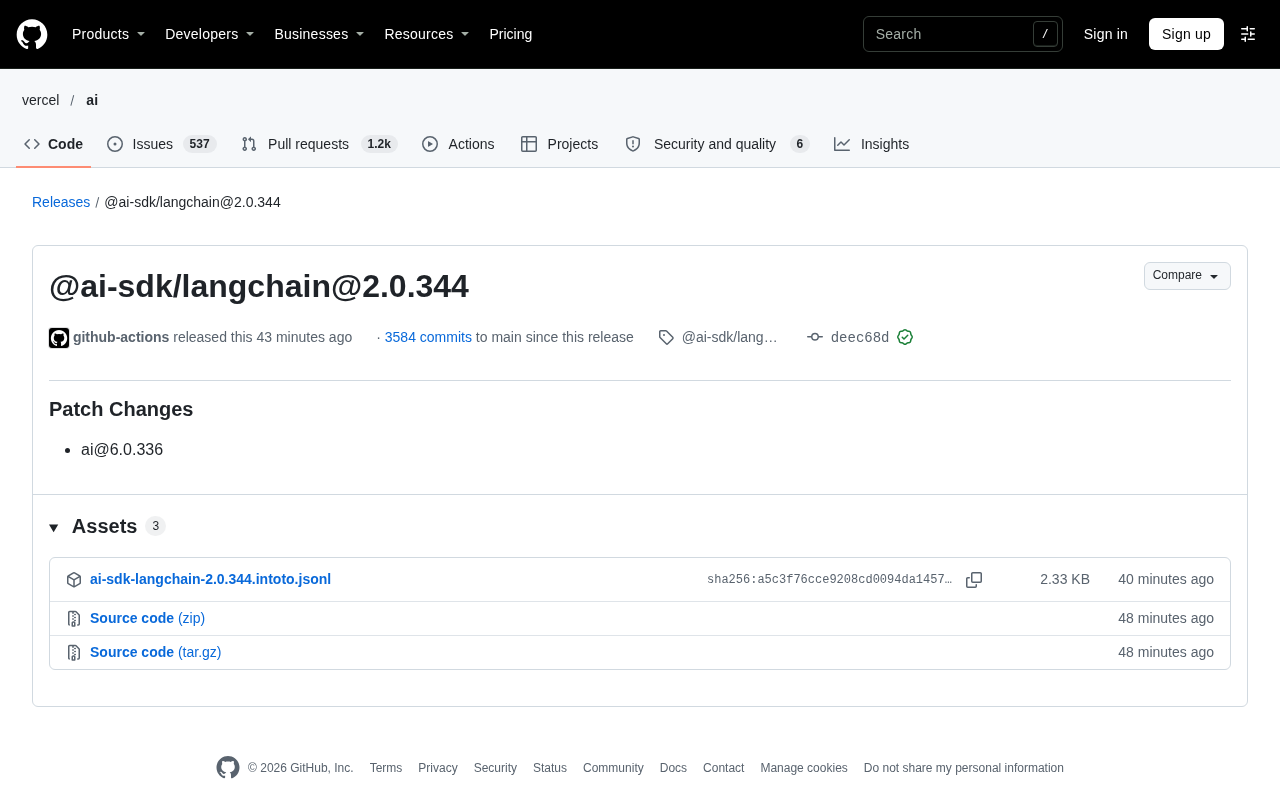
@ai-sdk/langchain 2.0.344 Released: Another Update to the AI SDK and LangChain Adapter Layer
@ai-sdk/langchain releases patch version 2.0.344, syncing with ai@6.0.336. This article examines the adapter package's role in the AI SDK and LangChain ecosystems, its version maintenance cadence, and practical impact on developers.