@ai-sdk/langchain 2.0.344 Released: Another Update to the AI SDK and LangChain Adapter Layer
The bridge package between AI SDK and LangChain releases a patch version, reflecting routine infrastructure maintenance.
The article interprets the release of the patch version @ai-sdk/langchain@2.0.344. Automatically published via GitHub Actions and syncing with the underlying core package ai@6.0.336, it demonstrates version coupling between the adapter layer and core package. The article explains why a dedicated bridge package is needed: AI SDK focuses on web streaming and frontend integration, while LangChain excels at chain orchestration and RAG — real projects often need both, making the adapter essential. The version number and frequent releases reveal a small-steps-fast-pace strategy with low upgrade costs and easy rollbacks. The author recommends running integration tests covering model calls and chain execution after upgrading, and notes that the reliability of such glue layers directly determines the building experience of upper-layer applications.
Vercel's AI SDK ecosystem has seen another minor version iteration. @ai-sdk/langchain@2.0.344 was automatically published via GitHub Actions. As a patch release, it syncs with the underlying ai@6.0.336 update. The release note itself is brief, yet it reflects the ongoing refinement happening in the AI application infrastructure layer.
A Patch Release Connecting Two Ecosystems
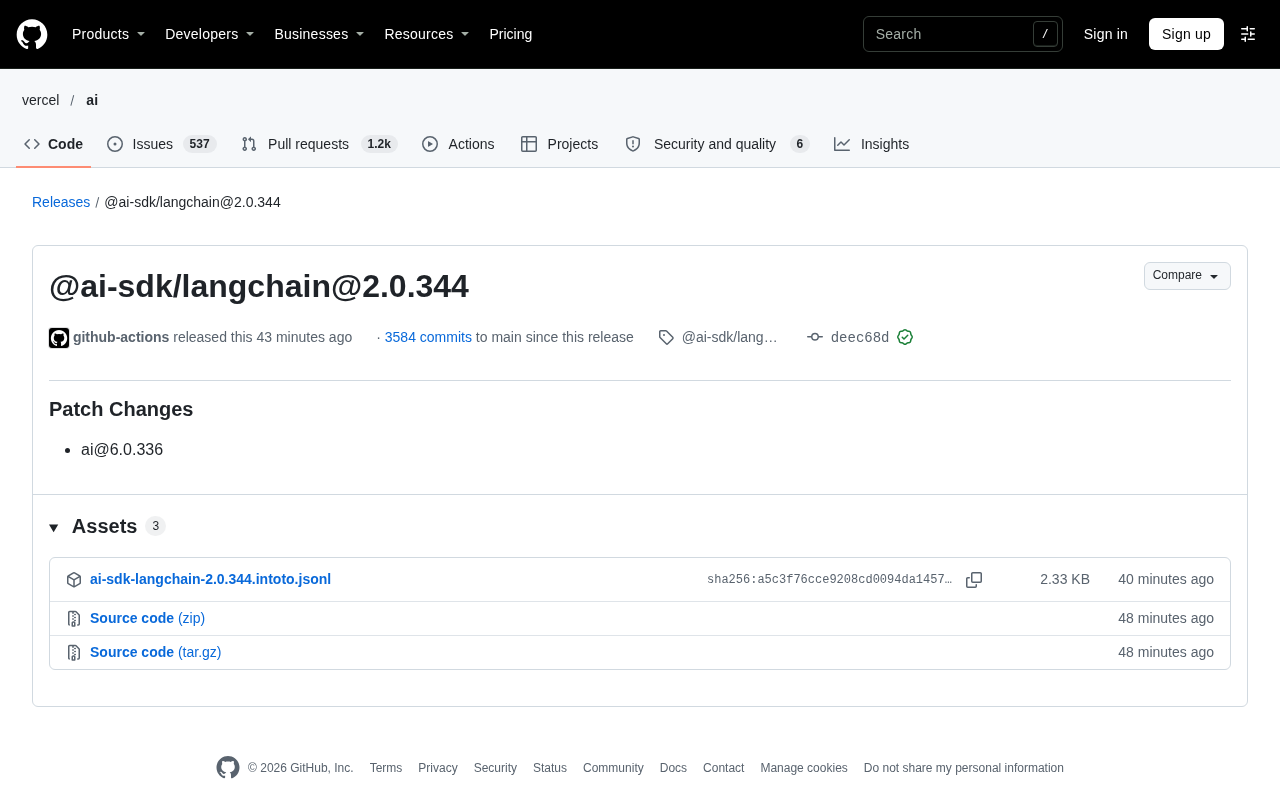
Judging from the release log, @ai-sdk/langchain has advanced to version 2.0.344, falling under the patch changes category. The release was completed by the github-actions bot, with the commit verified by GitHub's signature, targeting the main branch. This kind of automated release process has become standard practice in mature open-source projects, meaning maintainers have delegated version cadence to the CI pipeline, reducing delays and errors caused by manual intervention.
More noteworthy is the mention of ai@6.0.336 in the patch notes. This shows that @ai-sdk/langchain does not evolve in isolation but maintains version coupling with the AI SDK core package. The adapter layer package's job is to bridge LangChain's abstractions with AI SDK's interfaces. Once the underlying core package has a fix, the adapter layer needs to follow up to ensure users don't encounter interface mismatches when combining the two.
Semantic Versioning is a conventional versioning specification in the open-source ecosystem, formatted as MAJOR.MINOR.PATCH. The major version increments when incompatible API changes occur, the minor version increments when features are added in a backward-compatible manner, and the patch number is used for backward-compatible bug fixes. The 2.0.344 in this article means major version 2, minor version 0, patch number 344, and is therefore classified as patch changes, theoretically containing no breaking changes.
GitHub Actions automated publishing refers to using CI/CD pipelines to automatically complete version bumping, tagging, and package publishing after code is merged. A common approach combines tools like changesets, with a bot account (such as the github-actions appearing in this article) committing release records and pushing to registries like npm. This mechanism frees release cadence from manual operations and also makes each release's commit records traceable and auditable — a standard practice in mature open-source projects.
Why the Adapter Layer Deserves Dedicated Maintenance
Many developers may wonder: both AI SDK and LangChain have complete toolchains of their own, so why is a dedicated bridge package needed? The answer lies in their differing design philosophies. AI SDK emphasizes streaming responses and frontend integration for web applications, while LangChain has accumulated a wealth of components in areas like chain orchestration and retrieval-augmented generation. In real projects, teams often want to use AI SDK for frontend interactions while reusing LangChain's chains and tools, making the adapter layer essential.
The continuous minor version releases of @ai-sdk/langchain indicate that this combination path has real users and that maintainers are willing to invest effort in compatibility. For technical teams currently evaluating their options, this kind of high-frequency patching is a positive signal: the interfaces are being taken seriously rather than shelved after release.
Adapter/Bridge packages are middleware layers in software architecture used to connect two systems with incompatible interfaces. They typically only perform conversion without carrying business logic: mapping one side's input/output structures to the form the other side expects, so that two independently evolving libraries can be used together. The cost of an adapter layer is adding a dependency and a layer of abstraction; the benefit is decoupling — internal changes on either upstream side can be absorbed by the adapter layer without propagating to business code.
In the AI application stack, the value of such bridge packages is especially pronounced: AI SDK and LangChain have different release cadences, type definitions, and calling conventions. If business code interfaced with them directly, any upgrade on either side could trigger cascading modifications. By concentrating compatibility into the adapter layer, version coupling (such as the ai@6.0.336 sync mentioned in this article) only needs to be handled within the adapter layer, making the upgrade path smoother for users.
Maintenance Cadence Read from Version Numbers
A version number like 2.0.344 reveals the project's iteration frequency. The major version remains at 2.x while the patch number has accumulated to over three hundred, indicating that the project adopts a small-steps-fast-pace strategy — each change is limited in scope, but releases are frequent. This pattern is friendly to downstream users, with low upgrade costs and easy rollbacks.
This release is associated with 3584 commits — a number that reflects the repository's long-term accumulation rather than the change volume of a single version. It indirectly shows that there is continuous code activity behind the project. For applications depending on this package, a steady commit cadence brings more peace of mind than a single major version update.
Small-steps-fast-pace (continuous small-batch releases) and "concentrated major version releases" are two different release strategies. The former slices changes into small batches, frequently releasing patches or minor versions; the latter accumulates changes over a longer period and delivers them in a single major version. The advantage of small-steps-fast-pace is that both the cognitive burden and regression risk of each upgrade are lower — when problems arise, the scope for diagnosis is small and rollback is easy. The cost is that users need to follow versions more frequently, and there are higher demands on the maturity of automated testing and release processes.
To judge whether a project adopts this strategy, besides looking at the size of the patch number, you can also observe release intervals and the scale of individual changes. A patch number accumulated to over three hundred while the major version remains at 2.x usually means maintainers prefer to evolve with compatibility as the priority, deferring breaking changes until truly necessary.
Practical Impact on Developers
If you use both AI SDK and LangChain in your project, upgrading to 2.0.344 is routine. Patch versions typically contain no breaking changes, but it's still advisable to run integration tests covering model calls and chain execution after upgrading to confirm the adapter layer behaves as expected.
For teams that haven't yet adopted the adapter layer, this release can serve as an observation window: see whether the package's update cadence matches your tech stack's rhythm. If your team relies heavily on LangChain's orchestration capabilities while wanting AI SDK's streaming experience on the frontend, then paying attention to this package's version dynamics is worthwhile.
Summary
Behind a brief release log is the routine maintenance of AI application infrastructure. The patch update of @ai-sdk/langchain@2.0.344 reminds us that the competition in AI engineering doesn't only happen at the model capability level — it also happens in these glue layers that let different frameworks work together. The more reliable the glue layer, the more worry-free it is to build applications on top.
One-line Summary
The bridge package between AI SDK and LangChain releases a patch version, reflecting routine maintenance at the infrastructure layer.
Paragraph Summary
The article interprets the release of the patch version @ai-sdk/langchain@2.0.344. This version was automatically published via GitHub Actions and syncs with the underlying core package ai@6.0.336, demonstrating the version coupling between the adapter layer and the core package. The article explains why a dedicated bridge package is needed: AI SDK focuses on web streaming responses and frontend integration, while LangChain excels at chain orchestration and retrieval-augmented generation — real projects often need both combined, making the adapter layer essential. From the version number and high-frequency releases, it's clear the project adopts a small-steps-fast-pace strategy, with low upgrade costs and easy rollbacks. The author recommends still running integration tests covering model calls and chain execution after upgrading, and notes that the reliability of such glue layers directly determines the building experience of upper-layer applications.
Related articles

After Maduro's Arrest, Where Does Venezuela Go From Here?
After Maduro's capture by U.S. forces and detention in Brooklyn, Venezuela faces a power vacuum, no election date, and a geopolitical struggle over its oil.

The Birds of GTA 6: Audubon Explores Vice City's Wild Ecology
Audubon magazine publishes a GTA 6 bird field guide, comparing Vice City and Leonida's virtual ecology with real Florida avian communities. The article sparked discussion on Hacker News about ecological accuracy in game environment design and educational potential.

Major Tech Outages Are Becoming Routine: The Next Disruption Is Already on Its Way
FAA ground stop, multi-day Outlook outage, and JPMorgan failure strike in succession. DNI Jay Clayton warns more tech disruptions are coming as systemic risks mount.