GEPA-Curator: Teaching Self-Improving Agents to Curate Their Experiences

GEPA-Curator curates tasks and retrieves successful experiences so prompt optimizers learn only from reliable signals.
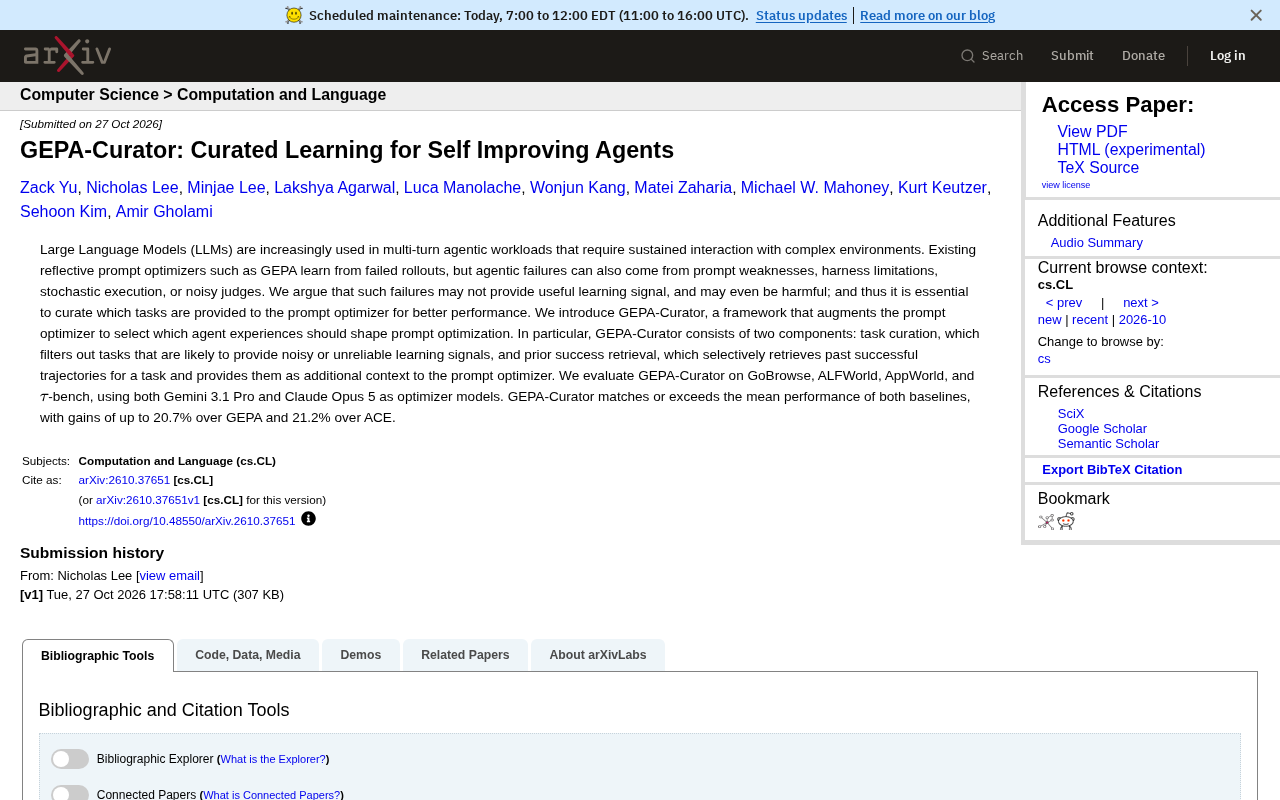
GEPA-Curator addresses the problem that reflective prompt optimizers (like GEPA) indiscriminately absorb failure trajectories. Its core insight: agent failures may stem from prompt flaws, framework limitations, stochasticity, or judge noise—not all failures provide useful learning signals. The framework adds two components: task curation excludes noisy, unreliable tasks before optimization; prior success retrieval provides past successful trajectories as positive references to avoid overly defensive prompts. On GoBrowse, ALFWorld, AppWorld, and τ-bench, using Gemini 3.1 Pro and Claude Opus 5 as optimizer models, GEPA-Curator matches or exceeds baselines, with up to 20.7% improvement over GEPA and 21.2% over ACE. The article notes that experience quality matters more than quantity for self-improving agents, and task curation plus success retrieval can serve as preliminary steps in optimization pipelines.
Large language models are increasingly involved in multi-turn agentic tasks that require sustained interaction in complex environments. Traditional reflective prompt optimizers (such as GEPA) can learn from failure trajectories, but an agent's failures do not necessarily stem from flaws in the prompt itself—limitations of the execution framework, stochastic fluctuations, or even noise from the judge model can all cause failures. Such failures not only fail to provide useful learning signals, but may also steer the optimizer in the wrong direction. The core thesis of GEPA-Curator is precisely this: rather than letting the prompt optimizer swallow every experience, it is better to first select the tasks worth learning from.
Agent Failure Does Not Mean the Prompt Needs Improvement
Reflective optimizers like GEPA work by collecting trajectories from the agent's task executions, reflecting on successes or failures, and rewriting the prompt accordingly. But the paper's authors point out that the sources of failure signals are multi-factorial. Prompt wording may be only one factor; the stability of tool calls, the randomness of environment states, and even misjudgments by automatic evaluators can all make a failure look like a prompt problem.
If the optimizer indiscriminately absorbs these signals, it will learn the wrong causal relationships. For example, a task may fail because the execution framework does not support a certain operation, not because the prompt failed to specify it clearly—in which case modifying the prompt neither solves the problem nor avoids damaging parts that were originally effective. Therefore, curating learning signals becomes a key step in improving the performance of self-improving agents.
Two Components: Task Curation and Prior Success Retrieval
GEPA-Curator adds two modules on top of the original prompt optimizer, approaching the problem from two directions: "filtering noise" and "supplementing positive samples."
Task Curation: Removing Unreliable Learning Signals
The first component is task curation. Before optimization, it determines which tasks are more likely to provide noisy, unreliable learning signals and excludes them from the optimization process. The logic is straightforward: not all failures are worth learning from—some failures only dilute the optimizer's attention or even introduce wrong directions for modification. By focusing the optimizer only on tasks whose failures are more likely attributable to the prompt, both learning efficiency and quality can be improved.
In practice, task curation typically relies on a learnable "value estimator" or heuristic rules to score the learnability of each trajectory. Common signals include: whether the failure is reproducible, whether the failure has a causal connection to the prompt content, and the confidence given by the evaluator. The specific mechanism of GEPA-Curator is not elaborated in the main text, but its design goal aligns with the sample-value ranking ideas in data pruning or curriculum learning—by excluding low-quality samples, it reduces the probability of the optimizer updating in the wrong direction.
Prior Success Retrieval: Providing Positive References for the Optimizer
The second component is prior success retrieval. For a given task, it selectively retrieves previously successful trajectories and provides them as additional context to the prompt optimizer. Failure trajectories tell the optimizer "where problems might lie," while successful trajectories provide a positive reference for "what kind of prompt and execution path is feasible." Combined, the optimizer has a more complete basis for rewriting prompts, rather than staring only at failure cases and patching repeatedly.
This design also addresses a common problem: purely failure-driven optimization tends to make prompts overly defensive, piling up numerous constraints that actually harm performance in normal cases. Introducing successful trajectories as references helps preserve effective behavioral patterns while correcting problems.
Prior success retrieval relies on a searchable library of historical trajectories. Each trajectory is typically indexed by task description, action sequence, and final result, and retrieved based on semantic similarity of the task or similarity of the execution path. Injecting successful trajectories as context into the optimizer is essentially an application of retrieval-augmented generation (RAG) in the prompt optimization setting: it does not fine-tune model parameters but dynamically provides reference examples to guide the optimizer toward prompt rewrites that better match feasible behavioral patterns.
Experimental Performance: Matching or Surpassing Baselines on Multiple Agent Benchmarks
The paper evaluates GEPA-Curator on four agent benchmarks: GoBrowse, ALFWorld, AppWorld, and τ-bench. The optimizer models used were Gemini 3.1 Pro and Claude Opus 5, respectively.
The results show that GEPA-Curator matches or exceeds both baselines in average performance. Compared with GEPA, performance improves by up to 20.7%; compared with ACE, by up to 21.2%. These figures come from the paper abstract; the specific task distribution and ablation details require consulting the full paper. What can be confirmed is that the idea of curating learning experiences shows effects across two different optimizer models and multiple heterogeneous environments, indicating that its benefits do not depend on a particular model or a single task type.
The baseline ACE (Agentic Context Engineering) mentioned in the paper is a method that improves agent performance through context engineering, focusing on leveraging the execution context rather than rewriting the prompt itself. GEPA (Generalized Reflective Prompt Optimizer) is a reflection-based prompt optimizer that iteratively rewrites prompts by analyzing failure trajectories. Comparing GEPA-Curator with both allows testing whether the curation mechanism brings gains on both the pure reflective optimization and context engineering routes.
Implications for Self-Improving Agents
The value of GEPA-Curator goes beyond a specific optimization framework. It raises a more general question: when agents begin to learn from their own experiences, the quality of experience matters more than the quantity. Ideas such as curating on the data side and augmenting on the signal side can be transferred to a broader range of agent training and prompt engineering workflows.
For teams building multi-turn agent systems, this means that when designing a self-improvement loop, they need to first answer "which experiences are worth learning from," rather than assuming that all trajectories are equivalent training material. Treating task curation and successful trajectory retrieval as preliminary steps in the optimization pipeline may be a pragmatic approach to improving an agent's long-term performance.
Related articles

Last Week Tonight Exposé: The Dangerous Ties Between Politicians and White Supremacy
Last Week Tonight investigates Georgia Senate candidate Mike Collins and Florida candidate Marshall Rawson, exposing their multiple ties to white supremacists and the Republican Party's silent response.
AI Buzz Weekly: GPT-6.5 Leak, New Claude Model, and MiniMax's Cost-Effectiveness
This week's AI buzz roundup: suspected GPT-6.5 leak, Microsoft configs showing GPT-6.1 Tera, Anthropic's new model that can identify entire classes of bugs, disappointing early Gemini 4 Carbon results, and MiniMax M3.1 Flash beating Claude Opus 5 and GPT-5.6 Sol in benchmarks at extremely low cost.

AI Briefing: Gemini 4 Carbon Released, Ant Open-Sources Ling-3.1
AI Briefing: Google releases Gemini 4 Carbon qubit model, claiming to surpass Opus 5.5 with half-price tokens; Ant open-sources Ling-3.1-1019 for real-task Personal Agents; domestic AI drug discovery succeeds in 18 of 19 projects, hitting all 6 GPCR targets; zero-revenue company valued at $20B raises another $1B; Sichuan convenience store robot sales fail.