German Companies Are Almost Entirely Dependent on American AI Models and Services

German enterprises depend almost entirely on US AI vendors, exposing Europe's structural gaps in foundational models and data sovereignty.
German and European enterprises deploying AI applications overwhelmingly turn to US vendors — OpenAI, Anthropic, Google, Microsoft — as domestic alternatives lag in capability and ecosystem maturity. This stems from America's commanding lead in compute, data, and talent, making US services the pragmatic default. Yet deep reliance on a single geopolitical source of technology creates tension with the EU's GDPR data sovereignty principles and introduces strategic risks around policy shifts and export controls. The EU is pursuing multiple countermeasures — the AI Act, support for startups like Mistral AI and Aleph Alpha, and open-source model deployment — but closing the technology gap will take years, and the efficiency-versus-autonomy trade-off shows no signs of resolving soon.
The State of German AI's Dependence on the US
A report that sparked discussion on Hacker News highlights that German companies are almost entirely reliant on American AI models and services. This phenomenon reveals a structural challenge facing Europe in the era of generative AI: despite a strong industrial base and rich data resources, German and European businesses remain heavily dependent on transatlantic vendors for core AI infrastructure.
From OpenAI's GPT series and Anthropic's Claude to cloud AI services from Google, Microsoft, and AWS, American tech companies have effectively monopolized the mainstream options for enterprise AI. When deploying intelligent customer service, document processing, code assistance, and similar applications, German companies typically call directly into these American vendors' APIs, with little in the way of viable domestic alternatives.
The Root Causes of This Dependency
This dependency is no accident. American AI companies have poured enormous capital and top-tier talent into foundational model development, establishing comprehensive leads across compute, data, and human capital. For businesses focused on efficiency and cost, adopting mature US AI services is simply the most pragmatic choice.
On the other side, Europe's homegrown AI players do exist — France's Mistral AI and Germany's Aleph Alpha, for example — but they still struggle to compete head-on with American giants in terms of market reach, ecosystem maturity, and commercial scale. When competitive local options are scarce, enterprises naturally gravitate toward market-proven solutions.
The Tension Between Data Sovereignty and Regulation
This situation carries real risks for Germany and the EU. The European Union has long championed data sovereignty and privacy protection, with regulations like GDPR imposing strict requirements on cross-border data flows. When core business processes become deeply entangled with American AI services, the location of sensitive data processing, the transparency of model training, and the controllability of the supply chain all become significant concerns.
For critical industries and government agencies, over-reliance on technology from a single geopolitical source creates strategic risks in the event of future policy shifts, export controls, or commercial disputes. This is part of the backdrop driving the EU's push for the AI Act and its efforts to support domestic compute infrastructure and model development.
The General Data Protection Regulation (GDPR), which came into force in 2018, is one of the world's most stringent personal data protection laws. It requires companies transferring EU citizens' data to third countries to ensure those countries provide an "adequate level of protection" — or else rely on supplementary mechanisms such as Standard Contractual Clauses (SCCs). The US has long occupied a legal gray zone: in 2020, the EU Court of Justice struck down the Privacy Shield agreement in the "Schrems II" ruling, finding that US intelligence laws — which grant the government broad data access powers — are fundamentally incompatible with GDPR. Although a new Data Privacy Framework (DPF) was reached in 2023, it continues to face legal challenges and remains uncertain in its long-term durability. This means German companies feeding business data into American AI services are not just taking on commercial risk — they may also be navigating genuine legal uncertainty at the compliance level.
Implications for European AI Autonomy
Addressing this situation requires action on multiple fronts: substantially increasing investment in foundational model research, building compute infrastructure at scale, fostering a domestic AI startup ecosystem, and using procurement policy to nudge enterprises toward local solutions. The rise of open-source models also offers Europe a potential path to leapfrog — by fine-tuning and deploying open-source base models locally, companies can reduce their dependence on closed-source American services to a meaningful degree.
That said, closing the technology gap takes time, and the market's inertia and first-mover advantages cannot be reversed overnight. German companies' current choices are, at their core, a practical trade-off between efficiency and autonomy.
Europe's most prominent homegrown large model efforts currently include France's Mistral AI, which has rapidly built a developer ecosystem through an open-source strategy — its Mixtral series benchmarks comparably to GPT-3.5 across several evaluations. Germany's Aleph Alpha positions itself around sovereign AI, focusing on government and critical-industry clients, though its commercial progress has been relatively slow. Meanwhile, the EU Commission-backed EuroHPC initiative is deploying high-performance compute nodes across multiple member states, aiming to break infrastructure-level dependence on American cloud providers. The core logic of the open-source path is that companies can deploy Meta's LLaMA, Mistral, and other open-weight models locally and fine-tune them for specific domains — keeping data processing within controlled environments while avoiding the high costs of API calls. This model is particularly attractive to sectors with strict data compliance requirements, such as finance, healthcare, and legal services.
Conclusion
German companies' heavy reliance on American AI services is a microcosm of the global AI competitive landscape. It reflects both the United States' commanding lead in foundational AI technology and Europe's growing sense of urgency in this technological race. For observers tracking the geopolitical dimensions of the AI industry, this trend is well worth continued attention.
(Note: This article is based on limited source information from a Hacker News thread. The original report contains few details; specific data and enterprise case studies await supplementation from more authoritative sources.)
Related articles
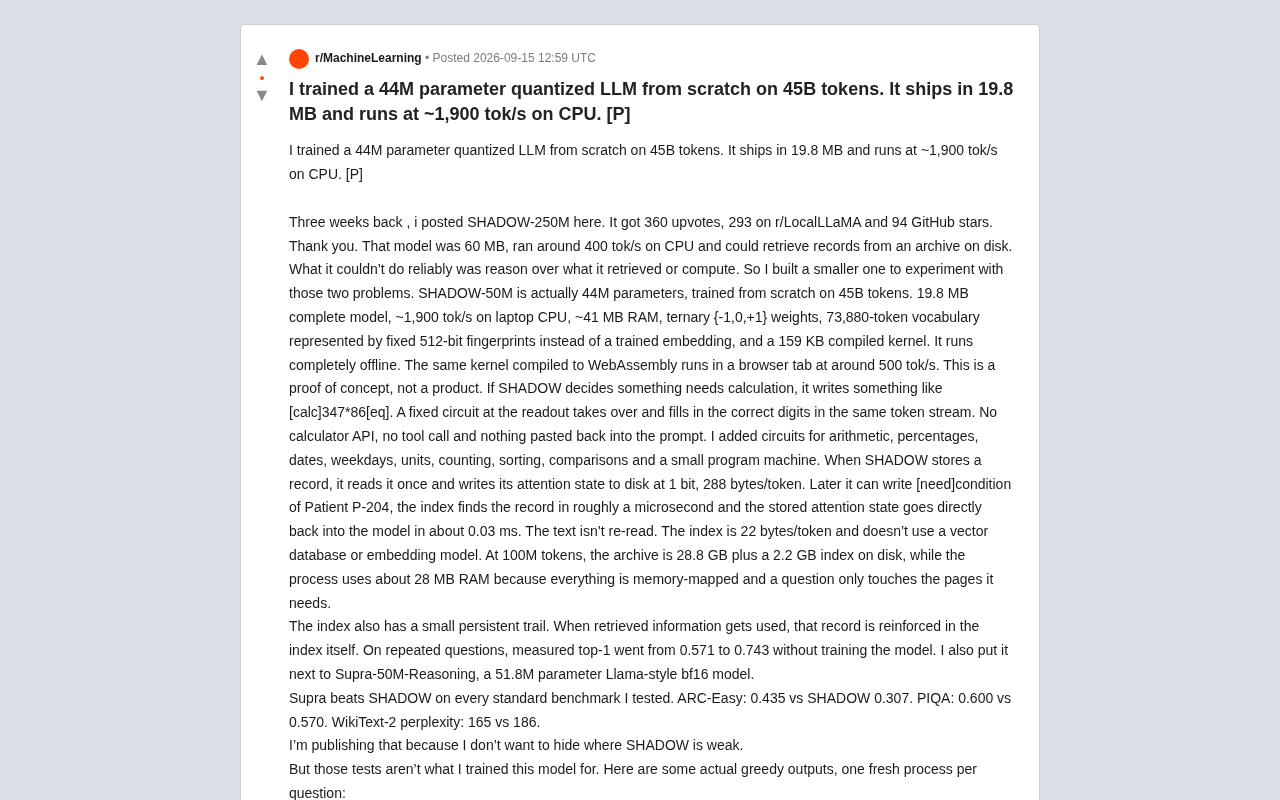
19.8MB LLM: How a 44M-Parameter Model Achieves 1900 tok/s on CPU
SHADOW-50M is a 44M-parameter, 19.8MB LLM trained from scratch using ternary weights and frozen fingerprint embeddings, achieving ~1900 tok/s on CPU with just 41MB of RAM.

Another Google AI Safety Researcher Quits, Warning 'We Might All Die'
Another Google AI safety researcher quits, warning of human extinction risks. We examine the structural tensions, existential risk debates, and governance challenges behind these recurring departures.

Let AI Audit Its Own Docs: An Open-Source Toolkit for Verifying CLAUDE.md Accuracy
Nir Diamant open-sourced a toolkit to verify which claims in CLAUDE.md and project docs are guesses or contradicted by code — using confidence labels and reverse code verification.