German Lawmakers' iPhones Suspected of Spyware Attacks, Apple Issues Warning

German lawmakers and a film producer received Apple spyware warnings, highlighting state-level surveillance threats to mobile devices.
Several German lawmakers and a film producer recently received Apple security notifications warning that their iPhones may have been compromised by spyware. Such notifications typically target highly targeted attacks with government backing, suggesting political or intelligence motives. Spyware like Pegasus is implanted through zero-click vulnerabilities and can steal messages, location data, and even activate microphones and cameras. The German government has launched an investigation, and the incident may prompt EU scrutiny of communication security policies. For high-risk individuals, Apple recommends Lockdown Mode and regular system updates, but a fundamental solution still requires international regulatory cooperation and continuous patching by manufacturers.
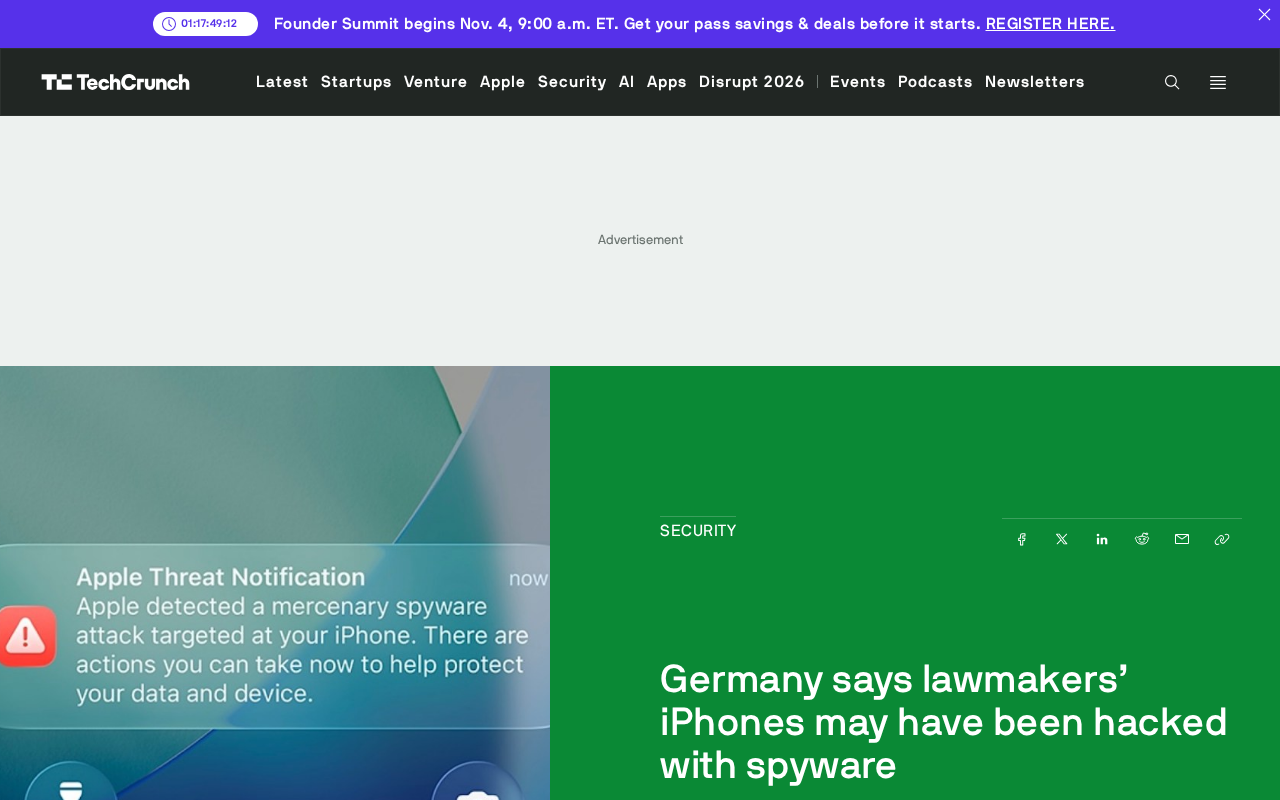
German lawmakers and a film producer recently received notifications from Apple warning that their iPhones may have been compromised by spyware. This incident has once again pushed mobile device security and state-level cyber surveillance into the spotlight.
Event Core: Apple's Warning and Affected Groups
According to source information, several German lawmakers and a film producer received security notifications from Apple indicating that their devices may be targets of spyware attacks. Apple has long issued such warnings to users when it detects "highly targeted" threats, typically related to government-backed surveillance activities.
The affected individuals include legislators and public figures, suggesting the attacks may have clear political or intelligence purposes. As a core EU member state, Germany's lawmakers being targeted for surveillance is particularly sensitive.
How Spyware Works and Threat Characteristics
Spyware (such as the notorious Pegasus-type tools) is typically implanted through zero-click vulnerabilities or deceptive links, capable of stealing messages, call records, location data, and even activating microphones and cameras. Such attacks are extremely costly and generally target only specific high-value individuals.
Apple's warning mechanism relies on threat intelligence and device behavior analysis, but it is not 100% accurate. Receiving a notification means the system has detected "anomalous activity" or "known attack signatures," and users should immediately seek professional forensic investigation.
Pegasus is commercial spyware developed by Israeli cyber surveillance company NSO Group. Since its discovery in 2016, it has been repeatedly reported to be used in attacks targeting journalists, human rights activists, and political figures. It exploits zero-click vulnerabilities in iOS or Android systems (such as silent exploit chains in iMessage) to remotely implant itself, gaining full control of the device without any user interaction. Pegasus attack chains typically involve multiple undisclosed vulnerabilities and cost millions of dollars, limiting them to government clients. Since 2021, Apple has used its Threat Notification mechanism to warn users suspected of being targeted by tools like Pegasus, while simultaneously updating systems to patch related vulnerabilities. The existence of this software highlights the global security risks posed by the proliferation of commercial surveillance tools and has prompted regions like the EU to strengthen regulatory discussions on spyware trade.
German Response and Political Impact
The German government has confirmed the matter and launched an investigation. The compromise of lawmakers' devices may involve foreign intelligence agencies or commercial surveillance vendors. The German parliament has previously held hearings on surveillance scandals, and this incident may drive stricter communication security reviews and device procurement standards.
For ordinary users, this incident reminds us that even iPhones with relatively closed encrypted ecosystems are not absolutely secure. High-risk individuals (journalists, activists, politicians) should consider using Lockdown Mode and regularly updating their systems.
Lockdown Mode is an extreme security feature introduced by Apple in iOS 16, iPadOS 16, and macOS Ventura, designed specifically for people who may be targets of highly targeted attacks (such as journalists, activists, and politicians). When enabled, the system significantly reduces the attack surface: for example, it blocks most iMessage attachments (except images), disables FaceTime from unknown callers, restricts certain complex web browsing technologies (such as just-in-time compilation, JIT), and prevents devices from joining insecure Wi-Fi networks. While these measures reduce device functionality, they can effectively defend against zero-click vulnerability exploits commonly used by spyware like Pegasus. Lockdown Mode is not a panacea, but as part of a defense-in-depth strategy, it significantly raises the cost of attack. For high-risk users, Apple recommends enabling it immediately upon receiving a threat notification, along with regular system updates and professional forensic checks.
Conclusion: Mobile Security Enters an Era of "High Confrontation"
From commercial spyware to state-sponsored hacker groups, mobile devices have become the frontline of intelligence warfare. While Apple's warnings provide a first line of defense, a fundamental solution requires international regulatory cooperation and continuous vulnerability patching by manufacturers. For individuals, keeping systems updated, being wary of suspicious links, and enabling advanced security features are currently the most effective self-protection strategies.
One-line Summary
German lawmakers and a film producer received Apple spyware warnings, highlighting state-level surveillance threats facing mobile devices.
Paragraph Summary
Several German lawmakers and a film producer recently received security notifications from Apple warning that their iPhones may have been compromised by spyware. Such notifications typically target highly targeted attacks with government backing, suggesting the incidents may have political or intelligence purposes. Spyware like Pegasus is implanted through zero-click vulnerabilities and can steal messages, location data, and even activate microphones and cameras. The German government has launched an investigation, and the incident may prompt EU scrutiny of communication security policies. For high-risk individuals, Apple recommends enabling Lockdown Mode and keeping systems updated, but a fundamental solution still requires international regulatory cooperation and continuous vulnerability patching by manufacturers.
Related articles

AI Tools Quietly Altering Settings: Postman Silently Installs Plugin, Codex Sharing Option Auto-Resets
AI Daily reports: Postman silently installs a Mac plugin and self-approves startup hooks, logged as auto-existing upgrade; Hacker News developers say Codex data-sharing opt-out flips back. Plus Simon Willison's raw float weight experiment with QEN 3.8-27B.

AI Learns to Rewrite AI: MIT's "Weightspace Programming" Redraws the Path to Recursive Self-Improvement
MIT team proposes weightspace programming: GPT-6 Astra reads and edits AI model weights directly. Math scores jump several-fold, hand-written networks beat trained models. Eight experiments analyzed, plus Anthropic's same-day warning and the real boundaries of recursive self-improvement.

Running Qwen 3.8 on a Laptop to Read Raw Weights: 46 Minutes Per Answer
Simon Willison reproduced weight space programming with Qwen 3.8 27B on a laptop: a 17GB model file, 46 minutes per answer, 43,506 reasoning tokens, Pong over an hour, Freeway failed. Suited for interpretability researchers.