Get Shit Done: Full Breakdown of the 60K-Star Claude Code Meta-Prompting & Spec-Driven Development System
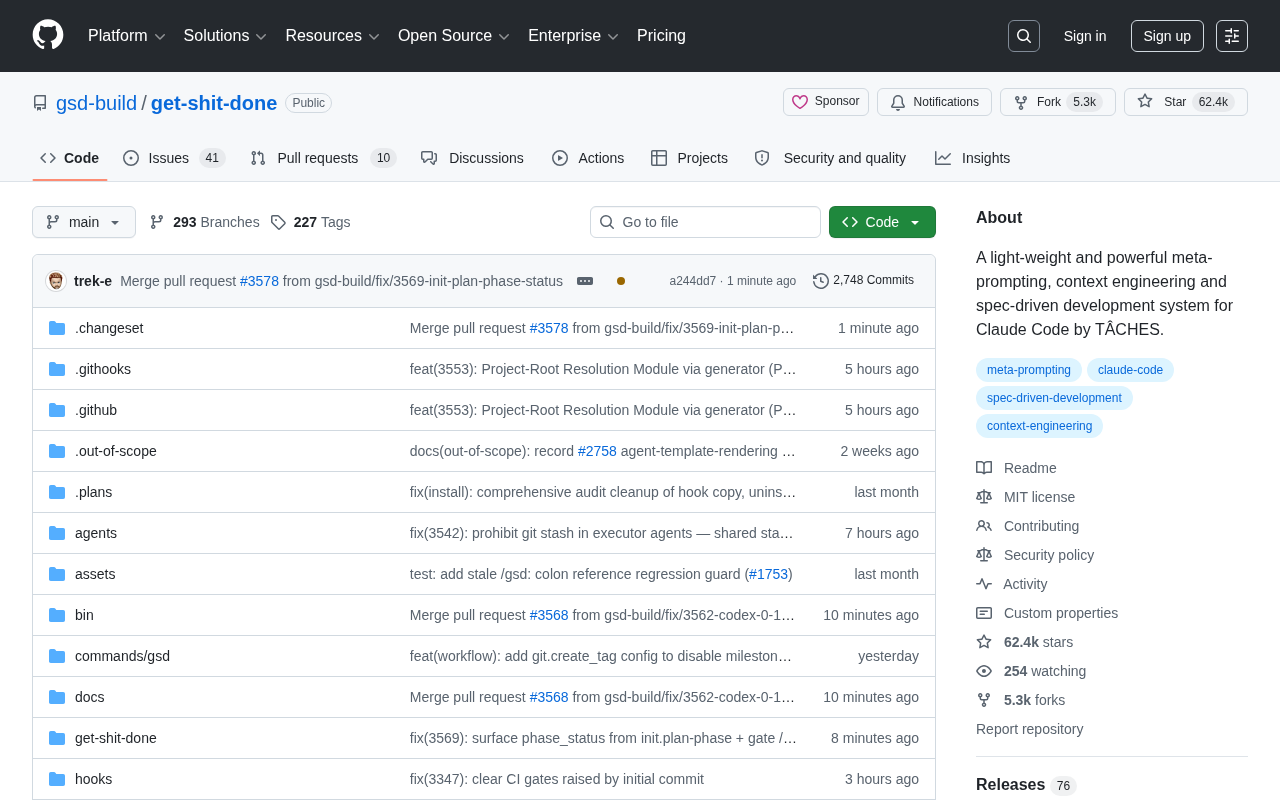
GSD is a lightweight AI coding system for Claude Code, combining meta-prompting, context engineering & spec-driven development.
Get Shit Done (GSD) is a 62K+ star open-source project on GitHub built specifically for Claude Code. It unifies meta-prompting (systematic prompt frameworks), context engineering (intelligent management of all context passed to AI), and spec-driven development (define specs before generating code) into a cohesive system, helping developers move from ad-hoc prompting tricks to systematic AI programming collaboration—marking the paradigm shift from prompt engineering to context engineering.
Overview
AI-assisted programming tools are becoming increasingly prevalent, but one key question continues to plague developers: how can you get a large language model to truly understand your development intent, rather than generating a pile of code that requires endless revisions?
Get Shit Done (GSD) offers a systematic answer. This lightweight development system built specifically for Claude Code integrates three core philosophies—Meta-Prompting, Context Engineering, and Spec-Driven Development—into a unified whole. It has rapidly amassed over 62,000 stars on GitHub, making it one of the most watched open-source projects in the AI programming tool ecosystem.
Three Core Philosophies: Meta-Prompting, Context Engineering & Spec-Driven Development
Meta-Prompting: Prompts About Prompts
Meta-prompting is a "prompts about prompts" strategy—instead of directly telling AI what code to write, you build a systematic prompting framework that helps AI understand development intent at a higher level. Through predefined meta-prompt templates, GSD helps developers transform vague requirements into structured instructions, dramatically improving Claude Code's output quality and consistency.
The concept of meta-prompting originates from applying metacognition theory to AI. In 2023, researchers from Stanford University and OpenAI systematically proposed the Meta-Prompting framework in a paper, with the core idea of having a "meta-model" act as an orchestrator that decomposes complex tasks and delegates them to multiple expert roles. In practical development scenarios, meta-prompting essentially establishes a "thinking about how to think" framework for AI—developers no longer describe requirements line by line, but instead define a rule system within which AI reasons and makes decisions autonomously. This is fundamentally different from traditional Prompt Engineering: the latter focuses on optimizing input for a single interaction, while meta-prompting focuses on systematic instruction architecture across multiple interactions.
The theoretical foundations of meta-prompting extend beyond metacognition to closely relate to Program Synthesis and automated reasoning. On a practical level, the effectiveness of meta-prompting has been validated across multiple benchmarks—for example, on the MATH mathematical reasoning dataset, models employing meta-prompting strategies showed approximately 17% improvement over standard prompting methods. Notably, meta-prompting has a complementary relationship with popular techniques like Chain-of-Thought prompting and Tree-of-Thought prompting: Chain-of-Thought focuses on unfolding a single reasoning process, while meta-prompting focuses on coordinating and orchestrating across multiple reasoning tasks. In GSD's implementation, meta-prompt templates effectively serve as "cognitive scaffolding," progressively decomposing developers' high-level intentions into atomic instruction sequences executable by the model.
The core advantage of this approach lies in reusability. Once a well-designed meta-prompt system is established, developers can quickly reuse it across different projects, eliminating the time cost of training AI from scratch each time.
Context Engineering: Beyond Prompt Engineering
Context Engineering is a concept receiving significant attention in current AI application development. Unlike simple "prompt engineering," context engineering focuses on systematically managing and optimizing all contextual information passed to AI models—including codebase structure, project specifications, dependencies, historical decisions, and more.
This concept was frequently cited in 2025 by industry leaders including Shopify CEO Tobi Lütke and former Google DeepMind researchers, gradually replacing "prompt engineering" as the core paradigm for AI application development. The technical backdrop for its rise is this: although LLM context windows have expanded from an initial 4K tokens to million-token scales, research shows that models exhibit a significant "Lost in the Middle" phenomenon when processing long contexts—models tend to focus on the beginning and end of context while ignoring information in the middle. Context engineering addresses this challenge through techniques like RAG (Retrieval-Augmented Generation), context compression, and dynamic context selection, ensuring the model receives optimal information input for each inference.
The rise of context engineering is inseparable from the technical evolution of LLM context windows. From GPT-3's 2,048 tokens to Claude 3.5's 200K tokens to Gemini 1.5 Pro's 1 million tokens, expanding context capacity hasn't automatically solved information utilization efficiency. A 2023 Stanford University research paper, "Lost in the Middle," revealed a critical finding: even when models can "see" all information in long contexts, their actual utilization follows a clear U-shaped curve. Furthermore, expanding context windows brings quadratic growth in computational costs (due to Transformer's self-attention mechanism) and "Attention Dilution" problems—when irrelevant information is excessive, the model's attention to critical information actually decreases. These technical limitations make context engineering a necessity rather than a nice-to-have.
GSD provides a complete solution in this area, intelligently organizing and filtering project context to ensure Claude Code receives the most relevant and precise background information in every interaction. This directly addresses the pain point of LLMs "losing their way" when working with large codebases.
Spec-Driven Development: Define First, Implement Later
Spec-Driven Development is GSD's most distinctive design philosophy. It requires developers to define clear specifications (Specs) before coding, then has AI automatically generate code based on those specs. This "spec first, implement later" workflow delivers several practical benefits:
- Reduced rework: Clear specs minimize cases where AI-generated code doesn't match expectations
- Traceability: Every piece of code has a corresponding spec document, facilitating future maintenance and review
- Team collaboration: Specs serve as shared documents, giving team members unified expectations for AI-generated code
The philosophy of spec-driven development traces back to several classic software engineering methodologies. In API development, OpenAPI (formerly Swagger) specifications have long promoted a "Design-First" development approach; in formal methods, specification languages like Z notation and TLA+ are used for critical system development verification. Test-Driven Development (TDD) is also a broad form of spec-first strategy—writing test cases to define expected behavior before writing implementation code. In the AI era, spec-driven development has gained new vitality because LLMs are naturally adept at transforming structured natural language specifications into code implementations, and humans are far more efficient at reviewing spec documents than reviewing AI-generated code line by line.
In GSD's practical implementation, spec-driven development typically follows a three-phase workflow: first is the "spec drafting" phase, where developers describe functional requirements, boundary conditions, and acceptance criteria in natural language, with AI assistance structuring them into standard spec documents; second is the "spec review" phase, where team members and AI jointly review the completeness and consistency of specs—this step costs far less than reviewing already-generated code; finally comes the "spec execution" phase, where Claude Code automatically generates implementation code based on reviewed and approved specs. This model is highly consistent with Design by Contract (proposed by Bertrand Meyer in the Eiffel language)—constraining program behavior through preconditions, postconditions, and invariants. The difference is that specs in the AI era can be expressed in more natural language, dramatically lowering the learning barrier for formal specifications.
Why GSD Has Earned 60K+ Stars
Phenomenal Community Growth
The GSD project uses JavaScript as its primary development language and has currently earned 62,430 stars and 5,298 forks—quite rare numbers for AI development tool projects. In GitHub's AI development tool space, 60K+ stars means GSD has entered the tier of top-level open-source projects. For reference, Cursor editor's open-source components have about 50K stars, LangChain has about 100K stars, and Auto-GPT reached 160K stars during its 2023 explosion. What's notable is GSD's growth velocity—as a vertical project focused on a specific AI tool (Claude Code), its attention level reflects that the developer community is transitioning from a "trying out AI programming" phase to a "systematically using AI programming" phase, where demand for methodology and best practices has surpassed interest in the underlying tools themselves.
Lightweight Design, Low Barrier to Entry
Unlike many bloated development frameworks, GSD adheres to "lightweight" design principles. It doesn't attempt to replace existing development toolchains but serves as an enhancement layer for Claude Code, seamlessly integrating into developers' existing workflows. This strategy of "adding rather than replacing" means developers face virtually zero migration costs.
Claude Code is a command-line AI programming tool launched by Anthropic in 2025, built on their Claude series of large language models (currently primarily using Claude 4 Sonnet and Claude 4 Opus). Unlike IDE-embedded tools such as GitHub Copilot, Claude Code adopts a Terminal-Native interaction approach, capable of directly reading and modifying the file system, executing shell commands, and managing Git operations—essentially more like an AI Agent with coding capabilities. This design makes it particularly suited for development tasks requiring a global perspective, such as cross-file refactoring, project initialization, and complex debugging. GSD leverages these Agent characteristics of Claude Code, implementing deep customization through CLAUDE.md configuration files and project-level instruction systems.
CLAUDE.md is Claude Code's core configuration file, with design inspiration drawn from .cursorrules (Cursor editor's project configuration file) and template files in .github directories. CLAUDE.md supports multi-level configuration: the CLAUDE.md in the project root defines global rules, CLAUDE.md files in subdirectories can override or supplement parent-level rules, and ~/.claude/CLAUDE.md in the user's home directory defines cross-project personal preferences. This hierarchical configuration mechanism is analogous to Nginx's configuration inheritance and CSS's cascading rules. GSD, through carefully designed CLAUDE.md template systems, encodes meta-prompting strategies and project specifications as "project memory" that Claude Code can continuously reference, avoiding the inefficient pattern of needing to re-establish context in every conversation.
TÂCHES Team's Pragmatic Approach
The project is developed and maintained by the TÂCHES team, which has deep expertise in AI-assisted development. The project name "Get Shit Done" itself conveys a pragmatic attitude—no pursuit of flashy feature bloat, just a focus on helping developers actually get things done.
Profound Implications for the AI Programming Tool Ecosystem
The Paradigm Shift from Prompt Engineering to Context Engineering
GSD's popularity marks an important paradigm shift in AI-assisted development. Early AI programming primarily relied on "just write good prompts," but the industry is now evolving toward systematic context management. Future AI development tools will place greater emphasis on engineering and systematization rather than remaining at the level of scattered prompting tricks.
The deeper reason for this shift is that as AI model capabilities strengthen, the bottleneck constraining output quality has moved from the model itself to the input side. Just as the classic "Garbage In, Garbage Out" principle in software engineering states, when models are sufficiently powerful, output quality becomes almost entirely dependent on the quality and organization of input context. Context engineering is essentially the product of systematizing and toolifying this insight.
The AI programming tool ecosystem where GSD operates is experiencing fierce competition and differentiation. The first tier includes GitHub Copilot (leveraging VS Code ecosystem and GPT models), Cursor (independent IDE route with multi-model support), and Claude Code (terminal-native Agent route). The second tier has seen the emergence of differentiated products like Windsurf (formerly Codeium), Augment Code, and Aider. Notably, these tools are evolving from "code completion" toward "Autonomous Agent" capabilities—Claude Code's Agent mode can autonomously plan tasks, execute multi-step operations, and even self-correct. Against this backdrop, GSD's value lies in providing a "human-machine collaboration protocol" that ensures AI agents still follow developer-defined boundaries and specifications when acting autonomously—crucial for AI programming adoption in production environments.
Spec-First: Redefining the Developer's Role
Spec-driven development isn't a new concept, but it takes on entirely new meaning in the AI era. As AI gradually becomes the primary code producer, the human developer's role is transforming from "the person who writes code" to "the person who defines specifications." GSD provides a practical, usable tool framework for this role transformation.
This role shift is consistent with the historical evolution of the software industry. From assembly language to high-level languages, from hand-written SQL to ORM frameworks, every elevation in abstraction level has freed developers from low-level implementation details to focus on higher-level design and architectural decisions. AI-assisted programming can be viewed as the latest extension of this trend—developers' core value no longer manifests in coding speed, but in the ability to precisely define "what to build" and "why to build it this way."
Vertical Integration: Deep Optimization Around Specific AI Tools
As AI programming tools like Claude Code continue to grow in capability, the trend of building vertically-integrated enhancement systems around specific AI tools becomes increasingly apparent. GSD's approach of focusing exclusively on Claude Code, compared to general-purpose solutions, can more deeply tap into the performance potential of a specific model. This vertical integration strategy is similar to the gaming industry's approach of deeply optimizing for specific GPU architectures—while universal compatibility is important, targeted optimization can often unlock order-of-magnitude performance differences.
Conclusion
Get Shit Done represents an important direction for AI-assisted development tools: not simply having AI write code, but building a systematic methodology and toolchain that makes human-AI collaboration more efficient, controllable, and predictable.
For developers currently using or planning to use Claude Code, GSD is worth exploring in depth. In this era of rapidly iterating AI programming tools, mastering the three core capabilities of meta-prompting, context engineering, and spec-driven development is becoming an essential skill for high-performing developers.
Key Takeaways
- Get Shit Done is a lightweight development system built specifically for Claude Code, with 62K+ GitHub stars, integrating three core philosophies: meta-prompting, context engineering, and spec-driven development
- Context engineering transcends traditional prompt engineering by systematically managing all contextual information passed to AI models, solving the "lost" problem when LLMs work with large codebases
- Spec-driven development requires defining specifications before AI generates code, reducing rework and improving traceability, redefining the human developer's role in the AI era
- The project's success reflects the industry trend of AI-assisted development evolving from simple prompting tricks toward engineering-grade, systematic approaches
- Its lightweight design serves as a Claude Code enhancement layer that seamlessly integrates into existing workflows, dramatically lowering the adoption barrier for developers
Related articles
 Product Reviews
The Programmer's Desk Setup Guide: Building a Workspace That Feels Like Home
Discover how programmers build productive, comfortable workspaces. From multi-monitor setups to ergonomic design, explore the desk philosophy that drives focus and flow.
 Product Reviews
Qoder vs Cursor Real-World Comparison: Which $20/Month AI IDE Is Better?
Hands-on comparison of Qoder vs Cursor AI IDEs: Agent autonomy, human interaction count, and architecture decisions. Qoder needed only 2 interactions vs Cursor's 8.
 Product Reviews
Cursor Cloud Agent Demo: Eliminating Bottlenecks Across the Entire Software Development Lifecycle
Deep analysis of Cursor's Cloud Agent demo showing how cloud VMs, automated test artifacts, and a full-chain control plane systematically eliminate human bottlenecks across the software development lifecycle.