Getting Started with AI Agent Development in Four Weeks: A Complete Learning Roadmap Breakdown
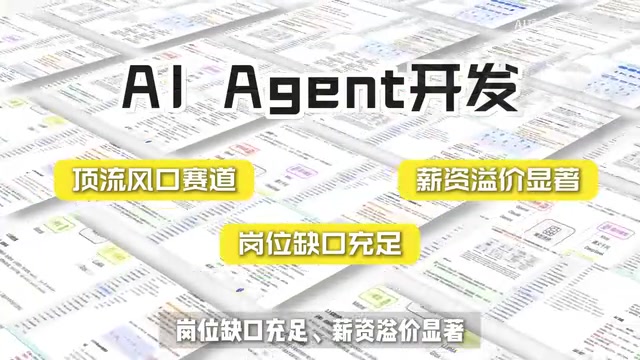
A four-week structured roadmap for developers to break into AI Agent development and advance their careers.
This article presents a structured AI Agent learning roadmap aimed at traditional developers facing stagnant career growth. The four-week plan covers: building a conceptual framework around LLMs, planning, memory, and tool sets (Week 1); mastering working principles and the ReAct paradigm (Week 2); advancing into multi-agent collaboration and Prompt tuning (Week 3); and applying everything through hands-on projects (Week 4). The article takes a realistic tone, noting that "land a high-paying job after finishing" is marketing language, and that the roadmap suits developers with existing coding skills — not beginners — while ongoing hands-on practice and keeping up with a fast-moving ecosystem remain essential.
Why Transitioning to AI Agent Development Makes Sense Right Now
The outlook for traditional development roles is becoming increasingly uncertain. Front-end, back-end, and mobile development positions are broadly facing salary cuts, layoffs, and compensation ceilings, while intense competition is making career advancement feel harder than ever. In contrast, AI Agent development has emerged as one of the hottest tracks in the industry — with a clear talent gap and significant salary premiums.
Whether you're looking to boost your resume, pursue an internal transfer, or land a higher-paying role elsewhere, Agent development has become a realistic path for developers with some coding background to break through career bottlenecks. This learning roadmap comes from a structured tutorial series on Bilibili, and the core logic is straightforward: as long as you have basic coding skills and the discipline to study consistently, you can upgrade your technical stack through a structured learning path — even without any prior AI background.
A word of candor here: Agent development is genuinely a hot area, but promises like "land a high-paying offer right after finishing the course" carry obvious promotional spin. The real value lies in having a clear learning framework — not a get-rich-quick guarantee.
The Complete Four-Week Learning Roadmap Breakdown
The most practical part of this tutorial series is how it breaks the onboarding process into a four-week closed loop. For the most common pitfalls in self-study — not knowing where to start, disorganized learning sequences, and theory disconnected from practice — this kind of structured plan significantly lowers the barrier to entry.

Week 1: Build the Foundation and Establish a Conceptual Framework
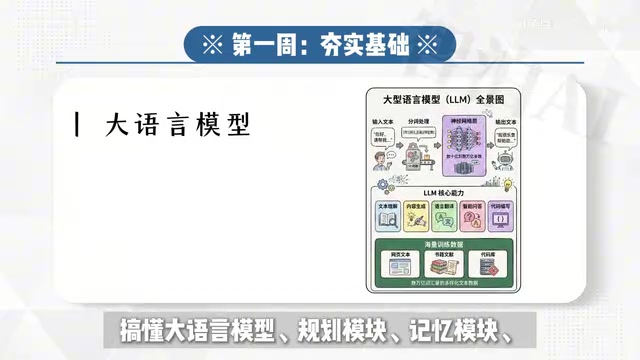
The focus of Week 1 is to thoroughly understand the core theory of AI Agents and get comfortable with the key components — including large language models, planning modules, memory modules, tool sets, and all the foundational concepts. The goal at this stage isn't to write code, but to build a complete mental model: what parts make up an intelligent agent, and what role does each part play.
For developers without an AI background, this step is especially critical. Jumping straight into framework code without understanding the concepts often leads to a state of "it runs, but I don't know why" — making it very difficult to debug problems later.
The four core components of an AI Agent each have distinct responsibilities: the Large Language Model (LLM) acts as the "brain," handling language understanding and generation; the Planning Module breaks complex goals into executable subtask sequences, with common implementations including task decomposition prompts and Tree-of-Thoughts; the Memory Module covers both short-term memory (the current conversation context window) and long-term memory (historical information and knowledge fragments stored in vector databases), addressing the LLM's limited context length; and the Tool Set serves as the interface between the Agent and the external world, encompassing search engines, code interpreters, API calls, file I/O, and more — where the quality and invocation strategy of tools directly determines the Agent's practical capability ceiling. Understanding how these four components work together forms the cognitive foundation for learning various frameworks and paradigms down the road.
Week 2: Master the Underlying Principles and Classic Paradigms
Week 2 dives deep into the Agent's complete working principles, tackles common pain points head-on, and expands into classic Agent development paradigms like ReAct. ReAct (Reasoning + Acting) is one of the mainstream approaches to agent design today — it has the model alternate between reasoning and tool invocation, making it the core entry point for understanding how modern Agents work.
The ReAct paradigm was proposed by Yao et al. in 2022. Its full name is Reasoning and Acting, and the core idea is to interweave the language model's chain-of-thought reasoning with external tool calls within the same loop. Specifically, at each step the model first outputs a natural language "Thought" explaining the current goal and intent, then outputs an "Action" to invoke a tool such as search, a calculator, or code execution. After the tool returns an "Observation," the model uses that new information to begin the next round of reasoning. This iterative "Thought → Action → Observation" loop enables Agents to handle complex tasks requiring multi-step information retrieval, while maintaining a readable reasoning trace that makes debugging easier. Major frameworks like LangChain and LlamaIndex both have ReAct-style Agent executors built in. Mastering this paradigm is a necessary prerequisite for understanding multi-agent collaboration architectures later on.
Week 3: Multi-Agent Collaboration and Prompt Tuning
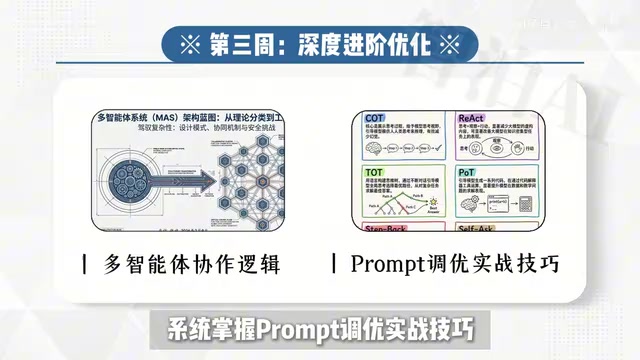
In the advanced phase, the focus shifts to multi-agent collaboration logic and practical Prompt tuning techniques. The goal this week is to get the Agents you build to accurately understand requirements and produce usable results — moving from "it works" to "it works well." Prompt engineering may sound straightforward, but in real projects it's often the key variable that determines whether an Agent performs well or poorly.
Multi-Agent collaboration refers to distributing a complex task across multiple Agents with specialized roles, completing the work through message passing or shared state. There are two common architectures: the Orchestrator-Worker pattern, where a primary Agent handles task decomposition and scheduling while multiple sub-Agents handle specific execution; and the Parallel Debate pattern, where multiple Agents independently reason about the same problem and then cross-validate each other's outputs to improve reliability. Frameworks like AutoGen and CrewAI encapsulate these collaboration patterns, lowering the engineering overhead. Compared to single-Agent systems, multi-agent systems are significantly more complex to debug — communication formats between Agents, role definitions, and error propagation all require careful design. This is the core engineering capability that Week 3 focuses on developing.
Week 4: Hands-On Implementation
The final week puts the theory from the first three weeks into practice. By independently completing several real-world mini-projects, you'll connect the knowledge together. The ideal outcome after completing this phase is the ability to interface with actual business scenarios and achieve real-world deployment of AI technology.
Who This Roadmap Is For — and How to Approach It Realistically
Based on the content structure, this roadmap is better suited for working developers who already have a programming foundation and want to expand laterally into AI — not for complete beginners. Its biggest strength is organizing scattered Agent knowledge into a sequenced learning flow: concepts first, then principles, then collaboration and tuning, and finally hands-on practice.
A few things worth keeping in perspective: first, completing the onboarding in four weeks is a fairly ambitious target — actual outcomes depend on the time you invest and how consistently you stick with it; second, phrases like "beats paid courses" and "land a high-paying job after finishing" are classic marketing hooks, and genuine technical depth still requires extensive hands-on practice and project experience; third, the tools and frameworks in the Agent ecosystem evolve quickly, and any tutorial series can only serve as a scaffolding for getting started — continuously following the latest developments in the ecosystem is equally important.
Closing Thoughts
For developers looking for a way to break through career plateaus, AI Agent development is a direction worth investing in — and a structured learning roadmap can help you avoid many of the detours that come with self-study. Treat this "four-week framework" as a learning map rather than a shortcut to success, combine it with solid hands-on practice, and you'll be in a much better position to translate the momentum of this trend into genuine personal competitive advantage.
Related articles
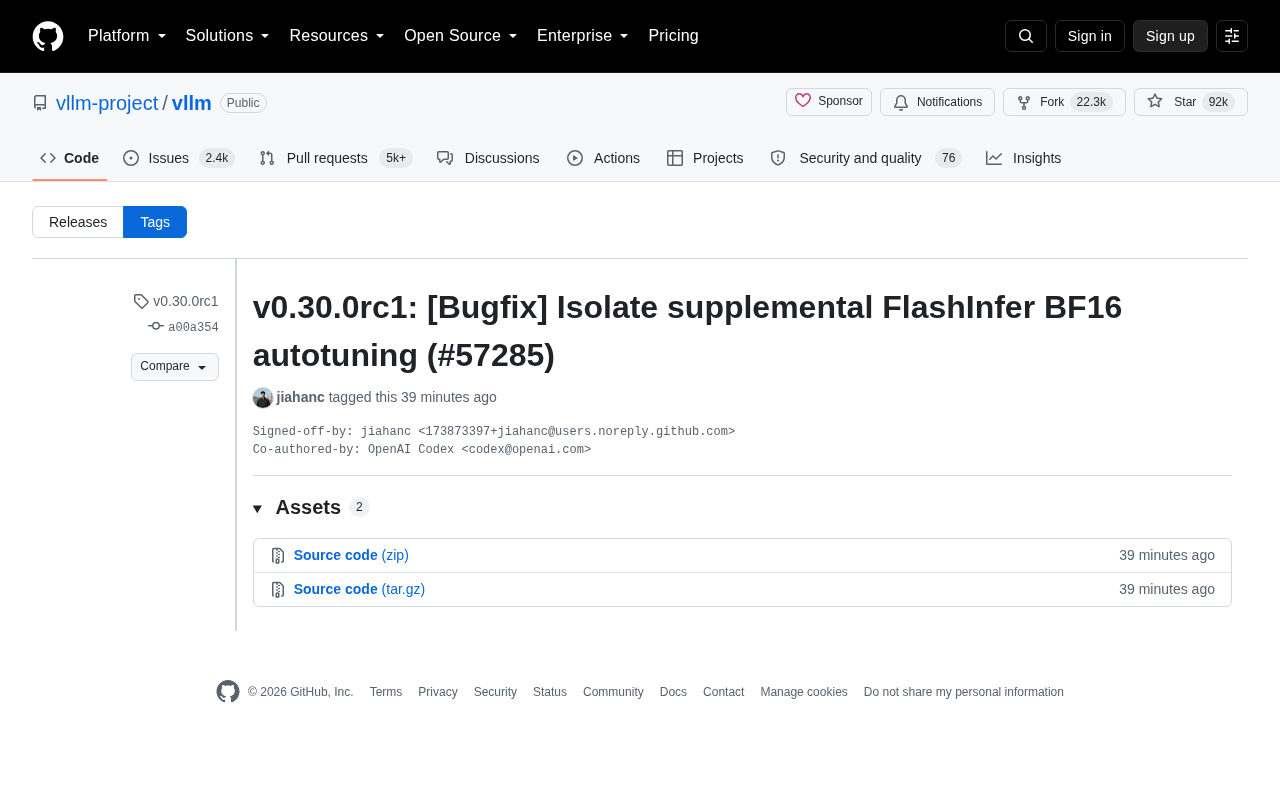
vLLM v0.30.0rc1 Released: Isolates FlashInfer BF16 Autotuning Logic
vLLM v0.30.0rc1 release candidate fixes FlashInfer BF16 autotuning isolation (PR #57285). Learn the technical background and its impact on inference deployment.
Comp AI Raises $34M Series A, Bets on Agentic Security Compliance
Comp AI raises $34M Series A led by Roo Capital and Grand Ventures, betting on "continuously agentic" AI to transform compliance from periodic audits into real-time monitoring.
MIT Technology Review's 35 Innovators Under 35: A Climate Tech Edition Explained
MIT Technology Review's latest 35 Innovators Under 35 list focuses on climate tech, spotlighting nine young global innovators. Here's what the list means and why it matters.