Getting Started with AI/ML from Scratch: Comparing Three Popular Courses & A Complete Guide to Choosing the Right One

A detailed comparison of three popular AI/ML courses and a complete learning path for beginners.
Choosing the right AI/ML course can be overwhelming for beginners. This article compares three popular Udemy courses — Machine Learning A-Z, ZTM Bootcamp, and 365 Data Science — breaking down their strengths and target audiences. It also provides a recommended learning path that combines algorithm intuition, math foundations, rigorous resources, and real-world project building.
A Common Dilemma: Where to Start Learning AI?
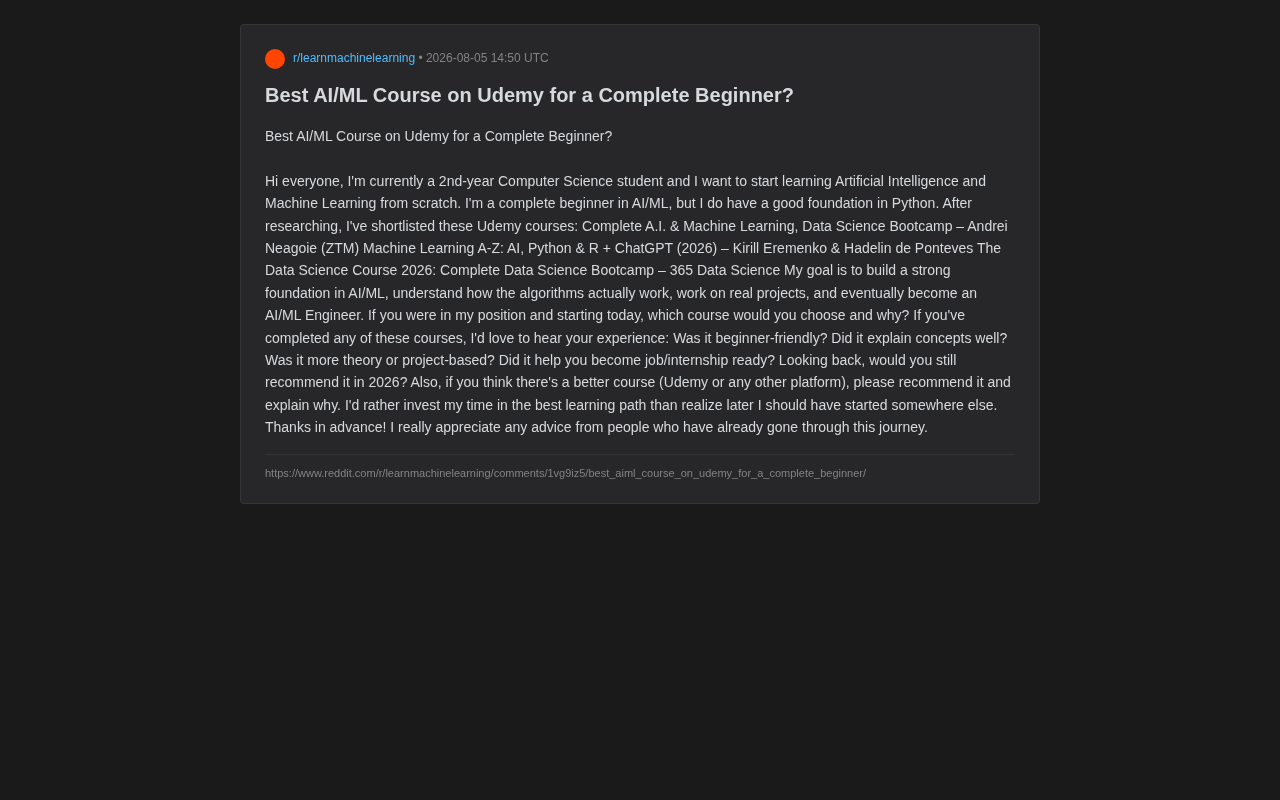
On Reddit, a sophomore computer science student posted a highly relatable question: as a complete beginner in AI/ML (but with a solid Python foundation), how do you choose from the overwhelming number of courses on Udemy?
He listed three popular courses that caught his attention:
- Complete A.I. & Machine Learning, Data Science Bootcamp — Andrei Neagoie (ZTM)
- Machine Learning A-Z: AI, Python & R + ChatGPT — Kirill Eremenko & Hadelin de Ponteves
- The Data Science Course: Complete Data Science Bootcamp — 365 Data Science
His goals were clear: build a strong AI/ML foundation, truly understand how algorithms work, work on hands-on projects, and ultimately become an AI/ML engineer. Behind this question lies an anxiety shared by countless beginners — not wanting to waste time on the wrong path.
How These Three Courses Differ in Focus
Although all three courses carry the "Bootcamp" label, they actually emphasize very different things. Understanding these differences is key to making the right choice.
The concept of coding bootcamps first emerged around 2012 in Silicon Valley, originally as in-person intensive programs that promised to turn complete beginners into job-ready software engineers in 8–16 weeks. With the rise of online platforms like Udemy and Coursera, the bootcamp model quickly moved online. Compared to traditional university courses, bootcamps emphasize practicality and project-driven learning while downplaying theoretical derivation. But precisely because of this, bootcamp graduates are often criticized for "knowing how but not why." This tension is especially pronounced in AI/ML — the core algorithms of machine learning deeply depend on mathematical intuition, and pure hands-on coding cannot replace a deep understanding of concepts like loss functions, gradient descent, and probability distributions.
Machine Learning A-Z: Building Algorithm Intuition for Beginners
This course by Kirill Eremenko and Hadelin de Ponteves is one of Udemy's longest-running and most-reviewed ML courses. Its biggest strength is explaining algorithm logic in an intuitive way rather than diving into heavy mathematical derivations. The course covers mainstream topics including regression, classification, clustering, association rule learning, reinforcement learning, and deep learning, with implementations in both Python and R.
These terms represent the core task types in machine learning. Regression is used to predict continuous values, such as house prices or temperature. Classification is used to predict discrete labels, such as spam detection or image recognition. Both belong to supervised learning, which requires labeled training data. Clustering belongs to unsupervised learning, automatically discovering grouping patterns in data without labels — typical algorithms include K-Means and DBSCAN. Association rule learning discovers interesting relationships between variables, with the most classic application being market basket analysis — "people who buy beer often also buy diapers." Reinforcement learning is yet another paradigm, where an agent learns optimal strategies by interacting with an environment and receiving reward signals — AlphaGo is the landmark achievement of reinforcement learning.
For beginners who "want to understand how algorithms work," this course excels in its low barrier to entry and broad coverage. But its weaknesses are also clear: in pursuit of accessibility, many concepts lack mathematical depth, and the hands-on projects tend to be "template-based" — after finishing, you may not be able to independently build a real-world system.
ZTM Bootcamp: A More Engineering-Oriented Choice
Andrei Neagoie's Zero to Mastery series positions itself as "zero to employment," with content that emphasizes the completeness of the engineering pipeline — from data processing and model training to deployment. For learners whose goal is to become an AI/ML engineer, ZTM's engineering-oriented approach may be more aligned with career plans. It typically includes a more modern tool stack (such as the complete workflow with TensorFlow, Pandas, and Scikit-learn).
Understanding the role of these tools is crucial for ML engineers. Pandas is the most essential data processing library in the Python ecosystem, providing the DataFrame data structure that makes data cleaning, transformation, and aggregation operations intuitive and efficient. Scikit-learn is the go-to framework for traditional machine learning, with built-in pipelines covering everything from data preprocessing and feature engineering to model training and evaluation, supporting virtually all classic ML algorithms. TensorFlow, open-sourced by Google in 2015, is one of the most mainstream deep learning frameworks, supporting the full lifecycle from research prototyping to production deployment. Its competitor PyTorch (developed by Meta) has become more popular in academia in recent years, known for its dynamic computation graphs and more Pythonic API. Understanding how these tools work together is a fundamental skill for AI/ML engineers.
365 Data Science: Oriented Toward the Data Science Ecosystem
The third course is positioned more toward "data science" rather than pure machine learning engineering. It dedicates more time to statistics, data analysis, SQL, visualization, and other foundational topics. If your goal is to become a data analyst, this course offers a complete system; but if your focus is on AI/ML algorithms and engineering implementation, it's less targeted.
The More Important Thinking Behind Course Selection
A Course Is Just the Starting Point, Not the Finish Line
Here's a harsh but true reality: no single Udemy course can directly turn you into an AI/ML engineer. The value of these courses lies in building a systematic knowledge framework and initial confidence. What actually makes someone "job-ready" is sustained practice after the course — reproducing papers on your own, competing on Kaggle, building end-to-end personal projects, and deploying them.
Kaggle plays a unique role in this learning path. As the world's largest data science competition platform (acquired by Google in 2017), Kaggle's value extends far beyond competitions themselves. The platform hosts tens of thousands of public datasets that anyone can use for free. Community-shared Notebooks (code notebooks) form a massive library of practical case studies, covering everything from data exploration to model tuning. Kaggle competitions require participants to optimize model performance on real or near-real data, and the leaderboard mechanism forces learners to continuously iterate on their solutions — this pressure-driven learning approach is extremely effective for building practical skills. Many AI/ML practitioners include their Kaggle rankings and competition results as important components of their resumes.
For this CS student with a Python background, rather than agonizing over which of the three courses to pick, the better move is to choose one quickly and start doing the work. Excessive "course selection anxiety" is itself a waste of time.
A Recommended AI/ML Learning Path
Given his background (sophomore CS student, Python foundation, goal of becoming an AI/ML engineer), a more sensible learning path would be:
- Start with Machine Learning A-Z to build algorithm intuition and quickly familiarize yourself with the application scenarios of various algorithms;
- Shore up your math foundations, especially linear algebra, probability & statistics, and calculus — this is the key to understanding "why algorithms work";
- Move on to more rigorous resources for deeper understanding, such as Andrew Ng's Machine Learning Specialization (Coursera), fast.ai's practical deep learning courses, or university open courses like cs231n;
- Build real projects and share your work publicly, building a portfolio through GitHub and blogs.
Mathematics is emphasized at step two because it forms the underlying language of machine learning. Linear algebra provides the basic framework for handling high-dimensional data — datasets are matrices, feature transformations are matrix multiplications, the core of Principal Component Analysis (PCA) is eigenvalue decomposition, and the forward pass of neural networks is essentially a series of matrix operations. Probability and statistics are key to understanding model uncertainty — concepts like Bayes' theorem, maximum likelihood estimation, and hypothesis testing run through every model from Naive Bayes to Variational Autoencoders. Calculus (especially multivariable calculus) is core to understanding model optimization — the gradient descent algorithm relies on partial derivatives to determine parameter update directions, and the backpropagation algorithm is essentially a systematic application of the chain rule. Without these mathematical foundations, learners can only stay at the level of "calling APIs" — unable to diagnose why a model fails or design innovative solutions for specific problems.
Don't Overlook High-Quality Free Resources
It's worth noting that while the original question focused on paid Udemy courses, the AI/ML field has an abundance of high-quality free resources. Courses from Andrew Ng, fast.ai, and free tutorials from Google and Kaggle often match or exceed the teaching quality of paid bootcamps. The main value of paid courses lies in their "structure" and "saving you the time of curating content" — not in exclusive content.
Andrew Ng is one of the most influential figures in AI education. He is a professor of computer science at Stanford University, founded the Google Brain project, and later served as Chief Scientist at Baidu. In 2012, he co-founded Coursera with Daphne Koller and published the legendary Machine Learning course on the platform, which has been taken by over 5 million learners worldwide and is hailed as a milestone in "democratizing machine learning knowledge." In 2022, he gave the course a major update, launching the Machine Learning Specialization, migrating the programming language from Octave/MATLAB to Python and adding more modern content. His organization DeepLearning.AI also offers the Deep Learning Specialization, systematically covering core topics such as neural networks, convolutional networks, and sequence models.
fast.ai was founded by Jeremy Howard and Rachel Thomas in 2016. Its teaching philosophy is "top-down" — first letting students run complete deep learning projects using high-level APIs, then progressively diving into lower-level principles. This stands in stark contrast to the traditional academic approach of "bottom-up" (learn math first, then write code). fast.ai also developed an open-source deep learning library of the same name, which wraps common PyTorch operations and significantly lowers the barrier to experimentation. cs231n (Convolutional Neural Networks for Visual Recognition) is Stanford University's classic computer vision course, created by Fei-Fei Li, Andrej Karpathy, and others, known for its rigorous mathematical derivations and programming assignments that involve building neural networks from scratch. One leans toward practical efficiency, the other toward theoretical depth — they complement each other perfectly.
Conclusion: Action Matters More Than Choice
This student's dilemma is highly representative and worth acknowledging — the willingness to research thoroughly before starting shows that he takes learning seriously. But the core principle of the AI/ML journey is: deep understanding comes from repeated practice, not from the course itself.
If forced to give one piece of advice: with an engineering career as the goal, consider starting with ZTM or Machine Learning A-Z, while simultaneously building your math foundations, then move into the project-building phase as soon as possible. What truly sets people apart is never which course they took — it's how many real problems they independently solved after the course ended.
Related articles

Python 3.15 New Feature: Is the sentinel Type Better Than None?
Python 3.15 adds the sentinel type, using named unique sentinel objects to replace None and bare object(), resolving confusion among missing values, explicit emptiness, and invalid input while avoiding type hint failures.

Deep Learning's Three Architectures and the Universal Approximation Theorem: A Complete Guide to MLPs, CNNs, and Transformers
Explaining the inductive bias differences among MLP, CNN, and Transformer, the existence meaning of the Universal Approximation Theorem (UAT), and the role of Taylor expansion in approximation analysis, while clearing up common misconceptions.

GitLab Emergency Patch Release: Analysis of Critical Security Fixes
GitLab releases critical patch 19.5.1, sparking 355 points of discussion on Hacker News. This article analyzes the background, upgrade steps for self-hosted instances, and verification points to help DevOps teams respond quickly to security updates.