Getting Started with C++26 Contracts: Parsing Preconditions and Postconditions

C++26 Contracts elevates preconditions and postconditions into language-level syntax, bringing a standardized contract mechanism to interface design.
The Contracts feature introduced in C++26 lets developers declare preconditions and postconditions directly on function interfaces, elevating contract information that was previously scattered across comments, asserts, and custom macros into language-level syntax. The same condition declaration can behave differently across development, testing, and release phases, so developers don't need to manually remove check code for performance or maintain two sets of interfaces. Contracts can also serve as input to static analysis tools; even if runtime checks are disabled, tools can still infer potential null pointer dereferences or array out-of-bounds based on condition declarations. However, the community is divided on the choice of default behavior, worrying about semantic inconsistency between teams. The article recommends piloting in core modules first, observing how well contract violations are exposed during testing, and then deciding on the scope of rollout. Library authors in particular need to pay attention to the semantic stability of contracts.
The Contracts feature introduced in C++26 is becoming a focal point of community discussion. This mechanism allows developers to declare preconditions and postconditions directly on function interfaces, elevating contract information that was previously scattered across comments and asserts into language-level syntax. For C++ projects that have long relied on documentation conventions and runtime checks, this could mark a substantial shift in how interfaces are designed.
What Exactly Are Preconditions and Postconditions
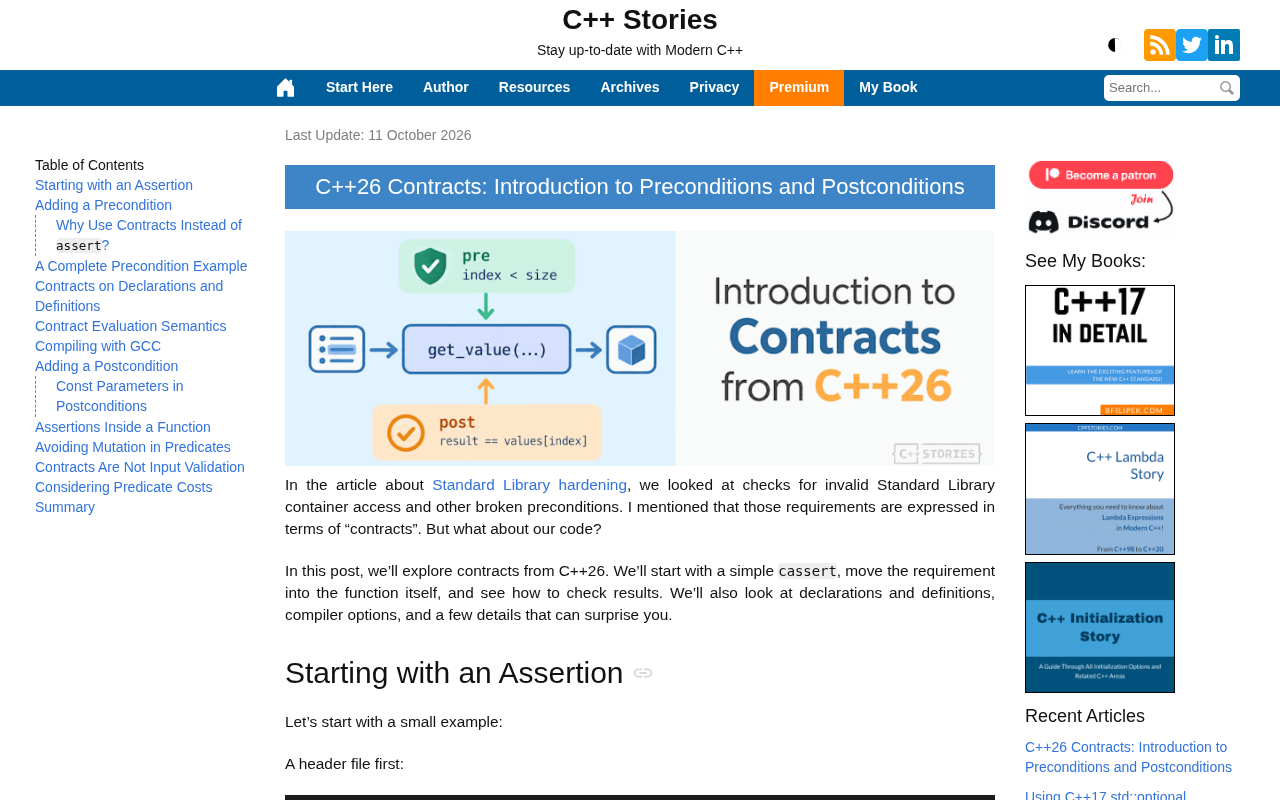
Preconditions describe the constraints that the caller must satisfy before entering a function. For example, a function that accepts a pointer parameter can require that the pointer be non-null; a function that computes a square root can require that the input be non-negative. Postconditions describe the properties that must hold when the function returns, such as the return value being greater than or equal to zero, or some output parameter having been correctly populated.
These two types of conditions together form an executable interface specification. Unlike comments, the compiler can recognize them and decide how to handle violations under different build configurations.
How Contract Violations Are Handled
One of the core design goals of Contracts is to let the same condition declaration behave differently across development, testing, and release phases. During development, it can trigger an assertion that terminates immediately, making it easy to locate problems; in performance-sensitive production builds, checks can be ignored or merely logged. This means developers don't need to manually delete check code for performance reasons, nor maintain two sets of interfaces.
Based on feedback from the HN discussion thread, the community's assessment of this point is mixed. Some developers believe that a unified contract syntax finally ends the chaos of having three coexisting systems — assert, custom macros, and documentation comments. Others worry that the choice of default behavior will diverge between teams, causing the same piece of code to have inconsistent semantics across different projects.
Several Modes for Handling Contract Violations
In the C++26 Contracts semantic model, when a precondition or postcondition is determined at runtime to not hold, the program does not automatically acquire a single deterministic behavior; instead, the implementation decides which "contract violation handling mode" to adopt. Common modes include: ignoring the condition (compiling the check out entirely, equivalent to having no contract), logging a single diagnostic message (for example, to a log or the standard error stream) and then continuing execution, and terminating directly (for example, calling std::terminate or abort, or throwing an exception that can be caught by a higher layer). This mode is typically selected through build options, attributes, or implementation-defined mechanisms, rather than being written into the function signature. Note that once a contract is declared as "ignorable," the compiler is permitted to optimize under the assumption that the condition holds, so if the caller actually violates it, program behavior becomes unpredictable. This is also the fundamental reason the community worries that "the same piece of code will have inconsistent semantics across different projects": the handling strategy for contracts is not part of the code, but part of the build environment.
Relationship with Existing Assertion Mechanisms
The problem with traditional assert is that it is typically tied to the NDEBUG macro and simply disappears in release builds. Contracts attempt to provide more fine-grained control: which conditions are retained under which build modes is determined by build configuration rather than macro definitions.
This brings a practical benefit — contracts can serve as input to static analysis tools. Even if runtime checks are disabled, tools can still infer potential null pointer dereferences or array out-of-bounds based on condition declarations.
The Binding Mechanism Between NDEBUG and assert
NDEBUG is a macro defined by the C standard library convention. When it is defined, the standard header <cassert> expands assert(expr) into an empty statement, thereby removing the assertion entirely at compile time. This design is related to the positioning of assert: it is regarded as a debugging aid rather than part of program logic, so the standard requires that the asserted expression must not have side effects (otherwise behavior would change once NDEBUG is defined). The problem is that many projects use assert as a permanent runtime check, causing release builds to lose both error detection capability and error information. In addition, NDEBUG is global and cannot provide differentiated control for a single function, a single module, or a single class of conditions, nor can it distinguish between the two semantics of "terminate immediately upon violation" and "log and continue upon violation." Contracts move this type of decision from preprocessor macros to the build configuration and implementation level, precisely to solve the coarse-grained problem of NDEBUG.
Practical Impact on Interface Design
Writing contracts into function signatures changes the way developers think about interfaces. In the past, interface constraints were often hidden in documentation, and callers had to actively read them; now constraints become another layer of checkable information beyond the type system.
However, this also brings trade-offs: excessive use of contracts makes function declarations verbose, and if the contracts themselves are written incorrectly, they can instead create a false sense of safety. Community consensus tends to favor using contracts for truly critical interface boundaries rather than adding them to every function.
The Boundary Between Contracts and the Type System and Defensive Programming
Contract declarations and the type system solve problems at different levels. The type system characterizes "what values can be passed," while contracts characterize "what additional properties the value must satisfy." For example, the char* type allows a null pointer to be passed, and only a precondition can express a constraint such as "must be non-null." Therefore contracts are not meant to replace type design; on the contrary, in many cases the issue should first be resolved through more precise types (such as std::span, std::not_null), narrower interfaces, or clearer error-return semantics. Only when a constraint cannot be expressed at the type level and violating that constraint constitutes a programming error is a contract the appropriate choice. Pushing responsibilities that should be borne by types onto contracts weakens the value of static checking; conversely, writing critical constraints that should be expressed by contracts into documentation delays errors until runtime. The usual criterion is: if certain inputs would never appear under normal circumstances, and violating them means the caller has a bug, then it is suitable to write them as contracts; if the input itself is legitimate and expected (for example, coming from a user or external data), then it should be handled with mechanisms such as error codes, exceptions, or std::expected.
Adoption Recommendations
If your project already uses custom check macros, migrating to Contracts requires evaluating the cost of changes to the build process. It is recommended to first pilot in a few core modules, observe how well contract violations expose problems during the testing phase, and then decide on the scope of rollout. For library authors, the semantic stability of contracts is especially important, because it directly affects the build behavior of downstream users.
Overall, C++26 Contracts provides a standardized way to express contracts, not a silver bullet. Its value depends on how teams define which conditions are worth declaring as contracts, and how they balance check costs against safety benefits in build configurations.
The Premise for Contracts as Static Analysis Input
The benefit of contracts for static analysis is not free. For analysis tools to treat contracts as reliable assumptions, the premise is that they can be confident these contracts will actually be checked at runtime, or at least treated by people as "must not be violated." If the build configuration sets certain contracts to "ignore," while the analysis tool still infers based on "must hold," two opposite risks arise: first, tool false positives (classifying originally legitimate code as a violation), and second, tool false negatives (treating an actually existing null pointer dereference as impossible). Therefore, during adoption, a clear distinction should be made between "contracts for human reading" and "contracts for tool use," and the build configuration should be kept consistent with the analysis configuration. For library authors, once contracts on public interfaces are released, they are very difficult to change, and their semantic stability directly affects downstream build options and static analysis results. This is another reason to pilot first in core modules: only after running through the real build and analysis pipeline can you judge whether the benefits of contracts outweigh the cost of introducing them.
One-line Summary
C++26 Contracts elevates preconditions and postconditions into language-level syntax, bringing a standardized contract mechanism to interface design.
Paragraph Summary
The Contracts feature introduced in C++26 allows developers to declare preconditions and postconditions directly on function interfaces, elevating contract information previously scattered across comments, asserts, and custom macros into language-level syntax. The same condition declaration can behave differently across development, testing, and release phases, so developers don't need to manually remove check code for performance or maintain two sets of interfaces. Contracts can also serve as input to static analysis tools; even if runtime checks are disabled, tools can still infer potential null pointer dereferences or array out-of-bounds based on condition declarations. However, the community is divided on the choice of default behavior, worrying about semantic inconsistency between teams. The article recommends piloting in core modules first, observing how well contract violations are exposed during the testing phase, and then deciding on the scope of rollout. Library authors in particular need to pay attention to the semantic stability of contracts.
Related articles

Chain of Thought Isn't Just for AI: How Humans Can Use CoT to Improve Thinking Quality
Chain of Thought isn't just a prompt trick for large models. Starting from a Hacker News discussion, this article analyzes why CoT works for human thinking too, breaks down actionable ways to transfer it, and highlights the key differences between human CoT and machine CoT.
Cloudflare Teams Up with OpenAI: Closi…
Cloudflare Teams Up with OpenAI: Closing the Loop from Vulnerability Discovery to Defense with AI
Cloudflare uses OpenAI Daybreak to investigate security vulnerabilities and generate reviewable remediation plans, while developers use Codex to boost coding efficiency and quality.

Orca Multi-Agent Orchestration in Practice: A Guide to Parallel Collaboration with Claude and Codex
Orca is Stable AI's free open-source agent workbench supporting 34 agents like Claude Code and Codex in parallel. Learn its Git worktree isolation, multi-model orchestration, and mobile management.