Getting Started with Chatbot Development: Which Programming Languages Do You Need for a RAG Stack?
A beginner's guide to language selection for RAG chatbot development, with Python as the recommended starting point.
This article offers practical guidance on language selection and learning paths for beginners building RAG-powered chatbots. Python is the natural starting point thanks to its comprehensive LLM ecosystem (LangChain, LlamaIndex, model SDKs); JavaScript/TypeScript only becomes necessary when building interactive web products. The article also breaks down RAG's three core stages — document chunking, vector storage, and retrieval-based generation — emphasizing that understanding the workflow matters more than mastering syntax. The recommended learning strategy is to follow official docs and drive progress through small hands-on projects, prioritizing action over perfect tech stack decisions.
Choosing a Language for Chatbot Development
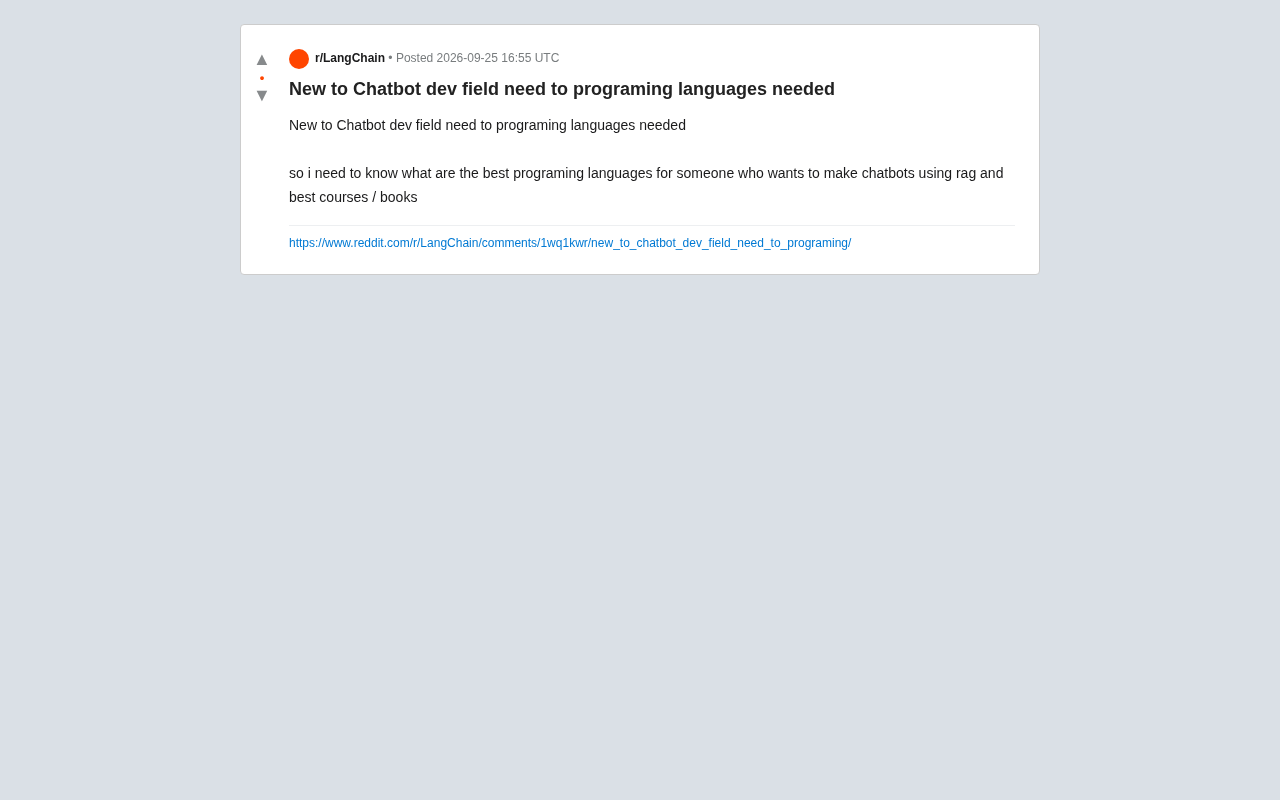
A Reddit user recently posted a question that many beginners share: if you want to build a chatbot using RAG (Retrieval-Augmented Generation), which programming languages should you learn — and where should you start in terms of courses and books?
The question sounds simple, but it touches on the entire technology decision-making process behind modern AI application development. Since the original post was light on details, this article draws on common practices in chatbot and RAG development to offer a practical learning roadmap.
Why Python Is Almost the Only Starting Point
For beginners looking to build a RAG chatbot, Python is the top priority — and the reason is straightforward: the entire ecosystem around large language models and vector search is built primarily around Python.
Major RAG frameworks like LangChain and LlamaIndex, vector database clients like Chroma, Pinecone, and Weaviate, and the official SDKs from model providers like OpenAI and Anthropic all offer Python interfaces first. That means you'll find the most complete documentation, the most example code, and the most active community support.
If your goal is to quickly prototype and validate a chatbot idea, Python lets you focus your energy on business logic rather than low-level implementation.
What is RAG? RAG (Retrieval-Augmented Generation) is a technical paradigm that combines an external knowledge base with a large language model. Traditional LLMs have knowledge frozen in their training parameters — they can't access information after their training cutoff date and struggle to answer questions based on private documents. RAG solves this by first retrieving the most relevant content from an external database before generating a response, then feeding that content as context to the model alongside the question — letting the model "answer with the documents in front of it" rather than from memory alone. This approach reduces the risk of hallucinations, enables chatbots to operate on continuously updated private knowledge bases, and is currently one of the most widely adopted techniques for deploying LLM applications in enterprise settings.
When You'll Need JavaScript/TypeScript
When your chatbot needs to be embedded in a webpage or built into an interactive front-end product, JavaScript or TypeScript becomes unavoidable.
LangChain officially provides a JavaScript version as well, and paired with frameworks like Next.js and React, you can integrate RAG capabilities directly into web applications. For developers aiming to build full-stack products, a common setup is Python handling the backend — data processing and model calls — while TypeScript handles front-end interactions.
In short: if you just want to get the logic working and run experiments, Python is enough. If you want to ship a product to actual users, you'll need to add a front-end language to the mix.
The Core Components of a RAG Stack
Beyond programming languages, understanding the RAG workflow matters more than obsessing over syntax. A basic RAG chatbot typically involves the following steps:
Document Processing and Chunking
Split raw documents (PDFs, web pages, databases) into appropriately sized text chunks. This step directly impacts retrieval quality.
Vectorization and Storage
Use an embedding model to convert text into vectors and store them in a vector database. Common choices include Chroma (lightweight, local), Pinecone, and Weaviate.
What are embedding models and vector databases? An embedding model is a neural network that converts text into high-dimensional vectors, with the core idea being that semantically similar text ends up closer together in vector space. Popular embedding models include OpenAI's
text-embedding-ada-002, the open-sourcesentence-transformersfamily, and Cohere's Embed model. Vector databases are purpose-built for efficient similarity search, supporting approximate nearest neighbor (ANN) algorithms that can find the most relevant passages across millions of vectors in milliseconds. Chroma is great for local development and prototyping — no account required. Pinecone and Weaviate offer cloud-hosted services suited for production deployments. For beginners, the choice of vector database matters less than understanding how the chain works: text → vector → storage → retrieval.
Retrieval and Generation
When a user asks a question, the system first retrieves the most relevant text chunks from the vector store, then sends both the question and the retrieved context to the LLM to generate a response. This is the essence of "retrieval-augmented" generation.
Once you understand this workflow, language is just an implementation tool — switching languages won't change your understanding of RAG.
Recommended Learning Resources
The original post also asked for course and book recommendations. For beginners, here's a suggested progression:
- Build a solid Python foundation: You don't need to master it — just enough to read functions, loops, and API calls.
- Start with official documentation: The LangChain and LlamaIndex tutorials are usually the most up-to-date and accurate starting points, and many include complete RAG examples.
- Build small hands-on projects: Rather than reading an entire book, first get a "question-answering bot over your own documents" up and running, then look things up as problems arise.
- Fill in the theory later: When you want to deeply understand embeddings, vector search, or how LLMs work, that's the right time to pick up a systematic book or course.
Practical Advice for Beginners
The RAG development landscape moves fast — frameworks and tools can see major updates within months. So instead of agonizing over "which language is best," start with Python, move quickly, and get a minimal working chatbot off the ground.
The challenges you encounter in practice will naturally guide you toward the knowledge you need next — whether that's front-end languages, vector database tuning, or prompt engineering. For beginners, taking action matters more than finding the perfect tech stack.
Related articles

Gmod TTT: Boba's Winning Streak and Game Design Insights
An in-depth analysis of Gmod TTT's role system, creative items, and social gameplay mechanics, exploring the relationship between randomness design and game balance through Boba's winning streak phenomenon.

FlexBudget: Fair Comparison of KV Cache Eviction Strategies Under a Unified Compute Budget
AMD engineer proposes FlexBudget at PyTorch Conference: a training-free fair comparison method for KV cache eviction rules using fixed kernels and memory budgets, all in core PyTorch.
