Getting Started with Claude Code: A Complete Beginner's Guide to AI Coding

A zero-to-launch AI coding guide using Claude Code and domestic models via natural language.
This article covers a beginner-focused AI coding course built around the "Vibe Coding" philosophy — describing requirements in plain language while AI drives the entire development process. The core tool is Claude Code, with alternatives including DeepSeek, Zhipu GLM, and Qwen for users in China. The course emphasizes cache hit rates as a key cost factor, with DeepSeek V4 Pro reaching 98–99% at roughly ¥3/day. It targets three audiences: business professionals who can't code, career changers, and developers new to AI tools. The article cautions that "live in three days" is marketing language — real outcomes depend on logical thinking and a constructive AI collaboration mindset.
The AI Coding Era: Those Who Don't Use AI Tools Are Being Left Behind
"You're never replaced by AI — you're replaced by someone who uses AI better than you." This quote captures the core logic of today's AI coding wave. This beginner's AI coding course, produced by Bilibili creator Meng Ge, is designed to help people with no programming background build real projects using AI coding agents like Claude Code and Codex.
Based on the course's introductory content, this article outlines the learning path, tool selection, and target audience for AI-assisted programming — helping you decide whether this kind of course is right for you and what key points to keep in mind before diving in.
What Is Vibe Coding (Web Coding)?
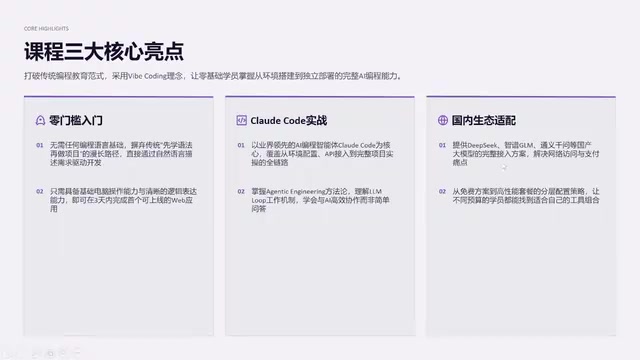
The central concept the course introduces is "Web Coding" — essentially what has become popularly known as "Vibe Coding." The idea is simple: instead of writing code yourself, you describe what you want in plain language, and AI drives the entire development process.
This means the traditional programming curriculum — learning syntax, writing code line by line — is largely set aside. In its place, you learn how to clearly articulate your requirements and how to collaborate effectively with AI. According to the course, anyone with basic computer skills and the ability to express ideas logically can launch a simple web app in as little as three days.
That said, the "zero experience to live app in three days" claim deserves some skepticism — it's largely a marketing pitch. Real web applications involve deployment, debugging, security, and more. AI can lower the barrier to entry, but as project complexity grows, a lack of foundational knowledge will eventually become a bottleneck.
The concept of "Vibe Coding" was formally coined by OpenAI co-founder Andrej Karpathy in early 2025. He described a new mode of programming on social media: developers fully immerse themselves in the "vibe," tell the AI their intent, accept the generated code without carefully reading it, and when errors occur, paste the error message back to the AI for fixes — iterating in a loop. The idea sparked wide debate. Supporters argue it dramatically lowers the barrier to software development; critics worry developers lose meaningful control over their code. At its core, Vibe Coding represents a shift in the human-machine collaboration paradigm: humans define what to build and why, while AI handles how it gets built. This division of labor is highly efficient for prototyping and internal tooling, but in production environments where reliability and security are critical, a baseline level of technical judgment is still needed to evaluate the quality of AI-generated code.
Core Tool: Claude Code and Domestic Model Alternatives
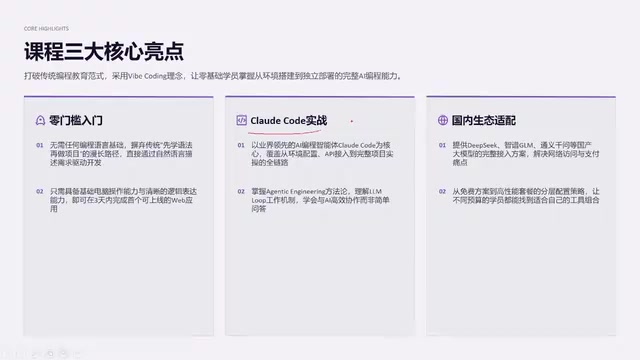
The course centers on Claude Code as its primary coding tool — one of the leading AI coding agents available today. The curriculum covers the full workflow, from environment setup and API integration to complete project development.
The course also highlights a common pain point: many users have tried Claude Code but didn't follow the officially recommended setup, resulting in low cache hit rates — meaning the output quality suffers while costs run higher than necessary. This is an easily overlooked cost issue: cache hit rate directly affects token consumption.
For users in China who face difficulties accessing overseas models like GPT or Claude, the course offers alternatives using domestic models, including DeepSeekAd, Zhipu GLM, and Qwen (Tongyi Qianwen). According to the course, a significant portion of the hands-on content is powered by DeepSeek V4 Pro, which can achieve cache hit rates of 98%–99% — but only with proper configuration; otherwise, costs can still add up.
Claude Code is a command-line AI coding agent developed by Anthropic. It differs fundamentally from typical code completion tools like GitHub Copilot: rather than just suggesting the next line in your editor, Claude Code understands the full context of your codebase, autonomously executes terminal commands, reads and writes files, calls external tools, and handles the complete development workflow from requirements analysis to code commit. "Cache hit rate" refers to how often an API call recognizes that the current request's context heavily overlaps with a previous one, allowing the system to reuse cached computation results and significantly reduce the number of tokens actually consumed. Claude's Prompt Caching mechanism can reduce the cost of repeated context to roughly 10% of the original price. If a developer builds context in a non-standard way — such as randomly shuffling file order or frequently modifying system prompts — cache invalidation occurs, and the same amount of work can cost several times more than an optimized setup.
Model Selection and Cost Comparison
The course provides a reference breakdown of different models and pricing to help learners choose based on their budget:
- Claude Code (Sonnet 4.6): Monthly subscription recommended, with tiers at $20/month, $100/month, etc.
- GPT: Monthly subscription also recommended
- Zhipu GLM (version 5.1): ~¥49/month, with discounts for quarterly or annual plans
- Qwen / Tongyi Qianwen (3.7 Max): ~¥100–200/month, often discounted
- DeepSeek V4 Pro: Pay-as-you-go API billing, averaging ~¥3/day — best value, but requires correct configuration
From this comparison, DeepSeek's pay-as-you-go model offers the lowest cost, though the tradeoff is the configuration effort required. For budget-conscious users willing to invest time in setup, domestic models are a viable option. For those who prioritize convenience and stability, a fixed monthly plan is the better fit.
Three Ideal Learner Profiles
The course identifies three types of people who are well-suited for this curriculum:
Business Professionals Who Can't Code
Product managers, designers, operations staff, and others who understand business logic but have no programming background. With AI coding, they can reduce their dependence on engineering resources and translate their requirements directly into working products.
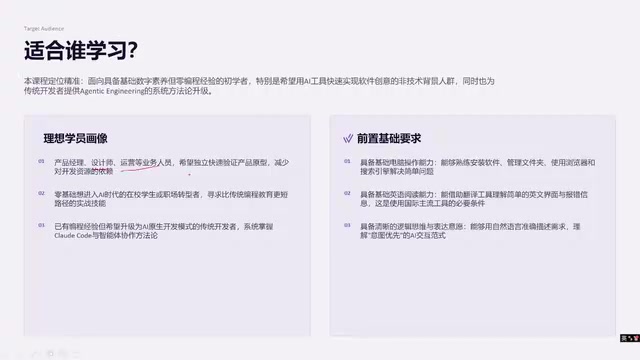
Students or Career Changers with No Technical Background
Those looking to enter the AI era — whether current students or professionals making a career pivot — don't need to follow the traditional path of learning to write code from scratch. Instead, they can use AI as a development accelerator.
Developers Who Want to Level Up with AI
Experienced developers who are already working in the field but haven't yet incorporated AI coding into their workflow. Through structured learning, they can master Claude Code and learn how to collaborate effectively with AI agents.
Prerequisites and the Right Mindset for Collaboration
The course sets a few baseline requirements: basic computer skills (powering on/off, installing software, navigating folders, using a browser); basic English reading ability — with the help of translation tools — to understand simple English interfaces and error messages, since most major international tools use English in their interfaces.
The third requirement is perhaps the most important: clear logical thinking and the right collaborative mindset. The course specifically warns against arguing with AI the way keyboard warriors argue online — doing so wastes tokens and money without producing anything useful.
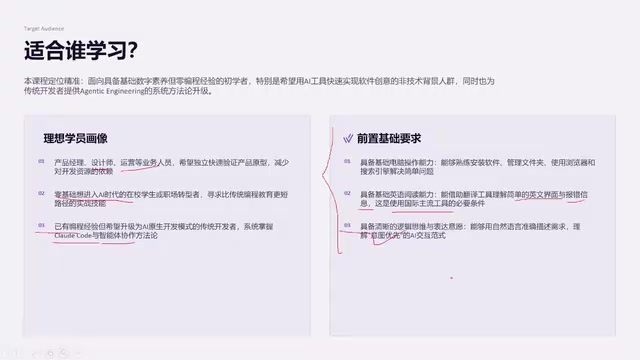
This touches on something fundamental about working with AI: the clearer, more trusting, and more constructive you are — and the more you let AI confirm its own reasoning — the better the output tends to be. The ability to collaborate effectively with AI is rapidly becoming a distinct and valuable skill in its own right.
What You'll Be Able to Do After the Course
According to the course roadmap, completing the full curriculum should bring learners to three levels of capability:
- Conceptual Level: Clearly explain what Vibe Coding and agent-based programming are, and understand their appropriate use cases
- Engineering Level: Master the full Claude Code development workflow, including environment setup, model integration, project development, debugging, and deployment
- Practical Level: Use and customize Skills, independently build and deploy complete web applications, write PRD documents, conduct code reviews, and manage production releases
A PRD (Product Requirements Document) plays a fundamentally different role in AI coding workflows than in traditional development. In traditional development, PRDs primarily serve as a communication bridge between product managers and engineers. In an AI coding context, the PRD becomes direct "input fuel" for the AI — a well-structured, clearly scoped requirements document significantly improves the accuracy and consistency of AI-generated code, reducing the need for repeated revisions. Learning to write PRDs aimed at AI is one of the core skills for non-technical users who want to translate business understanding into executable products. "Skills" in the Claude Code context typically refer to custom tool functions or workflow templates that allow users to encapsulate common operations into reusable instructions, further increasing development automation.
Conclusion: A Grounded Take on AI Coding Courses
AI coding is genuinely reshaping the barriers to software development, enabling more people without technical backgrounds to participate in building applications. The value of this course lies in its systematic coverage of the Claude Code workflow and domestic model alternatives — particularly the practical guidance around cache hit rates and model cost optimization, which are details that matter for newcomers.
At the same time, it's worth staying grounded: "zero experience to live app in three days" is marketing language. AI lowers the entry barrier, not the complexity of your project. What ultimately determines your learning outcomes is your ability to think and communicate clearly, your mindset when collaborating with AI, and your willingness to invest patience in configuration and debugging.
Related articles

Chain of Thought Isn't Just for AI: How Humans Can Use CoT to Improve Thinking Quality
Chain of Thought isn't just a prompt trick for large models. Starting from a Hacker News discussion, this article analyzes why CoT works for human thinking too, breaks down actionable ways to transfer it, and highlights the key differences between human CoT and machine CoT.
Cloudflare Teams Up with OpenAI: Closi…
Cloudflare Teams Up with OpenAI: Closing the Loop from Vulnerability Discovery to Defense with AI
Cloudflare uses OpenAI Daybreak to investigate security vulnerabilities and generate reviewable remediation plans, while developers use Codex to boost coding efficiency and quality.

Orca Multi-Agent Orchestration in Practice: A Guide to Parallel Collaboration with Claude and Codex
Orca is Stable AI's free open-source agent workbench supporting 34 agents like Claude Code and Codex in parallel. Learn its Git worktree isolation, multi-model orchestration, and mobile management.