Getting Started with Claude Code: An In-Depth Look at AI Coding Assistants and Tool Comparison

Claude Code vs. Cursor, Trae, and Codex: which AI coding assistant should developers choose?
Claude Code is Anthropic's CLI-based AI coding assistant that reads your entire project, auto-debugs errors, and operates as a full software development Agent — a major step beyond conversational tools like ChatGPT or DeepSeek. This article breaks down the three paradigms of AI coding tools and compares Claude Code, Cursor, Trae, OpenCode, and Codex through real-world testing, helping developers find the right tool for their needs.
What Is Claude Code?
Claude Code is an AI coding assistant developed by Anthropic. Unlike many tools that require you to log in through a web browser, it uses a local CLI (Command Line Interface) deployment model: no website login needed — just install it locally and invoke it directly within your development environment to move projects forward. Because the CLI tool interacts directly with your local file system without going through a browser, it can deeply read your project's contents at a technical level.
Anthropic is an AI safety company founded by former core OpenAI members, and has invested heavily in research around long-context processing and code understanding. In terms of system compatibility, Claude Code supports most mainstream operating systems, lowering the barrier to entry for everyday developers.
For developers just getting started, it can be hard to appreciate its true power at first. But the core reason it spread so quickly is simple: it's remarkably capable — many programmers have admitted to feeling a deep sense of professional anxiety after using it.

What Makes Claude Code Fundamentally Different from Conversational Coding?
Many developers are accustomed to writing code inside chat windows like DeepSeek or ChatGPT. The difference between that approach and Claude Code is fundamental. To understand it, you need to be familiar with the three paradigms of AI coding tools: Code Completion, Conversational Coding, and Agentic Coding. GitHub Copilot represents the first paradigm — cursor-context-based code prediction. ChatGPT and DeepSeek represent the second — you describe what you need in natural language and get back a code snippet. Claude Code represents the third paradigm, in which AI gains a full autonomous loop of plan → execute → verify → fix.
The Limitations of Conversational Coding
With conversational tools like DeepSeek or ChatGPT, what you typically get is a code snippet. You bring it back to your project, run it, and often find it doesn't work — so you return to the chat window for more back-and-forth, debugging across multiple rounds before arriving at something that actually runs.
More critically, conversational tools cannot read the full context of your project. If your project has 100 code files, the tool has no visibility into how those files relate to each other. You have to manually copy and paste the relevant parts in, which tanks both efficiency and accuracy.
Claude Code's Core Advantages
Claude Code works in an entirely different way:
- Reads your entire project: It can read all the code across your project and pass it as complete context to the underlying model, generating code that genuinely fits your business logic. This capability relies on Claude's extremely large context window — capable of handling hundreds of thousands of tokens. Tokens are the basic units a model uses to process text; roughly 1,000 tokens correspond to about 750 English words. A large context window lets the model simultaneously "see" cross-file dependencies, function call chains, and business logic, rather than just the fragment you manually paste in.
- Automatic debugging: It doesn't just generate code — it also automatically hunts down errors and delivers a correct, runnable version. This is powered by the Tool Use mechanism: after generating code, the model can directly execute it in the terminal, read the error output, feed that back into the model for analysis, and loop through "generate → execute → observe → fix" — a ReAct loop that effectively makes Claude Code a software development Agent.
- Automated development workflow: The overall process leans heavily toward automation, dramatically reducing the manual effort of shuttling code back and forth.
This combination of "global understanding + automatic error correction" is exactly what sets it apart from traditional conversational AI coding tools.
The Evolution of AI Coding Tools: From Copilot to Claude Code
To understand where Claude Code fits in, it helps to trace the evolution of AI coding tools over the past few years.
A Timeline of Major Tools
- GitHub Copilot: Launched as a plugin, its code autocomplete capability was genuinely disruptive at the time — giving many developers their first taste of AI-assisted programming. Its core mechanism is single- or multi-line code prediction based on surrounding context, making it the defining example of the "code completion" paradigm.
- Cursor: Arrived next and was considered smarter than Copilot, capable of more automated coding operations. It drew significant attention and is competitive with Claude Code in capability.
- Trae: The international version is paid; the domestic version has been specially optimized for Chinese-speaking developers and handles Chinese semantics quite well.
- OpenCode: Also a coding tool, but widely considered one of the harder ones to use in practice — not particularly recommended.
- Codex: Performs powerfully when paired with OpenAI GPT-5, and is competitive with Claude Code in coding quality.
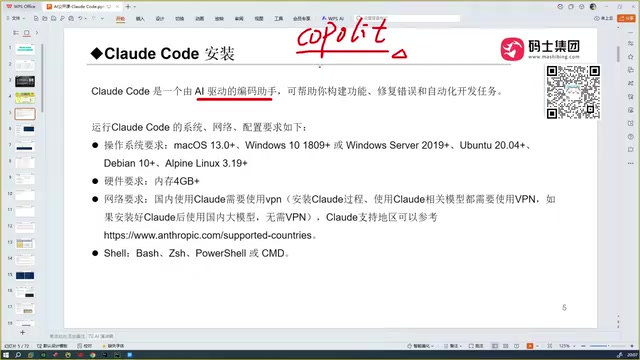
A Side-by-Side Comparison from Real-World Testing
After working through Copilot, Cursor, and Trae in sequence, many developers landed on Trae as the best coding tool — its understanding of Chinese is excellent and it aligns well with the habits of domestic developers. But once they encountered Claude Code, that conclusion often changed:
Claude Code is a full level above Trae.
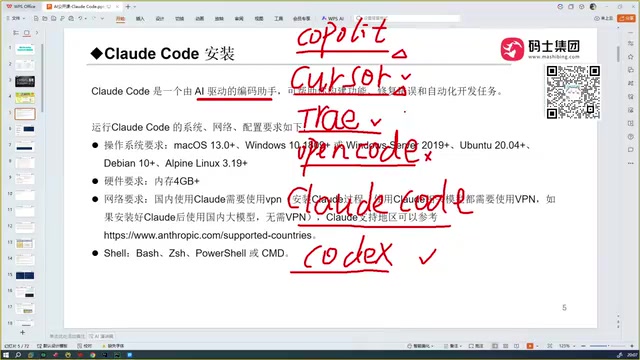
Why Is Claude Code More Powerful? It Comes Down to the Underlying Model
The capability ceiling of any AI coding assistant ultimately depends on the strength of the underlying model. This is the core logic for evaluating these tools.
Claude Code is built on Anthropic's Sonnet model family. Anthropic's model naming system is divided into three tiers by capability and cost: Haiku (lightweight and fast), Sonnet (balanced performance), and Opus (flagship, high-powered). Claude Code defaults to the Sonnet series — the optimal balance of performance and cost. Sonnet consistently ranks near the top of SWE-bench and other authoritative coding benchmarks. SWE-bench specifically tests a model's ability to resolve real GitHub Issues and is currently one of the most reflective benchmarks of actual AI programming capability. Higher-spec Opus models are also available.
By comparison:
- Trae's biggest advantage is that it's free domestically, but its code generation accuracy is somewhat lacking — code quality noticeably drops when dealing with complex logic.
- Codex paired with GPT-5 is equally powerful, and can go head-to-head with Claude Code on coding quality.
- Domestic models like Qwen and GLM are also in the mix, but their overall performance still trails the top-tier tools.
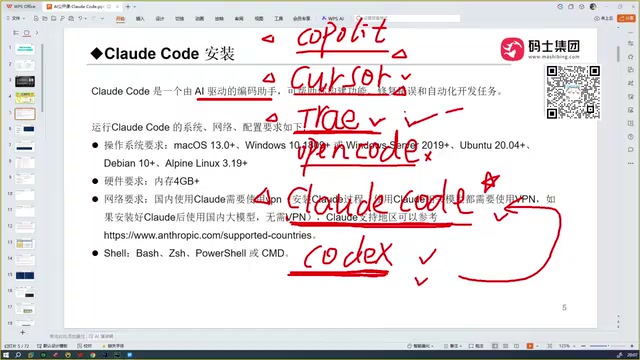
After side-by-side comparisons across multiple models, the overall conclusion is: at the tool level, Claude Code is the best; at the model level, Sonnet and above deliver the strongest results.
Tool Selection Recommendations
For developers with different needs, here are some guidelines:
- Prioritizing accuracy and automated development: Claude Code should be your first choice — full project context understanding and automatic debugging are its core competitive strengths.
- Budget-conscious, primarily working on Chinese-language projects: The free domestic version of Trae is a viable entry-level option, though you should be prepared for some trade-offs in accuracy.
- Deeply embedded in the OpenAI ecosystem: Codex + GPT-5 is another option that matches Claude Code in capability.
- Not recommended: OpenCode scores poorly on usability and offers weak value for money.
It's worth noting that the views in this article are primarily drawn from developers' hands-on experiences and represent personal usage summaries. Actual performance across different projects and tech stacks may vary — it's worth testing against your own specific scenario.
Overall, AI coding assistants are evolving from "snippet completion" toward "full-project automated development," driven by three converging technical trends: expanding context windows, maturing Agent loop mechanisms, and leaps in underlying model capability. Claude Code represents one of the most advanced implementations of this direction today. For developers, getting hands-on with these tools sooner rather than later may well be a necessary step in staying relevant as the industry shifts.
Key Takeaways
Related articles

Disaster and Glory of the Apollo Program: The History We Must Revisit Before Returning to the Moon
From the fatal Apollo 1 fire to Apollo 8's daring lunar orbit to Apollo 11's successful landing—revisiting the disasters, fears, and compromises of the Apollo program and their lessons for today's return to the Moon.

Netflix Trust Exercise Turns Into Firing Trap: Where Are the Boundaries of Corporate Trust?
A Netflix employee was fired after sharing private info in a trust exercise. We analyze the risks of corporate trust exercises and how employees can protect themselves.

AMD CDNA5 Architecture Deep Dive: Technical Evolution and the AI Computing Competition Landscape
Deep analysis of AMD's CDNA5 architecture covering Chiplet packaging upgrades, HBM memory evolution, and low-precision compute optimization, examining how AMD challenges NVIDIA's AI chip dominance.