Getting Started with Claude Code: Why It's More Powerful Than Cursor and Other Tools

Claude Code outperforms Cursor and other AI coding tools through superior agentic programming and code accuracy.
This guide explores Claude Code's agentic programming capabilities, comparing it with tools like Cursor, TRAE, GitHub Copilot, and OpenAI Codex. Claude Code stands out by reading entire project codebases, automatically debugging, and leveraging Claude Sonnet's powerful 200K-token context window to deliver highly accurate code — making it the strongest AI programming assistant available today.
What Is Claude Code: A Revolutionary AI Programming Assistant
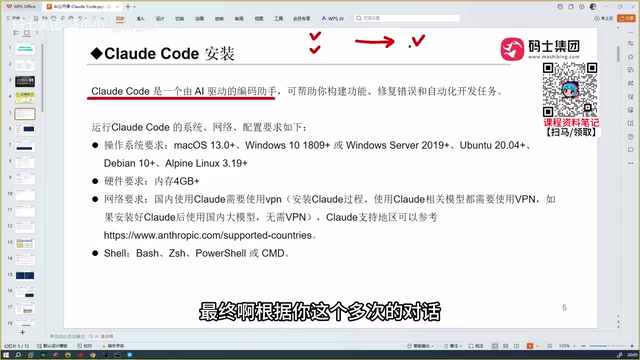
Claude Code is an AI programming assistant developed by Anthropic. Its biggest feature is that you don't need to log into any website — you simply install it on your local machine and start using it. Once installed, you can call it directly within your development environment to work on projects, making the entire workflow remarkably streamlined.
Anthropic was founded in 2021 by former OpenAI core members Dario Amodei and Daniela Amodei, siblings who built an AI safety company focused on creating reliable, interpretable, and controllable AI systems. Claude Code is Anthropic's key product for extending its large model capabilities into the developer toolchain, representing the company's strategic shift from "model provider" to "developer ecosystem builder."
It has certain operating system requirements, but most mainstream systems are supported. For developers in China, there are relatively mature paths from installation to practical use, which is a key focus of this article.
Don't underestimate this tool — its capabilities are remarkably powerful, which is the core reason it has rapidly gained popularity in the developer community.
Conversational Coding vs. Agentic Coding: What's the Fundamental Difference
Many people's first experience with AI-assisted programming starts with conversational tools like DeepSeekAd or ChatGPT. But Claude Code is fundamentally different from these. This difference isn't just about features — it represents a paradigm shift in AI programming, a leap from Conversational Coding to Agentic Coding.
Agentic coding is based on the core concept of AI Agents: AI is no longer a passive "consultant" answering questions, but an "executor" capable of autonomously planning tasks, invoking tools, and interacting with the environment. Technically, this relies on the ReAct (Reasoning + Acting) framework, where AI reasons about the current state at each step before deciding the next action — such as reading a file, executing a terminal command, or running test cases — forming a complete "observe-think-act" loop until the task is complete.
The Limitations of Conversational Coding
When you open DeepSeek or ChatGPT for conversational coding, it typically only gives you a code snippet. After getting the snippet, you need to go back to your project, manually run it, test it, and verify whether it actually works. If it doesn't, you have to return to the conversation and go through multiple rounds of back-and-forth before arriving at a relatively correct version.
More critically, these tools cannot read through your entire project. If your project has 100 code files, they can't access that context — you have to manually copy and paste relevant content, telling it "here's what I have, here's what I need." This process is both tedious and inefficient.
The root cause of this limitation lies in the architectural design of conversational AI — it operates on a "request-response" model with no file system access and no ability to execute terminal commands. Everything it knows is limited to what you tell it in the chat box.
Claude Code's Agentic Programming Capabilities
Claude Code takes a completely different approach. It can read through all the code files in your project and feed them as context to the underlying large model, which then generates the business code you need.
The key technical foundation for this capability is the large model's long context window. The Claude Sonnet series supports context lengths of up to 200K tokens, meaning it can process approximately 150,000 words at once — equivalent to the information from hundreds of code files. By comparison, early GPT-3.5 had only a 4K token context window, making it impossible to understand a complete project's code structure. The expansion of context windows, combined with techniques like Retrieval-Augmented Generation (RAG), has enabled AI programming assistants to evolve from "reading a code snippet" to "understanding an entire codebase."
Furthermore, it can automatically debug — running your code in the project environment, automatically identifying errors, and ultimately delivering an accurate, error-free code version. This is truly automated programming capability, not just delivering an isolated code snippet. This is also why many programmers feel a "deep sense of crisis" after using it.
The Evolution of AI Programming Tools
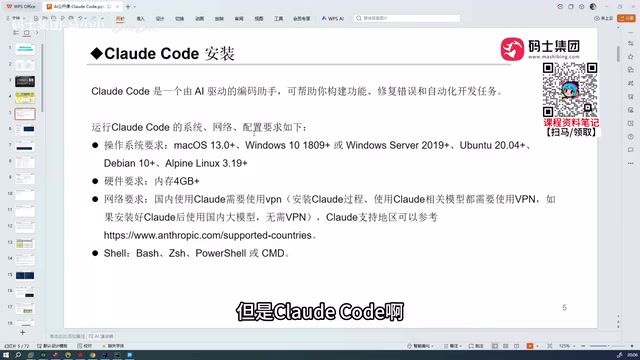
Before Claude Code, AI programming assistants had already gone through several iterations. Here's an overview of this evolutionary path.
From GitHub Copilot to Cursor
-
GitHub Copilot: The earliest representative of AI programming assistants, widely adopted around 2023. Its ability to auto-complete code felt deeply disruptive to developers at the time. Copilot was initially based on OpenAI's Codex model (a code-fine-tuned version of GPT-3) and later upgraded to a GPT-4-based version. Its core working mode is "inline completion" — predicting what developers are about to write in real-time and offering suggestions. Copilot's training data came from public code repositories on GitHub, which also sparked widespread discussions about code copyright and license compliance. While Copilot pioneered AI-assisted programming, it was essentially still an "auto-complete" tool, lacking the ability to understand projects holistically or execute tasks autonomously.
-
Cursor: A subsequent programming tool considered smarter than Copilot. Cursor can automatically write code, with capabilities comparable to Claude Code, though it's a paid product. Cursor is an AI-native IDE built as a VS Code fork, developed by Anysphere. Its core philosophy is to deeply embed AI capabilities into the editor itself rather than as a plugin. Cursor supports multiple underlying models (including Claude, GPT-4, etc.) and offers advanced features like Composer for cross-file editing, Tab completion, and codebase semantic indexing. Cursor uses a subscription pricing model, with the Pro version at approximately $20/month. The fundamental difference from Claude Code is that Cursor provides a graphical IDE experience, while Claude Code is a command-line terminal tool — the latter being better suited for developers who prefer terminal workflows.
TRAE and OpenCode
-
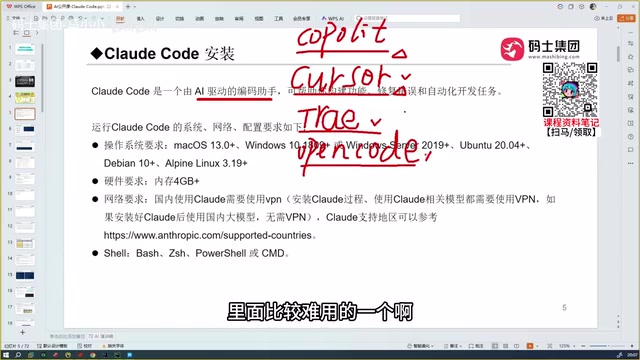
TRAE: An AI programming tool launched by ByteDance, available in international and domestic versions. Chinese developers are recommended to use the domestic version since the international version requires payment. TRAE has been optimized for Chinese programmers with localization, offering excellent Chinese language understanding, making it one of the best free programming tools available. TRAE (full name: Trae AI) is also deeply customized based on VS Code. The domestic version primarily relies on ByteDance's in-house Doubao large model, which has inherent advantages in Chinese semantic understanding due to the large volume of high-quality Chinese data in its training corpus. The international version connects to overseas models like Claude and GPT. TRAE's launch represents an important step in ByteDance's AI developer tool strategy, forming an ecosystem synergy with its cloud service platform Volcengine.
-
OpenCode: Also an AI programming tool, but in practice considered "one of the harder ones to use" among all available options.
Claude Code and OpenAI Codex
Beyond the above tools, there's also OpenAI's Codex. Paired with GPT-series models, Codex's programming capabilities theoretically rival Claude Code, though in actual experience it hasn't surpassed Claude Code's overall performance. It's worth noting that the Codex referenced here is OpenAI's cloud-based programming agent product launched in 2025 (not the earlier Codex model used to train Copilot). It runs on the codex-mini model, supports automatic code task execution in cloud sandbox environments, and represents OpenAI's direct competitive response to Anthropic's Claude Code.
Why Claude Code Is the Most Powerful AI Programming Tool
After horizontal comparison across multiple tools, the conclusion is clear: Claude Code is the most powerful AI programming tool in terms of overall performance.
Core Competitiveness Lies in the Underlying Model
The capabilities of all AI programming assistants ultimately depend on the power of the underlying large model. Claude Code is powerful precisely because the Claude Sonnet model behind it is powerful enough.
This assessment has a solid technical foundation. AI programming tools are essentially application-layer products built on top of large models — their code generation quality, logical reasoning accuracy, and multi-step task planning capabilities are all directly constrained by the underlying model's performance. On SWE-bench (Software Engineering Benchmark, a standardized software engineering capability evaluation benchmark), the Claude Sonnet series has consistently maintained leading scores. SWE-bench collects real GitHub Issues and tests whether AI can autonomously locate problematic code and submit correct fixes, making it one of the authoritative indicators for measuring AI programming tools' actual capabilities. As of now, Claude Sonnet 4's solve rate on this benchmark far exceeds most competitors, directly explaining Claude Code's excellent performance in real-world usage.
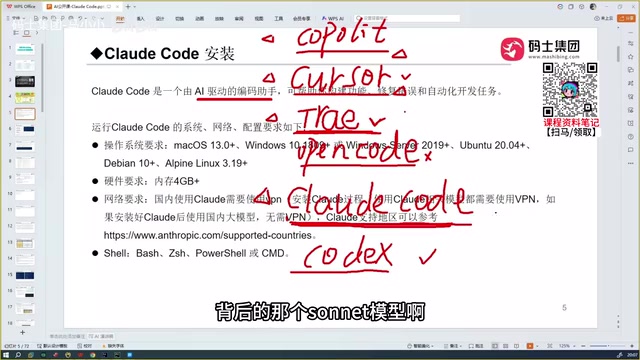
After comparing with domestic tools like TRAE, Tongyi, and various mainstream models, Claude Code's overall performance in code generation quality and logical understanding remains the most outstanding.
Accuracy Is Claude Code's Greatest Advantage
While Claude Code, Cursor, and TRAE can all achieve automated programming, Claude Code's core advantage lies in code accuracy.
TRAE's strengths are being free and having good Chinese understanding — in most cases, the code it produces is accurate. However, when encountering slightly niche technical requirements, its code quality noticeably declines. In contrast, Claude Code maintains high accuracy even in complex scenarios, putting it a tier above other tools.
This gap is particularly evident in real development: when projects involve complex asynchronous processing, multi-module coupling, edge case handling, or relatively niche technical frameworks, the underlying model's reasoning depth and code comprehension become the decisive factors. Claude Sonnet's "first-pass rate" in these high-difficulty scenarios — the probability that the first-generated code runs correctly — is significantly higher than competitors, greatly reducing developers' debugging time and communication costs.
How to Choose the Right AI Programming Assistant for You
From this evolutionary path, we can see that AI programming tools are evolving from "code snippet generators" to "programming agents that can read entire projects and debug automatically." For Chinese developers:
- If you want something free with great Chinese language support, the domestic version of TRAE is a good starting point;
- If you pursue ultimate accuracy and automation, Claude Code is worth serious consideration;
- If you're already accustomed to IDE-integrated experiences, Cursor is also a worthy paid option to consider.
It's worth noting that actual performance may vary across different projects and tech stacks — it's recommended to verify based on your own scenarios. Ultimately, choosing the right AI programming tool is about choosing the right powerful large model behind it.
Additionally, the AI programming tool landscape is still changing rapidly. As model capabilities continue to iterate across companies, today's "strongest tool" may not be tomorrow's answer. What developers need to focus on more is the model update frequency behind the tool, community ecosystem activity, and compatibility with their own workflows. True core competitiveness always remains in the hands of developers who understand business requirements, architecture design, and engineering judgment — AI programming tools are amplifiers, not replacements.
Related articles

Chain of Thought Isn't Just for AI: How Humans Can Use CoT to Improve Thinking Quality
Chain of Thought isn't just a prompt trick for large models. Starting from a Hacker News discussion, this article analyzes why CoT works for human thinking too, breaks down actionable ways to transfer it, and highlights the key differences between human CoT and machine CoT.
Cloudflare Teams Up with OpenAI: Closi…
Cloudflare Teams Up with OpenAI: Closing the Loop from Vulnerability Discovery to Defense with AI
Cloudflare uses OpenAI Daybreak to investigate security vulnerabilities and generate reviewable remediation plans, while developers use Codex to boost coding efficiency and quality.

Orca Multi-Agent Orchestration in Practice: A Guide to Parallel Collaboration with Claude and Codex
Orca is Stable AI's free open-source agent workbench supporting 34 agents like Claude Code and Codex in parallel. Learn its Git worktree isolation, multi-model orchestration, and mobile management.