Getting Started with Codex and Claude Code: A Beginner's Guide to AI Coding Agents

A beginner's guide comparing Codex and Claude Code AI coding agents with practical setup advice.
This guide explains what AI coding agents like Codex and Claude Code are, how they differ from traditional LLMs, and why they matter for both programmers and non-programmers. It covers practical tool selection considerations, common setup barriers, and provides a step-by-step learning path focused on transferable workflows rather than tool-specific knowledge.
What Are AI Coding Agent Tools
If you've been following the AI programming space recently, you've surely heard terms like Codex and Claude Code. They're typically categorized as Vibe Coding tools, or more precisely, AI Agent tools.
The concept of Vibe Coding was coined by OpenAI co-founder Andrej Karpathy in early 2025, describing a completely new programming paradigm: developers only need to describe the functionality they want in natural language, then let AI handle the actual code writing. This stands in stark contrast to traditional programming where developers must precisely control every line of code — the developer's role shifts from code writer to requirements describer and quality gatekeeper.
Many people confuse these tools with traditional large models, but there's a fundamental difference. Here's a helpful analogy: if large models (like GPT or Claude's conversational models) are equivalent to a brain that can only think and offer suggestions, then tools like Codex and Claude Code are like adding hands and feet to that brain — they can not only think but actually execute tasks for you, such as reading and writing files, running code, and debugging programs.
From a technical architecture perspective, AI Agents represent the core paradigm shift in artificial intelligence in recent years. Traditional Large Language Models (LLMs) are essentially text generation systems — they receive input and produce output but cannot interact with external environments. The Agent architecture adds tool use, environmental awareness, and autonomous planning capabilities on top of LLMs. Agents typically follow a "perceive-plan-execute-feedback" loop: they can read the file system state, formulate multi-step plans, invoke terminal commands or APIs to perform operations, then adjust their next actions based on execution results. This architecture upgrades AI from an "advisor" role to an "executor" role.
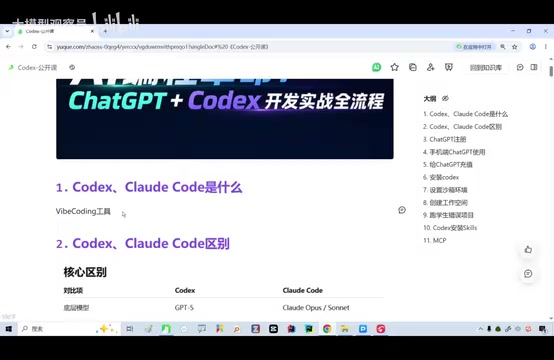
This distinction is crucial. In the traditional model interaction mode, you need to copy and paste code into a dialog box, and after the model responds, you manually apply it to your project. AI coding agent tools, however, bridge the complete chain from thinking to execution, operating directly within your development environment.
Why Focus on Comparing Codex and Claude Code
There are actually quite a few AI coding tools on the market, but at the beginner stage, it's recommended to focus on Codex and Claude Code. The reason is straightforward: among the developer community, these two are the most widely used, first-tier tools.
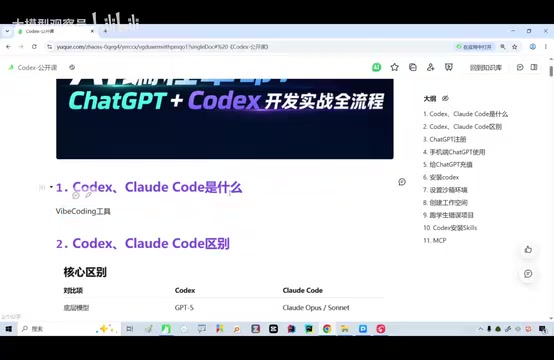
Specifically, Codex is OpenAI's AI coding agent product, built on their latest reasoning models (such as codex-1), capable of independently completing code writing, testing, and debugging tasks in a cloud sandbox environment. Claude Code is Anthropic's command-line AI coding tool, built on the Claude model series, running directly in the developer's local terminal with access to project files, shell commands, git, and other development tools. The core difference lies in the execution environment: Codex uses a cloud-based asynchronous execution model, suitable for submitting tasks and waiting for results; while Claude Code uses a local real-time interactive model, suitable for immediate conversational development.
In practice, Codex and Claude Code represent the mainstream direction of current AI coding agents. Their capabilities are powerful enough to independently complete the full development workflow from requirements understanding to code writing to debugging and execution. For beginners, rather than agonizing over numerous tools, it's better to master these two mainstream products first — the usage logic of other tools is largely similar.
Practical Considerations for Tool Selection
Regarding AI coding tool selection, one noteworthy perspective is: foreign models are currently somewhat ahead of domestic Chinese ones, but this gap is closing rapidly.
As of mid-2025, for code generation and programming reasoning tasks, OpenAI's GPT series and Anthropic's Claude series still lead on authoritative benchmarks like SWE-bench (Software Engineering Benchmark). SWE-bench is a test set simulating real GitHub Issues fix tasks, regarded by the industry as the gold standard for measuring AI programming capability. However, Chinese companies like DeepSeekAd, Zhipu, and Alibaba's Tongyi are catching up rapidly — especially open-source models like DeepSeek-R1, which have demonstrated extremely strong competitiveness in reasoning capabilities. The industry generally expects that within 12-18 months, the model capability gap in programming will narrow further, at which point tool ecosystem, usage costs, and localization services will become more important competitive dimensions.
It's foreseeable that as domestic large models catch up, the differences in tool choice will become increasingly smaller. At that point, the core selection factor will likely become cost — whichever is cheaper and offers better value wins.
This reminds us that when learning AI coding tools, the focus should be on mastering usage methods and workflows, rather than binding yourself to any specific product. Tools will iterate and be replaced, but the underlying usage logic and thinking approach are transferable.
Who Needs to Learn AI Coding Agent Tools
A common misconception is that AI coding tools are exclusively for programmers. The reality is quite the opposite.
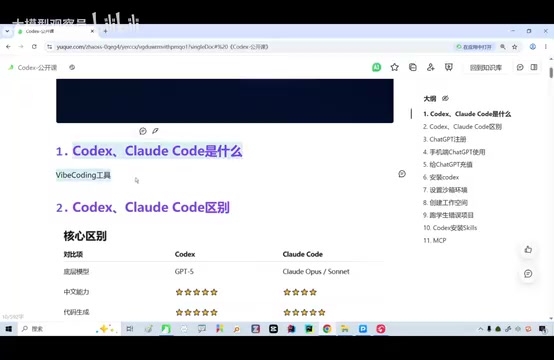
Whether you're a programmer or not, tools like Codex and Claude Code are worth mastering. Even if you can't write a single line of Java or Python, it doesn't affect your ability to use these tools. This is the biggest revolution brought by AI agent tools — they dramatically lower the barrier to programming.
This is possible because the interaction mode of these tools is essentially natural language conversation. You don't need to memorize programming syntax, you don't need to understand the underlying implementation of data structures — you only need to clearly describe "what I want." The AI agent will automatically translate your intent into code and independently debug when encountering issues. This model is referred to in the industry as "Intent-Driven Development," allowing non-technical people to participate in the software development process.
For non-programmers, even if you don't plan to develop software, at minimum configuring a GPT for daily research and information queries is extremely valuable. For those with some technical background, these tools can significantly boost development efficiency, letting you focus your energy on higher-level design and creativity.
It's fair to say that in the current AI era, mastering AI coding agent tools is becoming an essential skill for everyone in the industry.
Main Barriers for Beginners Getting Started with Codex and Claude Code
Many people want to use Claude Code or Codex but keep putting it off. The problem often isn't that the tools themselves are difficult, but rather the prerequisite configuration steps:
- Account login: How to register and log into the relevant accounts
- Download and installation: Downloading the tools and setting up the local environment
- API configuration: How to configure interfaces for models like GPT
The API configuration step is particularly worth explaining. API (Application Programming Interface) in the context of AI coding tools refers to the communication bridge connecting local tools with cloud-based AI models. When you use Claude Code or similar tools, your natural language instructions need to be sent via API to Anthropic's or OpenAI's servers, processed by the cloud model, and then results are returned. API configuration typically involves obtaining an API Key (a unique authentication key string), setting environment variables (a way to store configuration information in the operating system), selecting model versions, and other steps. API calls are usually billed per token (the basic unit of text processing, roughly equivalent to 0.75 English words or 0.5 Chinese characters), which is the main source of usage costs.
These seemingly basic steps are precisely what blocks most newcomers. Once these steps aren't clarified, many people give up at the onboarding stage. Therefore, for zero-foundation learners, figuring out these configuration processes step by step is more critical than rushing to write code.
Recommended Learning Path for AI Coding Agents from Scratch
Overall, learning AI coding agent tools like Codex and Claude Code can follow this path:
- Understand the concepts first: Clarify the difference between agent tools and regular large models, and establish a correct cognitive framework. Understanding the Agent's "perceive-plan-execute-feedback" work cycle will help you collaborate with tools more effectively.
- Get the environment configured: Patiently resolve prerequisite issues like accounts, installation, and API configuration. It's recommended to follow official documentation step by step, and use search engines and community forums when encountering problems.
- Start with mainstream tools: Choose the most widely used tools like Codex or Claude Code for practice. Start with simple tasks initially — for example, have the AI write a small script or modify a configuration file — and gradually build confidence.
- Focus on workflow transferability: Master universal usage logic rather than memorizing operations for a specific tool. Core skills include: how to accurately describe requirements, how to provide context information, how to verify AI-generated results, and how to iteratively optimize output.
- Stay tool-agnostic: As technology iterates, flexibly choose solutions with better value. Today it's Codex and Claude Code; tomorrow there may be more powerful alternatives, but the usage experience and work methodology you've accumulated will remain valid.
For those with zero background, as long as you've clarified the basic concepts and configuration process, hands-on practice is entirely achievable. The era of AI coding tools has arrived — the sooner you get started with Codex and Claude Code, the more proactive you'll be in this technology wave.
Key Takeaways
Related articles

How Big Can Stars Really Get? The Physical Limits of the Largest Stars
Red supergiants are the largest stars by volume, with radii up to 2,000 times the Sun, engulfing the inner solar system. But there is no precise upper limit on stellar size—models predict up to 15,000 solar radii. The most massive blue stars are far smaller than red supergiants—biggest and heaviest are two different things.

Apple HomeView Smart Display Full Feature Breakdown: Wall-Mount or Desktop, $299
Apple launches HomeView, a $299 smart display with wall-mount and desktop options, 12MP camera for facial recognition, smart home control, music playback, and recipe step-by-step cooking. Full breakdown of watch faces, apps, privacy, and cooking integration.

Where Did the Promised New Studio Go? Craft Computing Answers After Five Years
Craft Computing's host responds to viewer questions: the new studio promised five years ago was shelved as construction costs soared from $30,000 to $75,000, and was replaced by a 168-square-foot garage conversion.