Getting Started with Coze AI Agents: A Zero-Code Guide to AI App Development
Coze lowers the barrier to AI app development with zero-code drag-and-drop and a rich ecosystem, ideal for quickly building small agents.
The article introduces Coze, ByteDance's one-stop AI app development platform. Via visual drag-and-drop and natural language code generation, non-programmers can quickly build LLM-based agents. Its three advantages are a very low development barrier, ecosystem integrations like plugins and RAG, and enterprise features such as team collaboration. It compares the domestic vs. international versions (language and available models), noting the international version offers stronger models like GPT and Gemini but needs a VPN, while the domestic version suits beginners. It also clarifies the difference between agents (Bot, conversational) and apps (App, with a full interface and business logic, still in Beta), and notes Coze is best for professionals implementing small AI scenarios, while large enterprise projects still have limitations.
The Coze platform, launched by ByteDance, is changing the way AI applications are developed. The core goal of this one-stop development platform is to lower the barrier to AI application development, enabling non-programmers to build large language model–based agents through drag-and-drop operations.
The Core Positioning of the Coze Platform
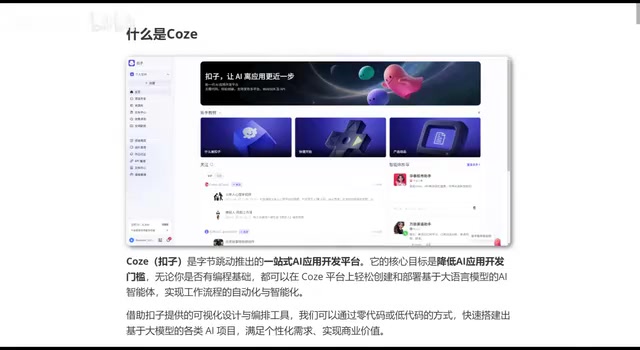
Coze is a one-stop AI application development platform under ByteDance, and its core value lies in turning AI capabilities into tools and democratizing them. Through visual design and orchestration tools, the platform supports the rapid building of various AI projects in a zero-code or low-code manner.

For programmers, Coze is better suited to developing small AI applications for life and work; for non-technical people, it opens the door to directly using large model capabilities. For example, a travel consultant can create an itinerary planning agent that, after entering the client's requirements and number of days, generates a complete itinerary within 10 seconds, replacing the original 10–30 minutes of manual writing.
Analysis of Three Core Advantages
Extremely Low Development Barrier
Coze's signature feature is its visual drag-and-drop and natural language development paradigm. When code is needed, users can describe requirements in Chinese or English, and the platform automatically generates the code, allowing users without a programming background to quickly build AI applications.
Low-code / No-code refers to a development approach that replaces handwritten code with visual configuration. No-code emphasizes completing the build entirely through dragging components and filling out forms, targeting business users; low-code retains room for writing a small amount of scripts or expressions on top of the visual foundation, balancing flexibility and efficiency. Such platforms usually come with built-in forms, processes, data connectors, and other prefabricated modules, letting developers focus on business logic rather than underlying implementation. Coze's drag-and-drop orchestration and natural language code generation are exactly the extension of this concept into the field of AI applications.
Powerful Ecosystem and Integrations
The platform integrates a rich plugin system that can easily connect to external APIs such as Feishu and Amap. It also supports a variety of mainstream large language models and provides a knowledge base feature (RAG), making it convenient to incorporate private data into agents.
RAG (Retrieval-Augmented Generation) is a technical paradigm that combines an external knowledge base with a large language model. Its basic process is: first split private documents (such as product manuals and customer service Q&As) into chunks and convert them into vectors stored in a vector database; when a user asks a question, the system first retrieves the most relevant chunks, then feeds these chunks as context into the large model, letting the model generate an answer based on these factual materials. Compared with directly fine-tuning the model, RAG requires no retraining, and updating knowledge only requires replacing documents—it is low-cost and traceable, and can effectively alleviate the hallucination problem of large models "making things up," which is why it has become the mainstream solution for enterprises to connect private data to agents.
Enterprise-Grade Solutions
Coze supports team collaboration, permission management, and version control, providing full-chain services from development and testing to deployment and monitoring. However, it should be objectively noted that enterprise-grade solutions are still incomplete, and developing large AI projects still has limitations; the platform's advantages are mainly reflected in the rapid development of small projects.
Differences Between the Domestic and International Versions
Coze is divided into a domestic version (coze.cn) and an international version (coze.com), with the main differences being language and available models. The domestic version has a Chinese interface and can use models such as Doubao, DeepSeekAd, Kimi, and Jieyue Xingchen; the international version has an English interface and requires a VPN to access, and can use GPT series, Gemini series, and DeepSeek series models.
In terms of model capability, models callable in the international version such as GPT-4o and GPT-5 are still in the strongest tier, so agents developed in the international version are more capable. But the domestic version requires no special network environment and has a low learning cost due to its Chinese interface, making it suitable for domestic users to get started.
The Difference Between Agents and Apps
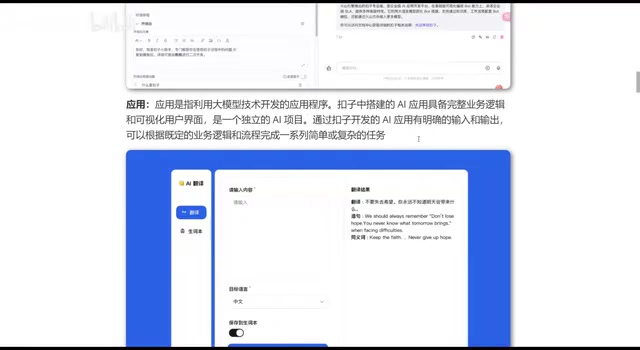
On the Coze platform, an agent (Bot) is a conversation-based AI project that receives user input through a question-and-answer format, automatically calls plugins or workflows to execute tasks, and generates replies. An app (App), by contrast, is an independent AI project with complete business logic and a visual interface, with clear front-end pages and input/output—for example, a translation tool: enter content, click translate, and directly call the large model to output the result, with no need for conversational interaction.
Interestingly, Coze calls AI agents Bot (robot) within the platform; in essence, a Bot is just an AI Agent—only the naming differs. Currently, the app creation feature is still in Beta testing.
AI Agent refers to a system that uses a large language model as its "brain" and can autonomously understand goals, plan steps, call external tools, and adjust subsequent actions based on execution results. Its difference from mere conversational Q&A lies in its ability to act: it can call tools such as search, databases, and code execution, and break complex tasks into multiple steps to complete them in sequence. Common implementation approaches include ReAct (alternating reasoning and action), Function Calling, and multi-agent collaboration. The Bot in Coze is exactly the productized encapsulation of this concept—by configuring prompts, plugins, and workflows, users can combine an Agent with specific capabilities.
Who Should Learn This
The Coze course is suitable for professionals who want to quickly put AI into concrete scenarios, rather than engineers pursuing large-scale system development. Mastering Coze means being able to validate AI ideas at the lowest cost and hand repetitive work over to agents. The course ultimately guides learners to create an application instance, completing the full practice from agent to app.
One-line Summary
Coze lowers the barrier to AI application development with zero-code drag-and-drop and a rich ecosystem, making it suitable for quickly building small agents.
Paragraph Summary
The article introduces the positioning and capabilities of Coze, a one-stop AI application development platform under ByteDance. Through visual drag-and-drop and natural language code generation, the platform enables non-programmers to quickly build large language model–based agents. Its three major advantages are an extremely low development barrier, ecosystem integrations such as plugins and RAG, and enterprise-grade features such as team collaboration. The article compares the domestic and international versions in terms of language and available models, noting that the international version can call stronger models such as GPT and Gemini but requires a VPN, while the domestic version is more suitable for beginners. It also clarifies the difference between agents (Bot, conversational) and apps (App, with a complete interface and business logic, still in Beta), and explains that Coze is better suited for professionals to quickly implement small AI scenarios, while large enterprise-grade projects still have limitations.
Related articles
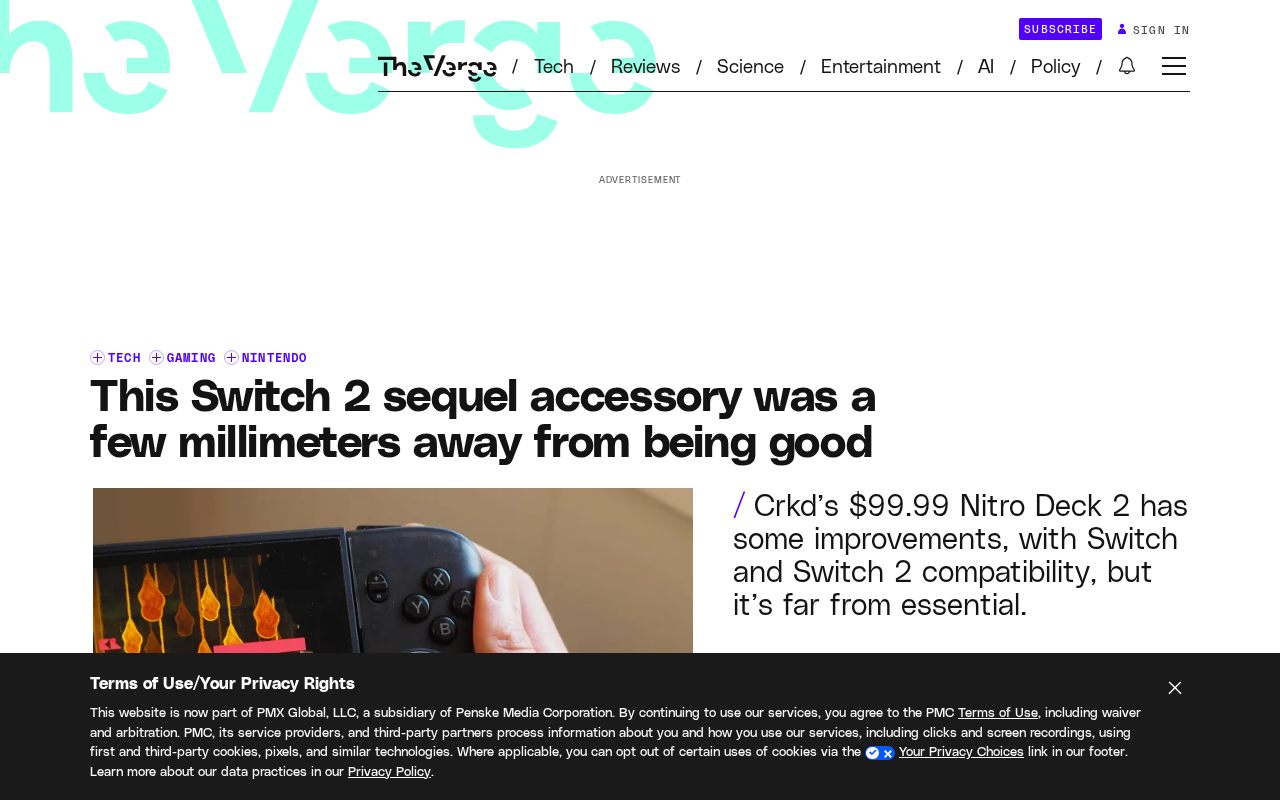
Switch 2 Accessory Review: Nitro Deck 2 Is a Few Millimeters Short of Perfect
CRKD Nitro Deck 2 review: this Hall Effect stick accessory for Switch 2 and the original Switch continues the original's legacy, but falls a few millimeters short of perfect due to size fit issues.
Apollo Economist: AI Delivers Zero Financial Return for Most Companies
Apollo Chief Economist Torsten Slok says AI has delivered near-zero financial return to U.S. companies outside tech. We analyze the adoption gap and investment implications.
Instagram Officially Launches on Apple TV, Ushering in the Era of Reels on the Big Screen
Instagram officially launches its Apple TV app, letting users watch Reels short videos and livestreams on the big screen. This article analyzes the evolution of Instagram's TV strategy, product challenges, and the impact on creators and users.