Getting Started with Deep Learning: A Complete Guide to Free Learning Resources and Roadmap

A complete free learning roadmap for transitioning from machine learning to deep learning.
This guide helps learners with machine learning backgrounds systematically transition to deep learning using free resources. It covers foundational courses (Andrew Ng, CS231n, CS224n, MIT 6.S191), free textbooks, hands-on frameworks (PyTorch, fast.ai), and practice platforms (Kaggle, Google Colab), with a step-by-step roadmap from theory to real-world projects.
From Machine Learning to Deep Learning: A Natural Progression
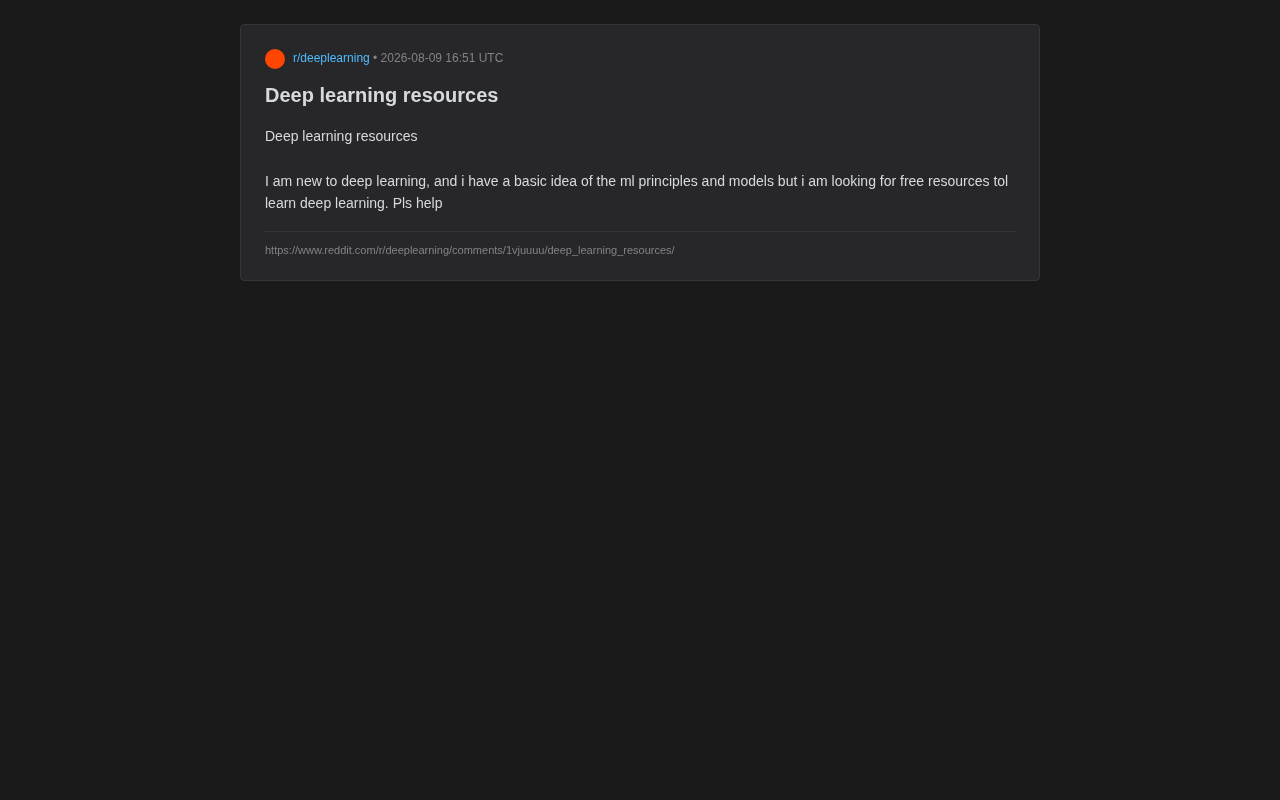
Recently on Reddit, I saw a learner raise a question that many beginners share: having already mastered the basic principles and common models of machine learning (ML), they want to systematically learn deep learning (Deep Learning) but don't know where to start with free resources.
This is a very typical learning path question. Deep learning, as a subfield of machine learning, shares many foundational concepts (such as loss functions, gradient descent, overfitting, etc.), but it has its own unique knowledge system — neural network architectures, backpropagation, convolutional networks, recurrent networks, Transformers, and more.
Fundamentally, the core difference between deep learning and traditional machine learning lies in how features are learned. Traditional machine learning methods (such as support vector machines, random forests, logistic regression) typically rely on manually designed feature engineering — where domain experts manually extract and select input features. Deep learning, through multi-layer neural networks, automatically learns hierarchical feature representations from raw data, progressively abstracting from low-level features (like edges and textures) to high-level semantic features (like object parts and complete concepts). This end-to-end learning capability has enabled quantum leaps in image recognition, speech processing, natural language understanding, and other fields. AlexNet's breakthrough performance in the 2012 ImageNet competition marked the true beginning of the deep learning era.
The good news is that high-quality free learning resources are now extremely abundant — even more systematic and cutting-edge than many paid courses. This article outlines a learning path from beginner to advanced, helping learners with an ML background efficiently dive into deep learning.
Deep Learning Theory Foundations: Classic Courses and Textbook Recommendations
Video Courses
For learners with an ML background, the most recommended starting point is Andrew Ng's Deep Learning Specialization. While full certification requires payment, course videos can be watched for free on YouTube and through Coursera's audit mode. This course series progresses from neural network basics to convolutional networks and sequence models, with clear explanations, and is globally recognized as the top choice for deep learning beginners.
Backpropagation, repeatedly emphasized in the course, is the core algorithm for training neural networks. It is essentially the systematic application of the chain rule on computational graphs. During forward propagation, input data passes through the network layer by layer to produce predicted outputs; backpropagation starts from the loss function at the output layer and uses the chain rule to compute each parameter's gradient contribution to the loss, layer by layer in reverse. These gradients are then used for gradient descent optimization, updating network weights to minimize the loss. Backpropagation is efficient because it avoids the enormous computational cost of calculating gradients for each parameter individually, reducing complexity from exponential to linear through the reuse of intermediate results. Understanding backpropagation is the foundation for understanding all deep learning training processes.
Another must-not-miss resource is Stanford's CS231n (Computer Vision) and CS224n (Natural Language Processing) — both courses have their lecture notes, assignments, and recorded videos freely available on their official websites. CS231n's coverage of convolutional neural networks is particularly in-depth, making it ideal for learners who want a solid understanding of the underlying principles.
Additionally, MIT 6.S191 (Introduction to Deep Learning) is updated annually, keeps pace with the frontier, and has all videos and slides openly available. It's compact and well-suited for quickly building a holistic understanding of deep learning. In recent years, the course has significantly expanded its coverage of the Transformer architecture — proposed in 2017 by a Google team in the paper "Attention Is All You Need." This architecture completely abandoned the recurrent structures (RNN/LSTM) that previously dominated sequence modeling, instead relying entirely on Self-Attention mechanisms to capture dependencies between any positions in a sequence. Self-attention allows the model to attend to all other positions in a sequence simultaneously when processing each element, solving the problem of long-range dependencies being difficult to propagate in RNNs. More importantly, the parallel computation properties of Transformers make their training efficiency far superior to RNNs. This architecture has not only revolutionized NLP (giving rise to BERT, the GPT series) but has also been successfully applied to computer vision (Vision Transformer), protein structure prediction (AlphaFold2), and many other fields, becoming the cornerstone architecture of modern AI.
Free Deep Learning Books
On the theoretical side, "Deep Learning" by Ian Goodfellow et al. (commonly known as the "flower book") is available for free online reading on its official website and is the authoritative textbook in the deep learning field. Michael Nielsen's "Neural Networks and Deep Learning" explains neural networks and backpropagation in an intuitive way, making it excellent for beginners to build intuition.
Hands-On Practice: Deep Learning Frameworks and Coding Training
Deep learning is a highly practice-dependent discipline — theory alone is far from sufficient. It's recommended to practice coding simultaneously while learning theory.
Choose a Mainstream Deep Learning Framework
The two major deep learning frameworks today are PyTorch and TensorFlow/Keras. For beginners, PyTorch has a relatively gentle learning curve due to its Python-native syntax and flexible debugging approach, and it is the mainstream choice in academia and research.
These two frameworks represent different design philosophies. PyTorch (developed by Meta/Facebook) uses dynamic computational graphs (Define-by-Run), meaning the graph is constructed on-the-fly during code execution, making debugging as intuitive as any regular Python program — you can use standard print statements and breakpoints. TensorFlow (developed by Google) initially used static computational graphs (Define-and-Run), requiring the complete graph to be defined before execution. Although TensorFlow 2.0 enabled Eager Execution by default, PyTorch has already established a significant advantage in the research community. According to statistics, over 80% of papers at top AI conferences in 2023 used PyTorch implementations. However, TensorFlow still holds advantages in industrial deployment, with its TensorFlow Serving and TensorFlow Lite ecosystem providing mature solutions for production deployment and mobile inference.
- PyTorch Official Tutorials: The official website provides complete beginner tutorials from tensor operations to model training, with runnable code.
- fast.ai Course: "Practical Deep Learning for Coders" taught by Jeremy Howard uses a "top-down" teaching approach, letting you run models and see results first, then gradually dive deeper into the principles. This approach is very friendly for learners eager to get hands-on, and it's completely free.
fast.ai was founded by Jeremy Howard and Rachel Thomas, and its teaching philosophy challenges the traditional "theory first, practice later" model. Howard believes that most people are motivated to understand underlying principles only after seeing concrete results, so the fast.ai course has students training a near-state-of-the-art image classifier from the very first lesson. This approach draws from language acquisition theory — people learn to use language before learning grammar rules. The course uses the fast.ai library (a high-level API built on top of PyTorch), encapsulating common deep learning best practices into concise interfaces, but progressively "unwraps" these abstraction layers as the course advances until students can implement core components from scratch. This teaching method is particularly suitable for learners with programming experience who want to produce results quickly.
Deep Learning Practice Platforms
- Kaggle: Not only provides free GPU compute, but also has massive datasets and beginner competitions. By participating in real projects, you can quickly transform deep learning theory into engineering capabilities.
Kaggle is the world's largest data science competition platform (acquired by Google in 2017), but its value extends far beyond competitions themselves. For deep learning learners, Kaggle's core value includes: free GPU computing resources (approximately 30 hours of P100 GPU time per week), over 200,000 public datasets, and most critically — community knowledge sharing. After each competition ends, top competitors typically publish their solutions and code (called Notebooks/Kernels), providing real-world experience that no textbook can replace. By reading winning solutions, learners gain insight into data preprocessing techniques, model ensemble strategies, learning rate scheduling, data augmentation, and other engineering details that are crucial in real scenarios but rarely covered in textbooks.
- Google Colab: A free cloud-based Jupyter environment with built-in GPU/TPU support, allowing you to run deep learning code without any local setup — an ideal tool for practice.
Recommended Learning Roadmap for Deep Learning Beginners
Combining the resources above, here's a recommended learning path for beginners with an ML background:
- Build the Framework: Spend 1-2 weeks on the first few courses of Andrew Ng's Deep Learning Specialization to quickly understand neural networks and backpropagation.
- Get Hands-On: Simultaneously study fast.ai or PyTorch official tutorials, and implement your first neural network on Colab.
- Dive into Specializations: Choose a direction based on interest — CS231n for computer vision, CS224n for natural language processing.
- Consolidate with Practice: Join beginner competitions on Kaggle and test what you've learned with real data.
- Track the Frontier: Read classic papers (such as ResNet, Attention Is All You Need) and gradually transition to the research level.
During the frontier-tracking phase, ResNet (Residual Network) is essential reading. Proposed by Kaiming He et al. in 2015, it solved the "degradation problem" in deep neural network training — the counter-intuitive phenomenon where simply adding more layers actually increases training error. ResNet's core innovation is the introduction of "skip connections," allowing information to bypass several layers and pass directly to later layers. Mathematically, this transforms the network's learning objective from fitting a complete mapping H(x) to fitting the residual F(x)=H(x)-x, so the network only needs to learn the "difference" between input and output. This simple yet profound design made it possible to train networks with over 100 or even 1000 layers. ResNet achieved a 3.57% top-5 error rate in the 2015 ImageNet competition, surpassing human-level performance (approximately 5.1%) for the first time, marking one of the milestones in deep learning history.
Conclusion: Consistent Practice Beats Hoarding Resources
Faced with an abundance of free resources, the most common trap beginners fall into is "hoarding courses" rather than actually getting hands-on. The core competency in deep learning comes from repeated coding, hyperparameter tuning, and trial-and-error.
I recommend picking one or two core resources and committing to completing them. The combination of "Andrew Ng's courses + fast.ai + Kaggle practice" is sufficient to take you from a deep learning beginner to someone capable of independently completing projects. The value of resources lies not in how many you've bookmarked, but in how many you've truly mastered. For the Reddit poster and all deep learning newcomers, the best action right now is — open Colab and write your first line of code.
Related articles

OpenAI Launches GPT-5.6-Cyber: How the Daybreak Initiative Is Reshaping the AI Cybersecurity Landscape
OpenAI releases GPT-5.6-Cyber, a dedicated cybersecurity model expanding the Daybreak initiative to arm trusted defenders with frontier AI capabilities against evolving threats.

How Claude Marks AI-Generated Content: Watermarking Technology and Content Provenance Mechanisms Explained
In-depth analysis of how Anthropic's Claude marks AI-generated content, covering metadata marking, implicit watermarking, C2PA integration, and the core technical challenges between robustness and imperceptibility.

AI Fake Citations Run Rampant: Lawyers Face Legal Sanctions for Submitting Fabricated Case Law
Lawyers using ChatGPT are submitting AI-fabricated case citations in court filings. Multiple jurisdictions now impose cost sanctions and disciplinary actions for fake AI-generated legal references.