How Claude Marks AI-Generated Content: Watermarking Technology and Content Provenance Mechanisms Explained

Exploring Claude's AI content marking mechanisms: watermarking tech, C2PA standards, and governance challenges.
This article examines how Anthropic's Claude model approaches AI-generated content marking, covering explicit metadata tagging, implicit statistical watermarking techniques, and integration with the C2PA provenance standard. It analyzes the fundamental tension between watermark robustness and imperceptibility, discusses vulnerabilities to paraphrase and translation attacks, and contextualizes content marking within the broader AI governance landscape including global regulatory trends and privacy considerations.
Introduction: Why AI Content Provenance Matters
With the widespread adoption of large language models, AI-generated text, code, and documents have become ubiquitous. As of 2024, major global LLMs (such as GPT-4, Claude, Gemini, etc.) process billions of requests daily, generating more text than the combined daily output of many traditional media organizations. By some estimates, the proportion of AI-generated content among new internet content is rapidly climbing, with some content farms and SEO websites already exceeding 90% AI-generated content. This scale of content production is fundamentally transforming the trust foundation of the information ecosystem.
This raises an increasingly urgent question: How do we distinguish whether content was created by humans or AI? Whether it's academic integrity, copyright attribution, or content platform compliance, the traceability of AI content has become a focal point in the tech community.
Recently, a discussion about how Anthropic's Claude model marks AI-generated content sparked debate on Hacker News. While the discussion wasn't extremely popular (15 points, 8 comments), the topic itself touches on one of the core propositions of current AI governance.
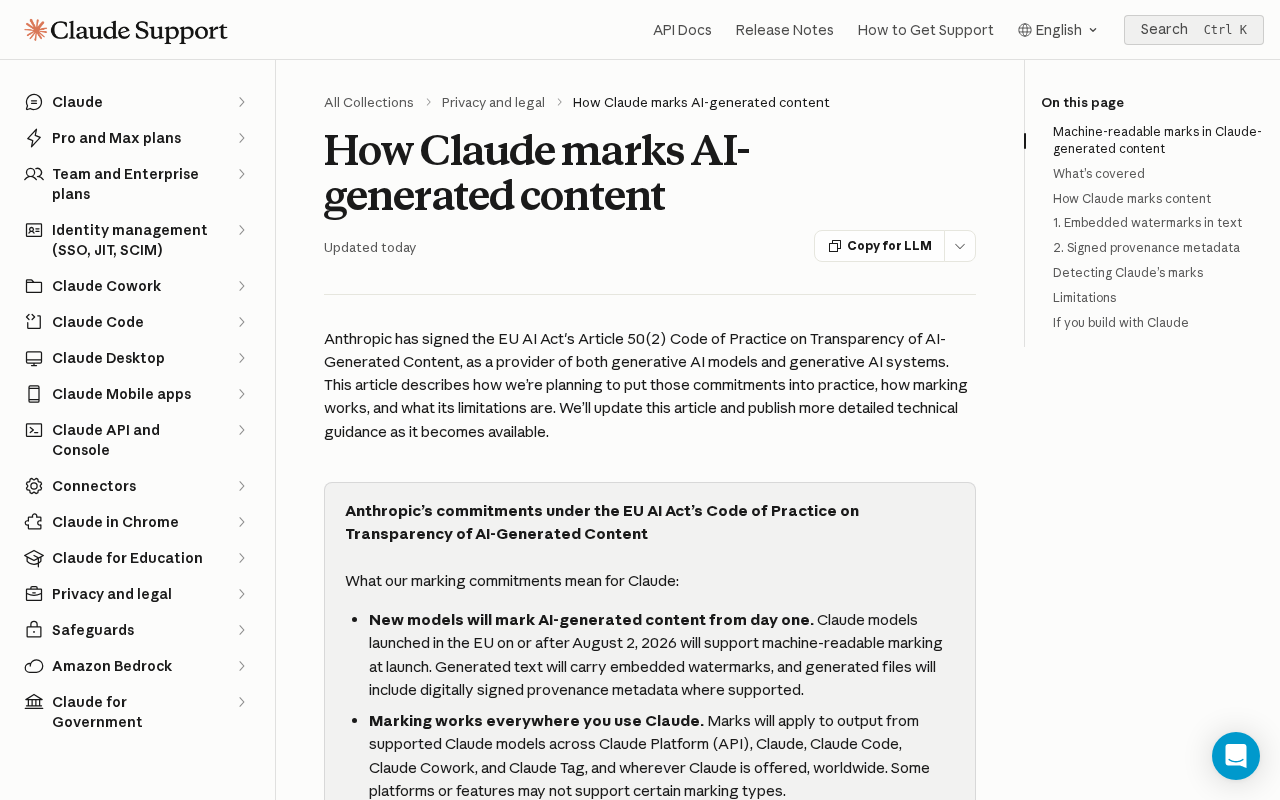
Claude's Technical Approach to Content Marking
Metadata and Explicit Marking
Current mainstream AI content marking approaches generally fall into two categories: explicit marking and implicit watermarking.
Explicit marking typically attaches metadata to generated content—for example, including model identifiers and generation timestamps in API responses. This type of marking is straightforward and clear, but extremely easy to lose during copy-paste operations, making its reliability limited. In practice, the effectiveness of metadata marking depends heavily on the integrity of the content distribution chain—once content leaves the original platform or API response context, this supplementary information often ceases to exist.
How Implicit Watermarking Works
Implicit watermarking is far more sophisticated. It works by introducing statistically detectable patterns during the model's sampling phase—such as subtly adjusting the probabilities of specific token combinations—thereby embedding an "invisible signature" without affecting text readability.
Specifically, the core mechanism of LLM text generation is autoregressive sampling: at each time step, the model predicts a probability distribution over the next token, then samples from it. The key insight behind watermarking technology is that, without significantly altering output quality, the token vocabulary can be divided into a "green list" and a "red list," with sampling probabilities adjusted to favor tokens from the green list. This statistical bias is virtually imperceptible for any individual token, but over sufficiently long text, it forms a detectable statistical signal. This method was first systematically proposed by Kirchenbauer et al. at the University of Maryland in a 2023 paper, which has since become foundational work in the field.
The challenge with this technology lies in ensuring both watermark robustness (remaining detectable after paraphrasing, translation, etc.) and avoiding degradation of generation quality.
The Role of the C2PA Content Provenance Standard
Notably, the industry is pushing for unified content provenance standards, with C2PA (Content Provenance and Authenticity) being one of the most prominent frameworks. C2PA is jointly driven by the CAI (Content Authenticity Initiative) and the C2PA coalition, initiated by Adobe, Microsoft, BBC, and other organizations. Its technical core embeds content creation and editing history as cryptographic manifests within files, using PKI (Public Key Infrastructure) for digital signatures. Each time content is edited or transformed, new operation records are appended to the provenance chain.
For text content, C2PA's challenge is that plain text lacks a standardized metadata container like image EXIF data, so it must rely on transport protocols or platform-level support to maintain provenance information integrity. Major providers including Anthropic and OpenAI are exploring integration approaches to varying degrees.
For Claude specifically, the marking mechanism is more reflected in product-level transparency commitments rather than mandatory, irremovable watermarking technology. This also reflects that current AI content marking remains in an exploratory phase between "technically feasible" and "practically effective."
Core Technical Challenges of AI Text Watermarking
The Tension Between Robustness and Imperceptibility
The core dilemma of AI text watermarking lies in an inherently contradictory pair of requirements:
- Imperceptibility: The watermark should not affect the naturalness and quality of the text; users should not perceive its existence;
- Robustness: The watermark should resist common evasion techniques such as paraphrasing, truncation, and translation.
These two requirements fundamentally constrain each other. Making a watermark difficult to remove requires embedding stronger statistical patterns in the text, which often sacrifices text diversity and naturalness. Conversely, pursuing high-quality output weakens the watermark's detectability. From an information-theoretic perspective, this is essentially a channel capacity problem—under the constraint of maintaining output quality, there is a theoretical upper limit on the amount of watermark information that can be reliably transmitted.
Vulnerability from an Attacker's Perspective
The Hacker News community discussion also pointed out that any marking mechanism appears fragile when facing users who intentionally attempt evasion. The academic community categorizes attacks against AI watermarks into several types: paraphrase attacks destroy statistical patterns through synonym replacement and sentence restructuring; translation attacks translate text into another language and back, which can almost completely eliminate the original watermark; model distillation attacks use another unwatermarked model to "rephrase" the content.
Experiments show that even the most advanced watermarking schemes see significant drops in detection accuracy after two or more rounds of paraphrasing. As long as AI-generated text undergoes a round of human editing, or is "laundered" through another model, most watermarks will be weakened or completely eliminated. This means AI content marking is better suited as a "good-faith indicator" rather than a "forensic enforcement" tool—its value lies more in improving overall ecosystem transparency than in tracing individual malicious acts.
Deeper Reflections: The Significance and Boundaries of AI Content Marking
From Technical Tool to AI Governance Framework
AI content marking should not be viewed as a purely technical problem, but rather as a systems engineering challenge involving technology, policy, and ethics. Watermarks or metadata alone cannot solve all content provenance challenges—platform responsibility, legal regulations, and user education must work in concert.
From a global regulatory perspective, the EU's AI Act explicitly requires that AI system outputs be marked as machine-generated, with non-compliant companies potentially facing substantial fines. China's Interim Administrative Measures for Generative AI Services similarly require identification of AI-generated content. While the United States has yet to enact federal-level mandatory legislation, the White House's AI Executive Order encourages voluntary adoption of watermarking and content provenance technologies. This global regulatory trend is forcing technology vendors to accelerate deployment of content marking solutions, but regional differences in the definition and requirements of "marking" create compliance challenges for multinational AI companies.
For a product like Claude, its marking strategy is more about signaling "responsible AI" to regulators and users, demonstrating the vendor's efforts toward transparency. This posture itself has value, even if the technical means are not yet perfect.
Balancing User Privacy and Content Transparency
Another dimension that cannot be overlooked is privacy. Overly aggressive watermarking technology may raise concerns about user privacy—if every piece of AI-assisted text carries a traceable signature, does that mean users' creative activities are being invisibly monitored? This concern is not unfounded: if the watermark encodes user IDs or session identifiers, any piece of text could theoretically be traced back to a specific user, potentially conflicting with fundamental rights such as anonymous expression and journalistic source protection. How to strike a balance between content provenance and user privacy will be a question that future AI governance must confront directly. Technologies like differential privacy may provide partial answers to this tension, but complete solutions will require the co-evolution of both technology and institutions.
Conclusion
How Claude marks AI-generated content may seem like a technical detail, but it actually reflects the entire AI industry's collective exploration of credibility, transparency, and governance. Current marking approaches still have obvious limitations: explicit markers are easily lost, and implicit watermarks face inherent trade-offs. But as standards like C2PA mature and regulatory frameworks develop, we have reason to expect a more transparent and traceable AI content ecosystem.
For developers and content creators, understanding the principles and boundaries of these mechanisms helps us view AI-generated content credibility more rationally, rather than blindly relying on any single "detection silver bullet." The future content provenance system will likely be multi-layered—a comprehensive approach combining watermarking technology, platform-level metadata, industry standards, and legal frameworks, rather than depending on any single solution.
Related articles

Gaussian Process Bandit Optimization: Exploration Strategies and Inference Regret Guarantees
Cumulative regret guarantees in Bayesian optimization fail to reflect final recommendation quality. This article examines a new study that provides inference regret guarantees for Gaussian process bandit optimization through exploration query strategies and fill distance analysis, validated on hyperparameter optimization and control tasks.

The Most Detailed Codex Guide on Bilibili: From Installation to Real-World Practice
The most detailed Codex guide on Bilibili: from app store installation to daily work mode configuration, with a real coffee shop project demonstrating file organization, data extraction, dashboard creation, and other practical tasks. Learn to use Plan Mode and desktop pets to leverage Codex efficiently.

Appearance Compensation in Volume Rendering: Why RGB Accuracy Cannot Guarantee Density Correctness
Volume rendering research reveals that volumetric data perfectly reproducing external RGB views may still contain density errors: appearance compensation can double central density and keep external rays unchanged even when L2 error exceeds 14.52%. Density recovery depends on appearance capacity, spatial resolution, and measurement design.