Getting Started with LangChain4j: A Deep Dive into the LLM Application Framework for Java

LangChain4j is a production-ready LLM framework for Java, offering a unified API and declarative programming for AI app development.
LangChain4j is an open-source LLM framework redesigned from scratch for the JVM — not a Python LangChain port. Its three pillars are a unified API, Java-native declarative programming, and production readiness, enabling Java teams to build enterprise AI apps without Python. The architecture spans a Core layer, an AI Service layer (declarative calls via dynamic proxy), a Provider layer, and an experimental multi-agent orchestration layer. Key capabilities include multi-model integration, RAG with 30+ vector store support, persistent chat memory, Function Calling, and structured output parsing — making it ideal for enterprise chatbots, document Q&A, and code generation within the Spring ecosystem.
What Is LangChain4j
LangChain4j is an open-source LLM application development framework built for the Java ecosystem. It is not a simple port of LangChain — it was redesigned from the ground up for the JVM, with deep integration of Spring and reactive data-flow paradigms. Its core goal is straightforward: let Java developers build production-grade AI applications without switching to Python.
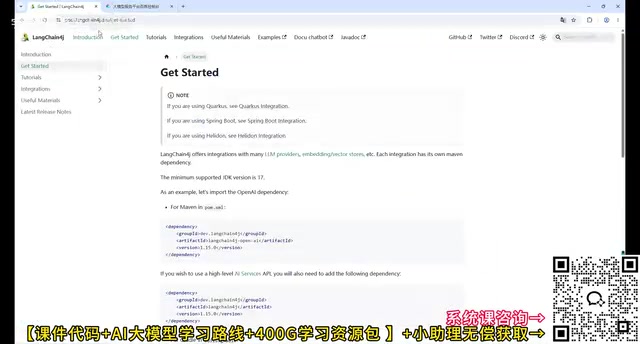
In the past, most LLM application development relied on Python and the LangChain ecosystem. LangChain4j fills that gap on the Java side. It provides a unified, native API for rapidly building LLM-powered applications, covering common scenarios like chatbots, RAG (Retrieval-Augmented Generation), and AI agents. The framework has iterated to a mature version, and the official documentation and website are essential references — especially the Starter guide and related tutorials.
Core Positioning and Design Goals
LangChain4j's design revolves around a few key principles. Unified API is its most central value proposition — when calling different LLMs, you use the same set of encapsulated APIs. In theory, switching models or storage backends requires changing just a single line of code. This unified abstraction layer dramatically reduces the cost of adapting to multiple models.
Java-native development is the second defining characteristic. The framework is built around declarative AI programming, aligning with existing Java developer habits and minimizing the learning curve. Third is production readiness: it ships with enterprise-grade capabilities like retries, caching, streaming responses, structured output, and monitoring — exactly the infrastructure you need when moving a demo to production.
Declarative AI Programming is the core programming paradigm that sets LangChain4j apart from imperative-style API calls. In a traditional imperative approach, developers manually handle every step: constructing prompt strings, calling HTTP endpoints, parsing JSON responses, and handling retry logic. The declarative approach flips this — developers simply describe what they want (by defining interfaces and annotations), and the framework handles how to do it. This mirrors how Spring Data JPA lets you define a method like findByNameAndAge(...) without writing any SQL. For the Java ecosystem, the declarative style also naturally fits Spring's IoC/AOP mechanisms, allowing AI services to be injected and enhanced as ordinary Spring Beans — making it easy to plug into existing logging, authorization, and transaction management infrastructure.
Core Architecture Layers
LangChain4j's architecture can be broken down into several layers. Understanding them helps you grasp the overall design philosophy.
Core Layer: Pure interfaces with no dependencies, defining standard abstractions for models, memory, tools, RAG, and more. This layer is the skeleton of the entire framework, ensuring extensibility and replaceability.
AI Service Layer: This is the framework's most distinctive feature. Using dynamic proxies and annotation-driven development, you simply define an AI service as a Java interface, and the framework auto-generates the corresponding implementation. This declarative style significantly simplifies business code.
Provider Layer: Handles concrete integrations with various LLMs, vector stores, and tools — the bridge connecting external capabilities to the framework.
Multi-Agent Orchestration Layer: Designed for decomposing and coordinating complex tasks. Currently experimental, but it represents the direction of future development.
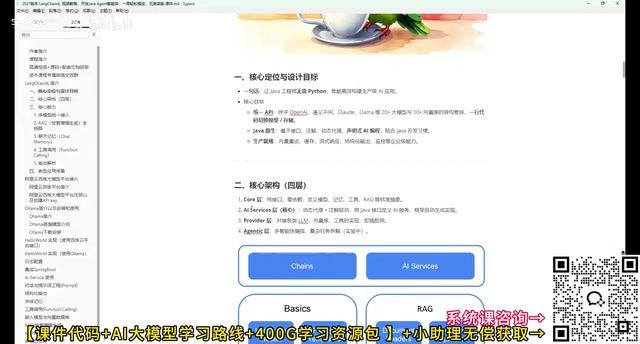
At the component level, the framework includes modules for prompt templates, output parsing, and conversation memory built around LLMs. The RAG-related components cover document loading, document splitting, embedding models, and vector storage — a pipeline very similar to other mainstream LLM frameworks. Developers familiar with Spring AI will find it immediately recognizable.

Dynamic Proxy is the implementation foundation of the AI Service layer and worth a brief explanation. Java's dynamic proxy mechanism allows the runtime to automatically generate implementations for interfaces, with no hand-written implementation code required. In LangChain4j, you simply define a Java interface annotated with @SystemMessage, @UserMessage, and similar annotations. The framework then generates an implementation at runtime via dynamic proxy, automatically handling prompt assembly, model invocation, memory management, and result parsing end-to-end. This is conceptually identical to how MyBatis auto-generates SQL execution logic from interface definitions — making it immediately intuitive for any Java developer with MyBatis experience. This declarative style hides the complex LLM interaction logic inside the framework, leaving only interface definitions in your business code, which greatly improves readability and testability.
Core Capabilities Overview
LangChain4j's capabilities cover the major stages of LLM application development.
Unified Multi-Model Integration: Supports major LLMs including models on Alibaba Cloud's Bailian platform (e.g., Qwen), along with multimodal text input and streaming responses.
RAG Retrieval Augmentation: This is a must-have capability in virtually every LLM framework — the difference lies in how powerful the implementation is. LangChain4j supports ingesting multiple data formats, provides document splitting and cleaning pipelines, supports 30+ vector stores, and offers query optimization techniques like reranking at retrieval time. This is a notable strength of the framework.

Chat Memory: Supports both persistent and in-memory modes, with built-in message windowing, token-count algorithms, and per-user memory isolation — suitable for multi-user chat scenarios.
Tool Calling (Function Calling): Java methods can be declared directly as tools, with the LLM automatically deciding when to invoke them. Dynamic tools are also supported — a critical capability for building agents.
Output Parsing: Automatically parses LLM responses into Java primitive types or objects, allowing results to flow directly into business logic and eliminating manual parsing overhead.
RAG (Retrieval-Augmented Generation) is one of the most important engineering patterns for deploying LLM applications in production. The core idea: before sending a question to an LLM, first retrieve relevant content fragments from an external knowledge base (such as enterprise documents or a database), then pass those fragments along with the original question to the model — guiding it to produce more accurate, grounded answers rather than relying solely on knowledge baked in during training. The key benefits are a significant reduction in "hallucination" (the model fabricating facts) and the ability to handle information that postdates the model's training cutoff. Vector stores play a central role: documents are split into chunks, converted into high-dimensional vectors by an embedding model, and stored. At query time, the same vectorization is applied to the user's question, and approximate nearest-neighbor search retrieves the semantically closest chunks. LangChain4j's support for 30+ vector stores gives teams with different technology stacks considerable flexibility in their selection.
Typical Use Cases
Based on the capabilities above, LangChain4j's typical use cases include: enterprise intelligent customer service (using RAG to connect knowledge bases for accurate Q&A), code comment generation, document Q&A, personal assistants, and content creation. What these scenarios have in common is the need to deeply integrate LLM capabilities with an organization's existing Java systems — and that is precisely where LangChain4j delivers its value.
For teams deeply invested in the Java stack, LangChain4j provides a path to deploying AI applications without introducing the Python ecosystem. Its unified API, declarative programming model, and rich enterprise-grade capabilities make it a worthy LLM development framework within the Spring ecosystem. Pairing it with hands-on model integration and real code examples will give you an even deeper appreciation of its design strengths.
Related articles

Felix Rieseberg Personal Homepage
Felix Rieseberg's personal homepage sparks attention on Hacker News. This article covers the Slack engineer's technical background, the rise and fall of nativefier, and the value of a developer homepage as a tech calling card.

@ai-sdk/vue 3.0.306 Patch Release Syncs with [email protected] Update
@ai-sdk/vue 3.0.306 released, synced with [email protected]. A routine patch release for the Vercel AI SDK ecosystem with no public API changes; the Vue adapter layer stays version-aligned with the core package.

Gemini 4 Argon API Launches: The Era of Million-Token Output Begins
Google launches Gemini 4 Argon with sparse MoE architecture, up to 1M output tokens, and a 68.90% Vals Index score, available across API, AI Studio, and the Gemini app.