Getting Started with Langfuse: A Complete Guide to the Open-Source LLM Monitoring Platform
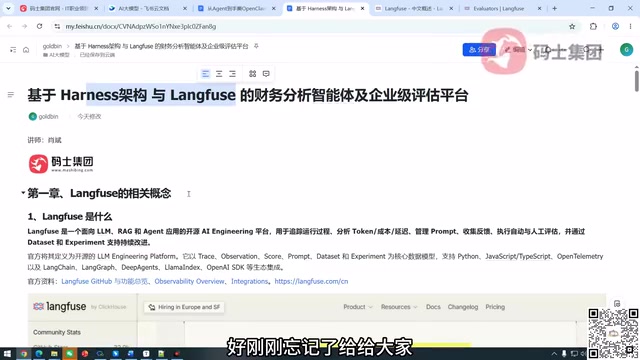
Langfuse: open-source observability platform for production-grade LLM, RAG, and agent applications
Langfuse is an open-source observability platform that provides tracing, evaluation, prompt management, and cost analysis for LLM applications. It integrates with frameworks like LangChain and LangGraph via self-hosted deployment, helping teams monitor RAG systems and agents in production with version control and rollback capabilities.
Getting Started with Langfuse: A Complete Guide to the Open-Source LLM Monitoring Platform
As large language model applications move from prototype to production, one unavoidable challenge emerges: how do you know what your RAG system or agent is actually doing? Which tools did it call, how many tokens did it consume, what's the latency, and are the answers correct? Langfuse is an open-source observability platform built specifically to solve these problems. Based on practical tutorials from Bilibili creator Xiao Bin (LLM instructor at Mashi Education), this article systematically covers Langfuse's core concepts, capability boundaries, and suitable use cases.
What is Langfuse: An Open-Source LLM Observability Platform
According to the official definition, Langfuse is an open-source AI engineer platform for LLM applications, RAG, and agents. In simple terms, its core purpose is to: trace execution processes, analyze token costs and latency, manage prompts, collect feedback, perform automated and manual evaluations, and support continuous improvement through datasets and experiments.
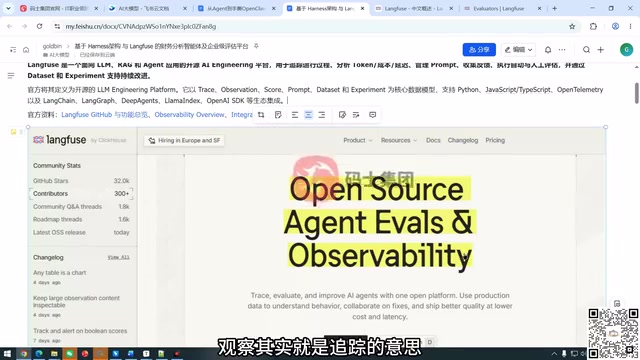
One key positioning needs clarification: Langfuse is a platform, not a development framework. When using it, you typically won't use it for AI application development itself. Instead, you install Langfuse's self-hosted service and integrate it with your already-developed LLM, RAG, or agent projects to enable log tracing, evaluation, and other operations.
RAG (Retrieval-Augmented Generation) is one of the most mainstream architectural patterns in current LLM applications. Its core approach is to retrieve relevant document chunks from an external knowledge base before the LLM generates an answer, then inject these chunks as context into the prompt, allowing the model to generate more accurate responses based on real data. This architecture effectively mitigates the "hallucination" problem of LLMs, but also introduces new complexity: retrieval quality, chunking strategy, vector similarity thresholds, reranking models—each step can affect the final output. In such multi-stage systems, "observability" becomes critical—borrowing from the distributed tracing concepts in traditional microservice architectures, it visualizes the complete call chain of each request, helping developers pinpoint bottlenecks.
Its primary languages are Python and TypeScript/JavaScript, and it seamlessly integrates with mainstream agent and RAG development frameworks like LangChain, LangGraph, LlamaIndex, DeepAgent, and OpenAI Agent SDK. This means regardless of your tech stack, Langfuse can almost always be integrated.
Langfuse adopts a self-hosted deployment model, meaning enterprises can deploy the entire platform on their own servers or private cloud rather than relying on third-party SaaS services. This design is particularly important for enterprise AI application scenarios: LLM application logs typically contain users' raw inputs, complete model outputs, and potentially business-sensitive data—all highly sensitive information. Private deployment ensures data never leaves the enterprise boundary. Simultaneously, the self-hosted model gives enterprises complete control over data storage, backup strategies, and access control, meeting compliance requirements for highly regulated industries like finance and healthcare. Langfuse also offers a cloud-hosted version for individual developers and small teams to get started quickly.
A Vivid Analogy: The Flight Recorder and Laboratory for AI Employees
If you think of an agent as a "digital AI employee" capable of researching, using tools, and performing various operations, then Langfuse is like this employee's flight recorder, quality assurance department, laboratory, and prompt configuration center.
Here it's worth understanding the technical meaning of agents themselves. Agents are an advanced form of LLM applications. Unlike simple Q&A systems, they possess autonomous planning, tool invocation, and multi-step reasoning capabilities. A typical agent workflow includes: receiving user instructions, decomposing tasks, selecting appropriate tools (like search engines, code executors, database query interfaces), executing operations, observing results, and deciding the next action. This "think—act—observe" loop mechanism (the ReAct paradigm) gives agents the ability to handle complex tasks, but also makes debugging and monitoring extremely difficult—a single user request might trigger dozens of model and tool calls, and any error in the middle could lead to deviations in the final result. It's precisely this complexity that makes Langfuse's tracing and observability capabilities indispensable.
- Flight Recorder: Completely traces every execution step of this digital employee.
- Quality Assurance Department: Evaluates the quality of AI-generated answers.
- Laboratory: When you modify prompts or switch models, you can first run tests in the lab to see if performance exceeds the current stable version before deciding whether to deploy.
- Prompt Configuration Center: Provides version management and quick rollback capabilities.
Why Prompt Management Deserves a Place in Langfuse
Many ask: isn't it fine to just write prompts directly in code? On the surface, it seems okay, but in actual production environments, prompts are constantly being modified. After modification, results might improve or worsen—no one can guarantee things only get better.
Prompt Engineering has evolved from an experimental technique into a core engineering practice in LLM application development. In production environments, minor prompt changes can cause significant fluctuations in output quality—adding a constraint might improve accuracy but could also cause abnormal behavior in certain edge cases. This uncertainty makes prompt management face challenges similar to code management: version control is needed to record every change, gradual rollout is needed to control risk, and quick rollback is needed to address production issues. The traditional approach is to hardcode prompts in code repositories managed through Git, but this requires every modification to go through a complete code review and deployment process.
The key is: when results worsen, can you quickly roll back to the previous version without restarting the entire RAG or agent project? If prompts are hardcoded, this is nearly impossible. Langfuse's Prompt Management decouples prompts from code, managing them as independent configuration items, enabling "hot updates"—modifying prompts requires no redeployment, and rollback operations can be completed in seconds. This version management and rollback capability makes prompt iteration controllable and traceable—precisely its irreplaceable value in enterprise-level development.
What Key Questions Can Langfuse Answer?
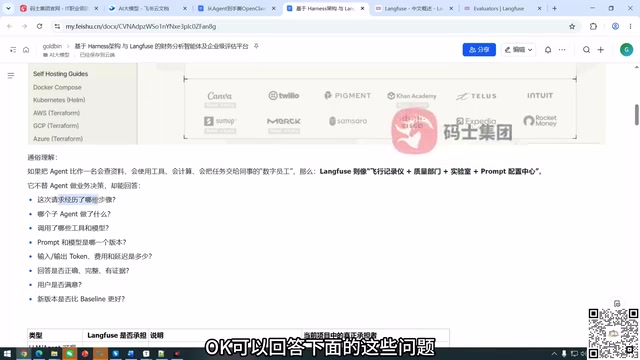
Langfuse's observability capabilities essentially help you answer a series of questions about "what happened during this request":
- What steps did this request go through?
- Which sub-agent did what?
- Which tools and models were called? How long did each take?
- Which version of the prompt and model was used?
- What are the input/output token counts, cost statistics, and latency?
- Are the answers correct? Is there complete accuracy data?
- Are users satisfied (can be collected through manual annotation)?
- Does the new version perform better than the current stable baseline?
Among these, token statistics and cost analysis are among the most watched metrics in production environments. A token is the basic unit for LLMs to process text, roughly equivalent to 3/4 of an English word or one Chinese character. Almost all commercial LLM APIs (like OpenAI, Anthropic, Google) charge based on token count, and input and output tokens typically have different prices. In production, a complex agent might consume tens of thousands or even hundreds of thousands of tokens in a single task; if multi-turn conversations or long document processing are involved, costs accumulate rapidly. Langfuse's value here lies in not only counting totals but also breaking down token consumption for each sub-call, helping developers find "money-burning" bottlenecks and providing data support for cost optimization.
These capabilities together form a complete "record—analyze—evaluate—improve" loop. One detail worth mentioning: Langfuse's tracing targets aren't limited to self-developed applications. Tools like Cloud Code and Codex are themselves agents, and you can fully perform log tracing, token analysis, and cost and latency analysis on them.
Langfuse's Capability Boundaries: What It Does and Doesn't Do
Understanding a tool means knowing not only what it can do but also what it doesn't do.
What Langfuse Can Do
- Observability: Record complete call chains of models, tools, retrieval, and sub-agents.
- Evaluation: Support automated and manual annotation evaluation.
- Feedback Collection: Collect user feedback data.
- Prompt Management: Version control, rollback, configuration center.
- Metrics Analysis: Statistical analysis of token usage, costs, latency, and other metrics.
What Langfuse Doesn't Do
- Doesn't provide the agent framework itself (you need to build the agent architecture yourself).
- Doesn't provide LLMs.
- Doesn't provide vector knowledge bases or vector databases (you need to prepare these yourself).
- Isn't responsible for server operations, health checks, or monitoring after application deployment.
- Doesn't replace RAG or agents in making specific business decisions.
This boundary is very clear: Langfuse focuses on the vertical segment of "observation and evaluation," leaving development, deployment, operations, and other aspects to their respective specialized tools. This "focused and refined" positioning actually makes it easier to embed into existing tech stacks. In actual technology selection, Langfuse typically works alongside infrastructure monitoring tools (like Prometheus and Grafana for server-level health checks), application deployment tools (like Docker and Kubernetes), and development frameworks (like LangChain and LangGraph), each fulfilling their roles to form a complete production-grade AI application tech stack.
From Concept to Implementation: Who Should Use It and How
This tutorial is part of a larger project—a LangGraph-based multi-agent financial analysis platform, along with tracing, evaluation, and observability development for this enterprise-grade agent. The author emphasizes that the series focuses not on how to develop the agent itself, but on how to build tracing, evaluation, and observability for an already mature enterprise-grade agent.
LangChain is one of the most popular LLM application development frameworks today, providing a series of out-of-the-box components like chain invocation, tool integration, and memory management, significantly lowering the barrier to building LLM applications. LangGraph is an advanced framework launched by the LangChain team specifically for building directed-graph-based multi-agent systems—developers can define different agents as nodes in a graph, use edges to describe collaboration relationships and control flows between them, enabling more complex orchestration logic like conditional branching, parallel execution, and human-in-the-loop. The "LangGraph-based multi-agent financial analysis platform" mentioned in this tutorial leverages LangGraph's graph orchestration capabilities to split financial data acquisition, analytical reasoning, report generation, and other stages into multiple collaborating agents, while Langfuse handles tracing and evaluating these agents' operational performance.
For teams pushing LLM applications into production, Langfuse fills precisely the critical gap between "it works" and "controllable, optimizable, continuously improvable." Mastering its core concepts and capability boundaries is the first step in building a production-grade LLM application monitoring system.
Summary
As an open-source LLM observability platform, Langfuse provides a complete quality assurance loop for RAG and agent applications through four core capabilities: tracing, evaluation, feedback, and prompt management. It integrates into existing projects as a self-hosted service, seamlessly works with mainstream development frameworks like LangChain and LangGraph, while maintaining clear capability boundaries. For developers and enterprises hoping to truly deploy AI applications into production, Langfuse deserves core consideration in technology selection.
Key Takeaways
- Langfuse is an open-source observability platform designed specifically for LLM applications, RAG systems, and agents
- Core capabilities include complete tracing, automated/manual evaluation, prompt version management, and cost/latency analysis
- Adopts self-hosted deployment to ensure data security and compliance in enterprise scenarios
- Integrates seamlessly with mainstream frameworks like LangChain, LangGraph, and LlamaIndex
- Maintains clear boundaries: focuses on observation and evaluation, doesn't replace development frameworks or infrastructure
- Prompt management enables hot updates and quick rollback without redeployment
- Particularly suitable for teams transitioning AI applications from prototype to production environments
Related articles
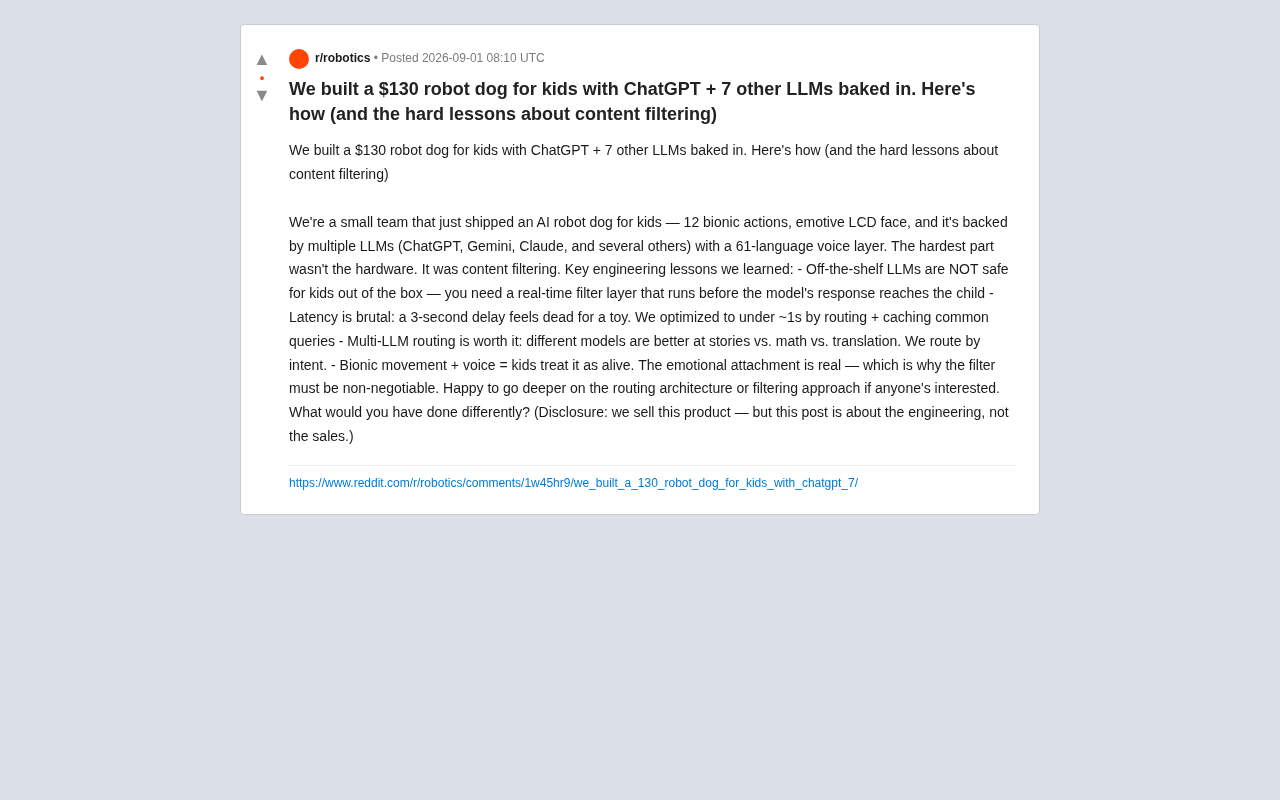
Building an AI Robot Dog for Kids: Multi-Model Routing, Content Filtering, and Latency Optimization
A $130 AI robot dog for kids integrates 8 LLMs with 61-language voice interaction. The team shares key engineering lessons on content safety filtering, multi-LLM intent routing, and sub-1-second latency optimization.
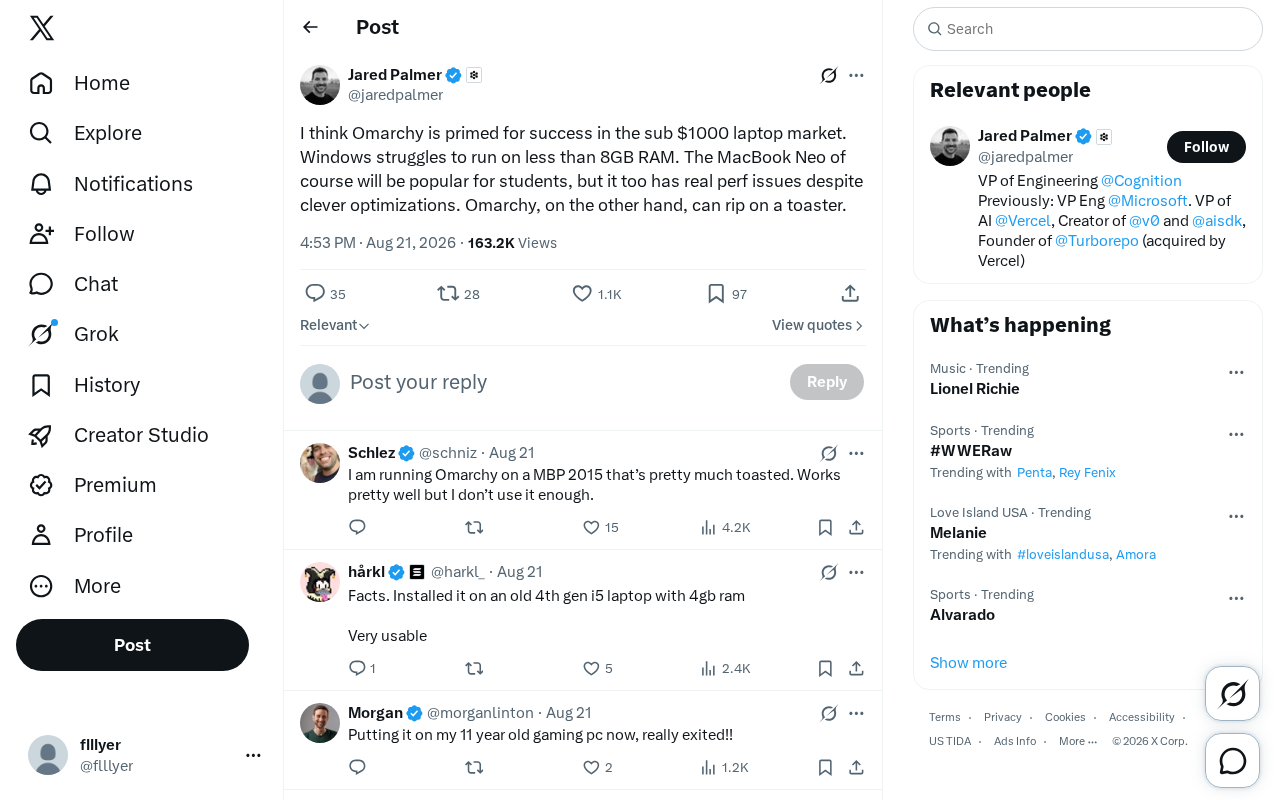
Can Omarchy Dominate the Sub-$1000 Laptop Market? An In-Depth Analysis
Omarchy, based on Arch Linux, shows unique advantages in the sub-$1000 laptop market. This analysis compares Windows and MacBook performance bottlenecks on low-spec hardware and examines why Omarchy enables cheap laptops to run smoothly, plus the ecosystem challenges and market prospects it faces.
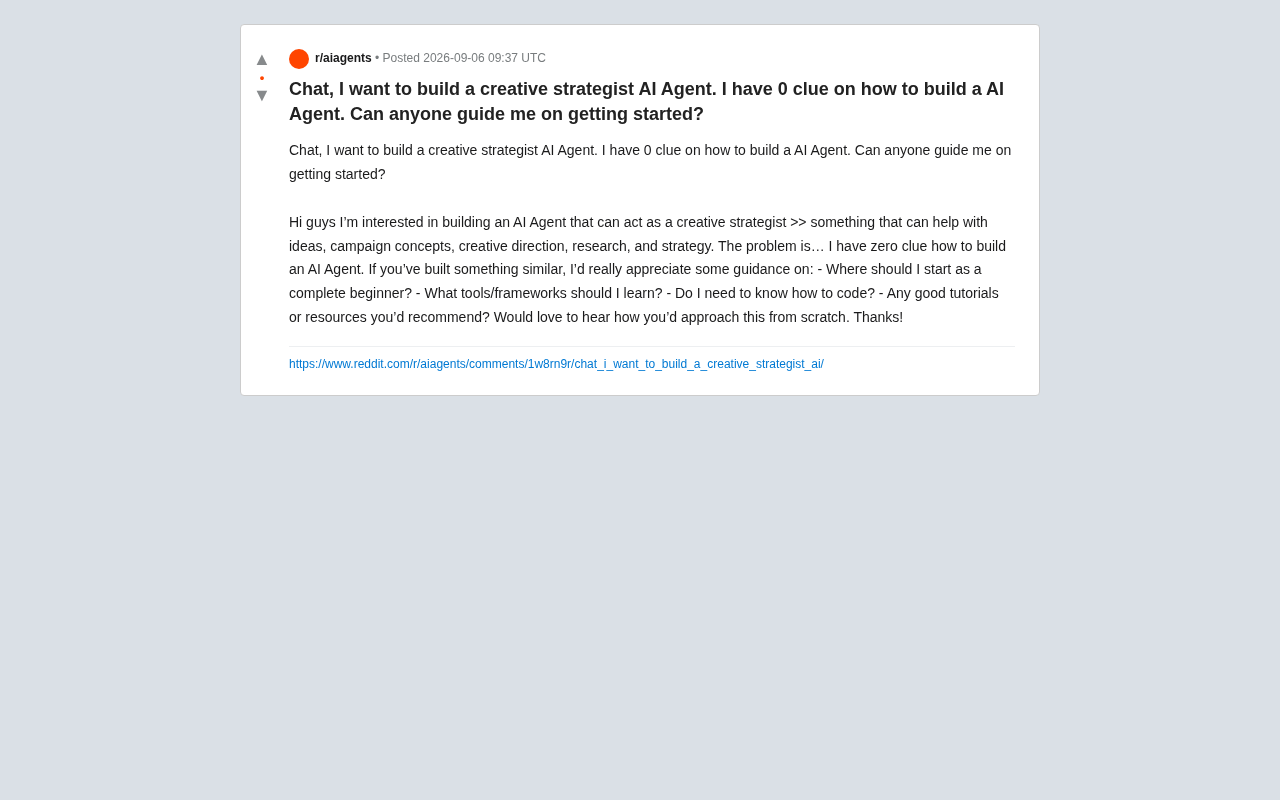
AI Agent Beginner's Guide: Building a Creative Strategy Intelligent Assistant from Scratch
A complete guide to building a creative strategy AI Agent from scratch. No coding required — use tools like Dify and Coze to quickly build an intelligent assistant.