Getting Started with Langfuse: A Deep Dive into the LLM Observability Platform

Langfuse is an open-source LLMOps platform for observability and continuous improvement of LLM, RAG, and agent applications.
Langfuse is an open-source LLMOps platform designed for the production observability and continuous optimization of LLM, RAG, and agent applications. Its four core capabilities can be summarized as: a flight recorder (tracing call chains), a quality department (evaluating answer quality and user satisfaction), a laboratory (comparing prompt or model versions), and a prompt configuration center (supporting versioning and hot rollback). As a platform rather than a framework, Langfuse integrates with LangGraph, LlamaIndex, OpenAI Agent SDK, and more via a self-hosted service, and can even track usage costs for off-the-shelf agents like Claude Code. Its scope is clearly bounded: it focuses on the observability and optimization layer, without providing models, vector databases, or server infrastructure.
What Is Langfuse
As LLM applications make the journey from experiment to production, one question becomes unavoidable: how is your RAG system or AI agent actually performing in the real world? Which tools did it call? How many tokens did it consume? What's the latency? Are the answers even correct? Langfuse was built to answer exactly these questions.
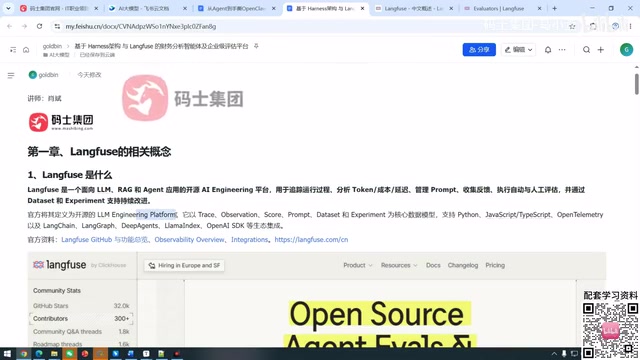
According to tutorials by Xiao Bin, a Bilibili instructor focused on large models, Langfuse officially describes itself as an open-source LLMOps platform for large language models. More precisely, it's an open-source AI Engineer platform designed for LLM, RAG, and agent applications. Its core capabilities include tracing execution flows, analyzing token costs and latency, managing prompts, collecting user feedback, running both automated and human-annotated evaluations, and continuously improving application quality through datasets and experiments.
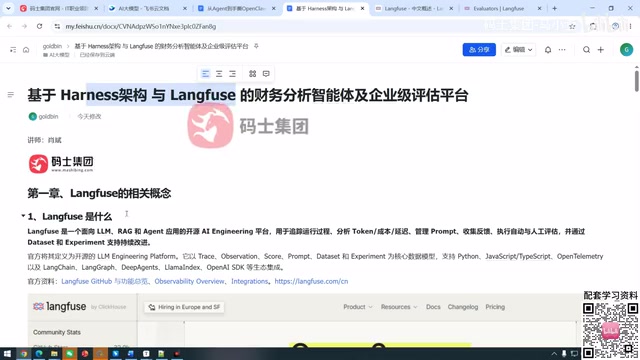
It's worth emphasizing that Langfuse is a platform, not a development framework. The tutorial specifically draws this distinction: using Langfuse typically doesn't require custom development. Instead, you deploy its self-hosted service and integrate it with your existing LLM, RAG, or agent projects to enable logging, tracing, and evaluation. Its primary supported languages are Python and TypeScript — if custom development is needed, those are the recommended choices.
LLMOps (Large Language Model Operations) is an engineering discipline that has emerged alongside the scaling of LLM applications, analogous to DevOps for traditional software or MLOps for machine learning. It covers the full lifecycle of LLM applications — from development and testing to deployment, continuous monitoring, and iteration. Unlike traditional software, LLM applications are non-deterministic: the same input can produce different outputs, and quality is difficult to measure with simple unit tests. The core challenges of LLMOps therefore center on observability (knowing what the system is doing), evaluation (judging output quality), and versioned management of prompt engineering. Langfuse is purpose-built to fill this engineering gap, playing a role in the LLM space similar to what Datadog or Sentry play in traditional software monitoring.
Which Frameworks Does Langfuse Integrate With
One of Langfuse's key strengths is its broad compatibility. It integrates seamlessly with popular agent and RAG development frameworks including LangGraph, LangChain, DeepAgent, LlamaIndex, and the OpenAI Agent SDK. This means that regardless of your tech stack, you can almost always plug Langfuse in as a unified observability layer.
An often-overlooked use case: Langfuse can observe not just applications you build yourself, but also off-the-shelf agent products. The tutorial points out that many teams regularly use AI coding agents like Claude Code or Codex. Since these are agents at their core, they can be fully traced — with logs, token analysis, cost tracking, and latency monitoring. This gives organizations a unified way to manage the usage costs of all their AI tools.
RAG (Retrieval-Augmented Generation) is currently one of the most widely adopted architectures for deploying LLM applications in enterprise settings. The core idea is to retrieve relevant document chunks from an external knowledge base (typically a vector database) before passing the user's question to the model, then feeding both the retrieved context and the question to the model together. This allows the model to answer based on up-to-date or proprietary knowledge, rather than relying solely on what it learned during training. A typical RAG pipeline involves multiple steps — query rewriting, vector retrieval, context assembly, and model invocation — and a failure at any stage can degrade the final answer quality. This makes tracing the inputs, outputs, latency, and token consumption at each step critically important, which is exactly where Langfuse's tracing capabilities shine.
Understanding Langfuse's Four Core Functions Through an Analogy
The tutorial uses a vivid analogy to explain Langfuse. If you think of an AI agent as a "digital AI employee" who can look things up, use tools, perform calculations, and carry out all sorts of tasks, then Langfuse is that employee's flight recorder, quality department, laboratory, and prompt configuration center.
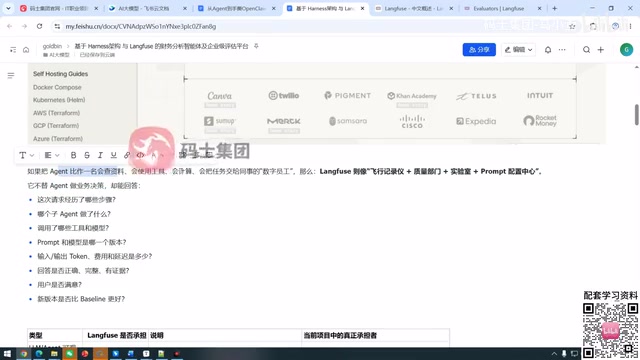
- Flight Recorder (Tracing): Records every step the digital employee takes, fully reconstructing the call chain.
- Quality Department (Evaluation): Assesses the quality of generated answers — is the response correct? Is the chain complete? Is the user satisfied?
- Laboratory (Experiments): When you modify a prompt or swap out a model, you can run the new version in the lab first and compare results. Only if the new version outperforms the current stable ("Best") version do you decide to roll it out.
- Prompt Configuration Center (Prompt Management): This is the most underestimated capability.
Why Prompt Management Deserves More Attention
Many developers habitually hard-code prompts directly into their codebase. The tutorial raises a practical challenge: will those prompts need to be modified later? If so, could changes make things worse? And if they do, can you roll back quickly — without restarting the service?
If prompts are hard-coded, versioning and hot rollback become nearly impossible. Langfuse's prompt configuration center solves exactly this problem — it supports version management and rollback without requiring a restart of your RAG or agent project. In enterprise development, this capability is far more valuable than it might seem at first glance.
Hot update (Hot Reload/Hot Update) refers to dynamically loading new configuration or code without stopping or restarting a service, enabling zero-downtime changes. In production LLM environments, prompts often need frequent adjustment — due to model behavior drift, changing business requirements, or discovering better phrasings. If prompts are hard-coded, every change requires a full release cycle (commit, build, deploy, restart), which is time-consuming and causes brief service interruptions. Langfuse's prompt management center decouples prompts from code: the application pulls the latest version via API at runtime, meaning prompt changes require no code repository modifications and enable true hot updates. Every version is recorded, and if a new version underperforms, you can roll back to a previous stable version with a single click.
What Questions Can Langfuse Answer
Once Langfuse is integrated, you can clearly answer a range of operational and quality questions:
- What steps did this request go through, and what did each sub-agent do?
- Which tools and models were called, and how long did each take to execute?
- Which versions of the prompt and model were used?
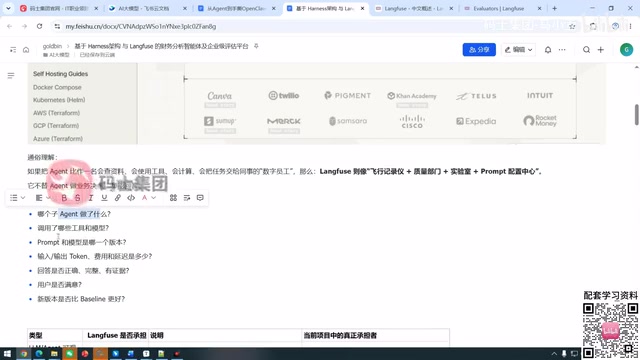
- What are the token counts, cost totals, and latency figures for inputs and outputs?
- Is the answer correct? Is there a complete, correct reasoning chain?
- Is the user satisfied? (User annotations can be appended)
- Is the new version better than the current stable ("Best") version?
These questions, taken together, form a complete feedback loop — from observability to continuous improvement of LLM applications.
The Boundaries of Langfuse's Capabilities
Understanding what a tool can't do is just as important as understanding what it can. The tutorial explicitly lays out what Langfuse does and doesn't cover.
What Langfuse can do: Observe LLM, RAG, and agent applications; record call chains for models, tools, retrieval steps, and sub-agents; perform evaluations and collect feedback; manage prompts; and analyze metrics.
What Langfuse cannot do: It doesn't provide an agent development framework, doesn't supply a large language model, doesn't provide a vector knowledge base (you need to build your own vector database), and doesn't handle server operations, monitoring, or health checks after deployment.
In other words, Langfuse is focused on the observability, evaluation, and optimization layer. It doesn't replace agents or RAG systems in making business decisions, nor does it take on the role of underlying infrastructure. Being clear about this boundary is essential to placing it correctly in your architecture decisions.
Summary
Langfuse fills the observability and evaluation gap in the productionization of LLM applications. Built around four core capabilities — tracing, evaluation, prompt management, and metrics analysis — it's compatible with major agent frameworks and can observe both custom-built applications and off-the-shelf AI coding agents. For teams looking to deploy AI applications in enterprise environments and continuously iterate on them, this kind of LLMOps platform is nearly indispensable infrastructure. The tutorial series will continue with "Why Use Langfuse" and a hands-on integration walkthrough using a multi-agent financial analysis project built on the Harness architecture.
Related articles

Chain of Thought Isn't Just for AI: How Humans Can Use CoT to Improve Thinking Quality
Chain of Thought isn't just a prompt trick for large models. Starting from a Hacker News discussion, this article analyzes why CoT works for human thinking too, breaks down actionable ways to transfer it, and highlights the key differences between human CoT and machine CoT.
Cloudflare Teams Up with OpenAI: Closi…
Cloudflare Teams Up with OpenAI: Closing the Loop from Vulnerability Discovery to Defense with AI
Cloudflare uses OpenAI Daybreak to investigate security vulnerabilities and generate reviewable remediation plans, while developers use Codex to boost coding efficiency and quality.

Orca Multi-Agent Orchestration in Practice: A Guide to Parallel Collaboration with Claude and Codex
Orca is Stable AI's free open-source agent workbench supporting 34 agents like Claude Code and Codex in parallel. Learn its Git worktree isolation, multi-model orchestration, and mobile management.