Getting Started with Machine Learning at 16: A Complete Learning Path from Zero to Hands-On Practice
A complete machine learning learning path designed for high school students starting from zero.
This article provides a structured machine learning learning path for a 16-year-old A-Level student with basic Python knowledge. It covers leveraging school math as ML foundations, essential Python libraries, a phased resource roadmap from 3Blue1Brown to Kaggle competitions, and hands-on project ideas that bridge mathematics and ML, including building linear regression from scratch and physics-data prediction.
The Starting Point: A Question from a 16-Year-Old
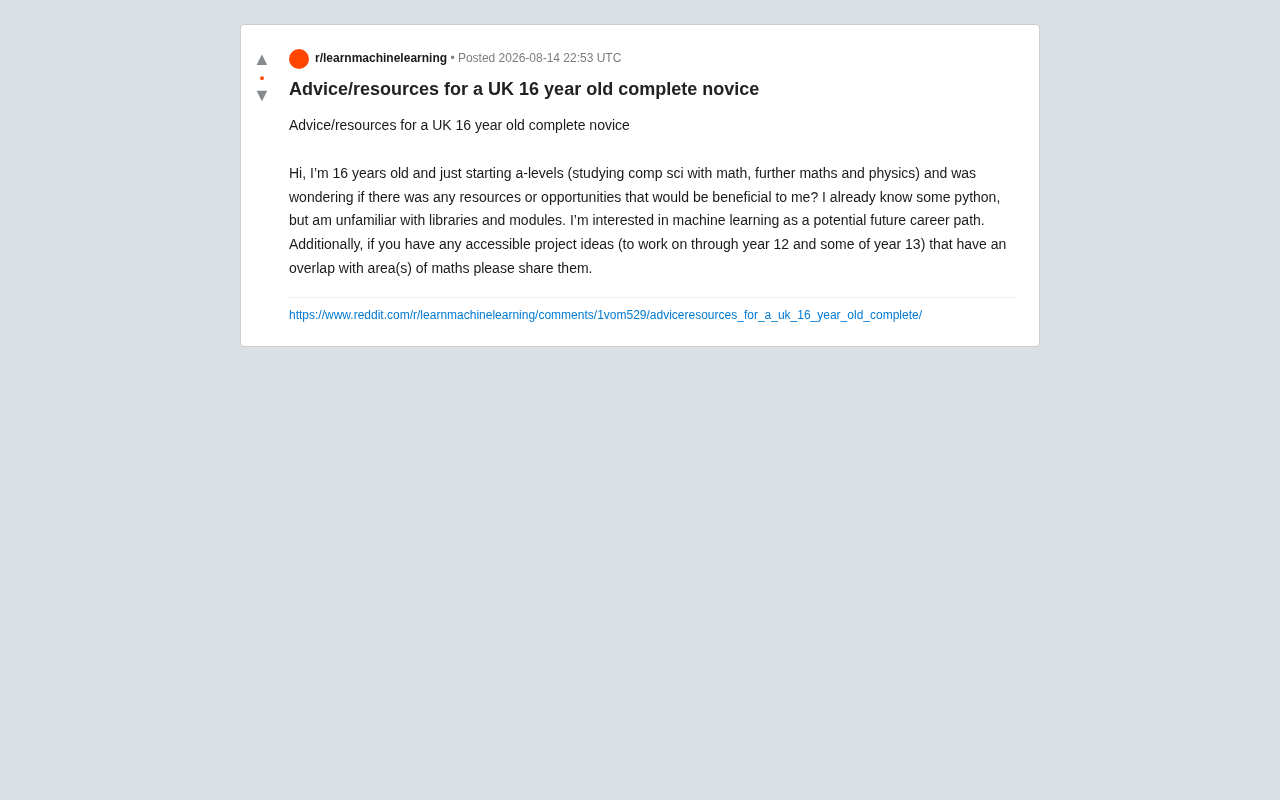
In Reddit's machine learning community, a 16-year-old student from the UK — currently preparing for A-Level exams in Computer Science, Mathematics, Further Mathematics, and Physics — posed a highly representative question: as a complete beginner who knows a bit of Python but isn't familiar with libraries and modules, how should I get started with machine learning? Are there any project suggestions suitable for the Year 12 to Year 13 stage that also tie in with mathematics?
A-Levels (Advanced Levels) are the UK's senior secondary academic qualifications, typically completed during Year 12 and Year 13 (ages 16–18). Students usually choose 3–4 subjects for in-depth study. Among these, Further Maths covers university-preparatory topics like linear algebra, complex numbers, and differential equations — concepts that many education systems worldwide don't introduce systematically until university. Students who take this subject have a significant advantage when applying to top universities like Oxford and Cambridge for STEM programs.
The question seems simple, but it reflects a common struggle shared by many beginners: Faced with an overwhelming number of resources, where do you start? And how do you translate your math foundation into real machine learning skills? This article draws on this real-world scenario to map out a clear, actionable learning path.
Why This Starting Point Is Actually a Huge Advantage
Let's start with a fact that's easy to overlook: this student's position is actually remarkably favorable.
The two pillars of machine learning are programming skills and mathematical foundations. This student happens to be systematically studying Further Maths and Physics — meaning they'll gain early exposure to core concepts in linear algebra, calculus, and probability & statistics, which form the mathematical bedrock of machine learning.
Many adults transitioning into machine learning find that math is their biggest obstacle. Gradient descent requires calculus; the forward pass in neural networks is essentially matrix multiplication (linear algebra); and model evaluation relies heavily on probability and statistics. Gradient Descent is one of the most fundamental optimization algorithms in machine learning. At its core, it uses the concept of partial derivatives from multivariable calculus to iteratively update parameters in the direction where the loss function decreases most steeply. Specifically, for a loss function L(θ), the algorithm computes ∇L (the gradient vector composed of partial derivatives with respect to each parameter), then updates parameters according to the rule θ = θ - α·∇L, where α is the learning rate. Geometrically, this process is like searching for the lowest point in a high-dimensional "valley." The differentiation rules and chain rule learned in A-Level Mathematics are precisely the mathematical foundations needed to understand the backpropagation algorithm.
While peers are still wondering "why do we need to learn all this math," this student is already building the foundation through school coursework. Treating your school math classes as a free prep course for machine learning is their greatest advantage.
Leveling Up Python from "Know a Little" to "Can Actually Use It"
The student mentioned knowing "some Python but not being familiar with libraries and modules." This is the critical next step. Machine learning relies almost entirely on the Python ecosystem:
- NumPy: Numerical computing and array operations — understanding it means understanding vectorized thinking. Vectorization is a core programming paradigm in scientific computing. Traditional Python loops are extremely slow when processing large-scale data because Python is an interpreted language with significant overhead per iteration. NumPy pushes operations down to underlying C/Fortran code, executing operations on entire arrays at once, achieving speedups of 100x or more. For example, computing the dot product of two vectors with a million elements might take hundreds of milliseconds with a Python loop but less than 1 millisecond with NumPy. Learning to "replace loops with matrix operations" isn't just a performance optimization trick — it's the mental foundation for understanding batch computation in neural networks.
- Pandas: Data processing and cleaning — 80% of time in real projects is spent here. There's a widely cited saying in the industry: data scientists spend 80% of their time on data preparation. Real-world data is riddled with missing values, outliers, inconsistent formats, and duplicate records. Pandas provides powerful data manipulation capabilities — including missing value imputation (fillna), pivot tables (pivot_table), group-by aggregations (groupby), and merge/join operations. The performance ceiling of a machine learning model often depends more on data quality than algorithm choice, making data cleaning skills the key dividing line between "can follow a tutorial" and "can solve real problems."
- Matplotlib / Seaborn: Data visualization — helps build intuition about data.
- Scikit-learn: A one-stop toolbox for classical machine learning algorithms — the go-to choice for beginners.
Don't study libraries in isolation. Instead, learn by looking up documentation and using them while solving problems. True mastery of a library comes from repeated use, not from reading tutorials cover to cover.
Recommended Machine Learning Learning Path
For complete beginners, too many resources can actually be a burden. Here's a step-by-step ladder from easy to advanced, designed to help you avoid "Tutorial Hell" — the cycle of endlessly bookmarking resources without ever getting your hands dirty. "Tutorial Hell" is a widely discussed phenomenon in programming learning communities, referring to learners who continuously consume tutorial content — watching videos, bookmarking blog posts, buying courses — yet never manage to independently complete a project. The psychological root is a fear of "not being prepared enough": the persistent feeling that you need one more course before you can start building. An effective way to break this cycle is the "start at 70% readiness" approach — once you feel you roughly understand a concept, immediately try to implement it in code, and look things up when you hit a wall. This "learn by doing" approach may involve frequent stumbling blocks early on, but knowledge retention is far higher than passive learning.
Phase 1: Building Intuition (A Few Months)
- 3Blue1Brown's Linear Algebra and Neural Network video series: 3Blue1Brown is a mathematics education YouTube channel founded by Grant Sanderson, renowned for its beautiful animated visualizations. The channel uses a self-developed open-source animation engine called Manim (Mathematical Animation Engine) to produce videos that transform abstract mathematical concepts into intuitive geometric imagery. The Essence of Linear Algebra series uses animations to show how matrix transformations "warp" space, helping viewers truly understand the geometric meaning of determinants and eigenvalues. The Neural Networks series explains the complete mathematical process of forward propagation, backpropagation, and gradient descent from scratch. This teaching philosophy of "build intuition first, then handle formulas" is fundamentally different from traditional textbooks and is especially well-suited for self-learners. These videos explain matrices, vectors, and neural networks visually, complementing what you're learning in school math — highly recommended.
- Kaggle Learn's free micro-courses: The Python, Pandas, and Intro to Machine Learning modules are concise and hands-on, letting you write code in the browser as you learn.
- Andrew Ng's Machine Learning course (Coursera): A true classic among classics, with a moderate math threshold that's perfect for high school students with a solid math background. Andrew Ng's course was originally offered at Stanford University in 2011, later moved to the Coursera platform, and became one of the most influential courses in online education history, with over 5 million registered learners worldwide. In 2022, the course underwent a major update, migrating from Octave/MATLAB to Python and adding deep learning fundamentals. The course's core strength lies in Ng's exceptional ability to simplify complexity — he breaks down intricate mathematical derivations into intuition-level understanding while maintaining sufficient rigor. For students at the A-Level math level, the linear algebra and calculus involved won't be a barrier; rather, they'll get to see these mathematical tools applied elegantly to real problems.
Phase 2: Hands-On Practice (Throughout Year 12–13)
Once the foundational concepts are clear, the focus should shift to practical work. At this point, you can:
- Join beginner-level competitions on Kaggle (such as the Titanic survival prediction challenge) and learn from others' public notebooks. Kaggle is the world's largest data science competition platform, acquired by Google in 2017. The Titanic: Machine Learning from Disaster competition is Kaggle's most classic beginner challenge, asking participants to predict a passenger's survival probability based on features like age, sex, and ticket class. This competition is ideal for beginners because the dataset is small (only 891 training records), the features are intuitive, and there are thousands of public Notebooks to learn from. More importantly, it covers the complete machine learning workflow: exploratory data analysis → feature engineering → model training → prediction submission → score feedback, letting newcomers experience the entire process in one complete loop.
- Read and reproduce examples from the Scikit-learn official documentation, one by one.
- Try fast.ai's practice-oriented course, which emphasizes "get it running first, understand the theory later." fast.ai was founded by Jeremy Howard and Rachel Thomas, and its core teaching philosophy is the "top-down" learning approach — students run a complete deep learning model (such as an image classifier) in the very first lesson, gaining a sense of accomplishment and a big-picture overview, then gradually peel back the underlying principles in subsequent lessons. This is the complete opposite of the traditional academic path of "study linear algebra for three months before touching a model." fast.ai also developed a Python library of the same name, providing a high-level wrapper around PyTorch that enables training decent models with just a few lines of code. This approach is especially suitable for learners who already have some programming background and want to quickly gain practical experience.
Machine Learning Project Ideas That Connect with Mathematics
The student specifically wanted projects that intersect with mathematics. This is an excellent direction because "translating" classroom math into code deepens understanding of both. Here are several project ideas of moderate difficulty that can be developed progressively:
1. Implement Linear Regression from Scratch
Without using any machine learning library, use only NumPy to write gradient descent and fit a straight line. This project directly connects calculus (derivatives), linear algebra (matrix operations), and programming. When you derive and implement the gradient of the loss function by hand, machine learning stops being a black box. Although linear regression is one of the simplest models, it contains all the core elements of machine learning: hypothesis function, loss function, optimization algorithm, and model evaluation. During the from-scratch implementation, you'll deeply appreciate how learning rate selection affects convergence speed — too large causes oscillating divergence, too small means painfully slow convergence. This intuition for hyperparameters is extremely valuable when learning more complex models later on.
2. Visual Exploration of Probability and Statistics
Use real-world datasets (such as weather, sports, or economic data) for exploratory analysis: compute correlation coefficients, plot distributions, and verify the Central Limit Theorem. This overlaps heavily with the A-Level statistics curriculum while also building data processing skills. The Central Limit Theorem is one of the most beautiful results in statistics — regardless of the shape of the original data distribution, as long as the sample size is large enough, the distribution of sample means will converge to a normal distribution. Simulating this process in Python (repeatedly drawing samples from uniform distributions, exponential distributions, etc. and computing means), then watching the histogram gradually morph into a bell curve, is a truly memorable learning experience.
3. Making Predictions with Physics Data
Leveraging a physics background, collect or simulate a set of physics experiment data (such as pendulum period or projectile motion), use machine learning models to fit the underlying patterns, and then compare the results with theoretical formulas. This kind of interdisciplinary project is also very compelling in university applications. For example, you could use sensors to collect pendulum motion data, let a machine learning model automatically "discover" the square root relationship between period T and length L (T ∝ √L), and then compare it with the theoretical formula derived in physics class. The convergence of these two cognitive paths — "letting data speak" and "deriving from first principles" — is where the beauty of scientific research lies.
4. Handwritten Digit Recognition (MNIST)
This is the "Hello World" of machine learning. The MNIST (Modified National Institute of Standards and Technology) dataset was compiled and published by Yann LeCun and others in 1998, containing 70,000 grayscale images of handwritten digits at 28×28 pixels (60,000 training and 10,000 test images). Its status in machine learning is comparable to "Hello World" in programming — nearly every deep learning textbook uses it as the first hands-on case study. Although modern models can achieve over 99.8% accuracy on MNIST, it remains the best teaching tool for understanding the image classification pipeline (pixel input → feature extraction → classification output).
You can start with a quick implementation using Scikit-learn, then progress to building a simple neural network. It gives you an intuitive feel for the complete pipeline from data to model to prediction. More advanced learners typically move on to the more challenging Fashion-MNIST (replacing digits with clothing images) or CIFAR-10 (containing 10 classes of color images including planes, cars, birds, etc.) datasets.
Practical Tips for Young Learners
Drawing on community experience, here are a few pieces of advice that go beyond specific resources:
First, prioritize practice over collecting resources. The easiest trap for beginners is "hoarding resources without ever getting started." It's better to use just one course and complete every single exercise in it.
Second, let projects drive your learning. Rather than passively watching an entire course from start to finish, approach learning with a problem you want to solve — learn what you need when you need it, and both retention and understanding will be stronger.
Third, take advantage of the free ecosystem. Kaggle, Google Colab (free GPU), and GitHub are all powerful tools at zero cost. Google Colaboratory (Colab for short) is a free cloud-based Jupyter Notebook environment provided by Google. Users don't need to install any software locally — just a browser and a Google account to start writing and executing Python code. Colab offers free GPU (typically a Tesla T4) and TPU computing resources, which are extremely valuable for deep learning training — a single T4 GPU costs approximately $2,500 on the market. Colab also integrates seamlessly with Google Drive for easy code saving and sharing. For beginners, Colab's greatest value is eliminating "environment setup" — the most common barrier to entry. Many beginners give up before writing their first line of machine learning code, defeated by Python version conflicts, CUDA installation issues, and other configuration headaches. Writing code on Colab requires no local environment setup, making it ideal for newcomers.
Fourth, don't rush. From Year 12 to Year 13, you have nearly two years — steady progress is the way to go. Machine learning is a marathon. A solid foundation in math and programming matters far more than chasing the latest model hype.
For a 16-year-old with mathematical talent and clear interests, now is the perfect time to start. Stay curious, keep building, and in two years, you'll look back and find that what you've accumulated far exceeds what you imagined.
Key Takeaways
Related articles

Chain of Thought Isn't Just for AI: How Humans Can Use CoT to Improve Thinking Quality
Chain of Thought isn't just a prompt trick for large models. Starting from a Hacker News discussion, this article analyzes why CoT works for human thinking too, breaks down actionable ways to transfer it, and highlights the key differences between human CoT and machine CoT.
Cloudflare Teams Up with OpenAI: Closi…
Cloudflare Teams Up with OpenAI: Closing the Loop from Vulnerability Discovery to Defense with AI
Cloudflare uses OpenAI Daybreak to investigate security vulnerabilities and generate reviewable remediation plans, while developers use Codex to boost coding efficiency and quality.

Orca Multi-Agent Orchestration in Practice: A Guide to Parallel Collaboration with Claude and Codex
Orca is Stable AI's free open-source agent workbench supporting 34 agents like Claude Code and Codex in parallel. Learn its Git worktree isolation, multi-model orchestration, and mobile management.