Getting Started with Ollama: A Powerful Tool for Deploying Open-Source LLMs Locally

Ollama lets you deploy open-source LLMs locally with one click—free, cross-platform, and zero token costs.
Ollama is a free, open-source platform for managing and deploying open-source LLMs like DeepSeek locally. It hides low-level GPU complexity, supports macOS, Windows, Linux, and Docker, and offers REST API, CLI, and Web UI modes—enabling private AI apps such as RAG knowledge bases with zero token costs.
Why Deploy Large Language Models Locally
Today, almost everyone has used online large language models—from ChatGPT and DeepSeek to Baidu's ERNIE Bot and Alibaba's Tongyi Qianwen. These services share a common trait: you need to log in to a URL specified by the provider, converse with a model that the vendor has pre-deployed, and the model answers you based on its own knowledge base.
For everyday chat scenarios, such online services are usually free or extremely low-cost. But once personalized development comes into play, the situation changes drastically. Take API calls as an example: when using the ChatGPT or DeepSeek APIs, you need to apply for a dedicated API Key and pay based on the number of tokens actually consumed.
What is a Token? A token is the basic unit that large language models use to process text—you can think of it as a word or a fragment of characters. Typically, one English word corresponds to about 1–2 tokens, and each Chinese character corresponds to about 1–2 tokens. Token billing is calculated separately for input tokens (the content you send) and output tokens (the content the model returns). For GPT-4, for instance, the cost is roughly 10–30 US dollars per million tokens; the DeepSeek API is relatively affordable, but over the long term and at large scale, these accumulated costs can still add up considerably.
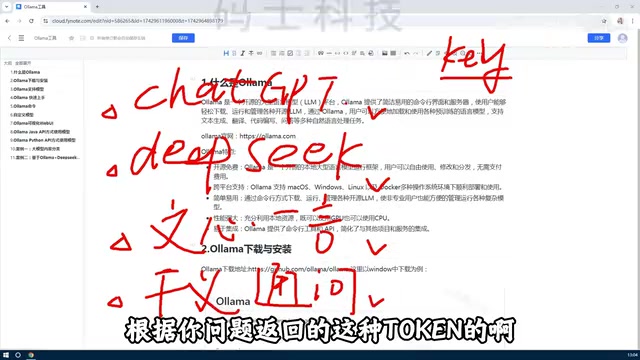
This naturally raises a question: since models like DeepSeek are already open-source (ChatGPT is not), can we bypass online services and deploy these open-source models directly on our local machines?
What is an open-source LLM? An open-source LLM is a large language model whose weight parameters and model architecture are made publicly available, allowing users to freely download, modify, and deploy it locally. Meta's LLaMA series, Mistral, and DeepSeek are among the most representative open-source LLMs today. Compared with closed-source models (such as GPT-4 and Claude), open-source models offer natural advantages in commercial use, data privacy, and personalized customization—but they require users to provide their own hardware resources to run the model.
The answer is yes—once deployed locally, whether for daily use or API development, you will no longer incur any token fees. And to achieve this, you'll need the star of this article: Ollama.
What is Ollama
Ollama is an open-source LLM management platform. Its core purpose is to help developers conveniently deploy various open-source LLMs onto their local machines, while supporting model downloading, management, deletion, and even personalized customization.

Ollama offers two ways to use it:
- Command-line interface (CLI): interactive operation, ideal for quick validation and scripted management;
- Web UI mode: a graphical interface that is intuitive, friendly, and has a lower barrier to entry.
With Ollama, you can easily download and deploy open-source models locally—including large models with hundreds of gigabytes of parameters. Of course, the larger the model, the higher the hardware requirements. In addition to language models, Ollama also supports managing multimodal models, such as LLaVA, which excels in image understanding.
The Core Advantages of Ollama
One-Click Deployment That Hides Low-Level Complexity
Before Ollama came along, deploying open-source LLMs on your own was quite a cumbersome affair. You had to manually configure CUDA (NVIDIA's GPU parallel computing platform), cuDNN (a deep learning acceleration library), deep learning frameworks like PyTorch or TensorFlow, as well as the model-specific Python dependency packages. Different models often had conflicting library version requirements, and version incompatibility issues were extremely common; on top of that, you had to write your own inference scripts to load and invoke the models. The entire process presented an extremely high barrier for non-professional developers, and a single misstep could leave you stuck on environment configuration.
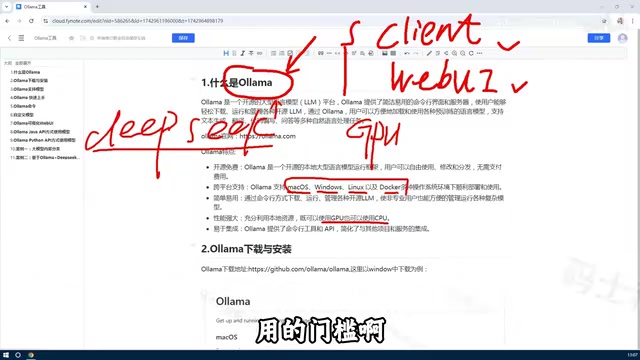
Ollama hides all of this complexity. Once installed, you can directly download, manage, and run models—no need to manually wrestle with low-level GPU configuration—dramatically lowering the barrier for developers and enterprises to use open-source models.
Cross-Platform and Hardware Adaptive
Ollama is free and open-source, and offers full platform support, running on macOS, Windows, Linux, and Docker environments:
- Personal learning and experimentation: installing on Windows or macOS is recommended;
- Enterprise production environments: deploying on Linux or via Docker is recommended.
It's worth noting that when running models, Ollama can intelligently schedule hardware resources—prioritizing the GPU when one is available, and automatically falling back to the CPU when there isn't. This adaptive capability allows even machines with limited configurations to run large models smoothly.
Comprehensive API and Multi-Language Extensibility
Ollama provides a comprehensive command-line interface and a REST API, supporting offline invocation of local models.
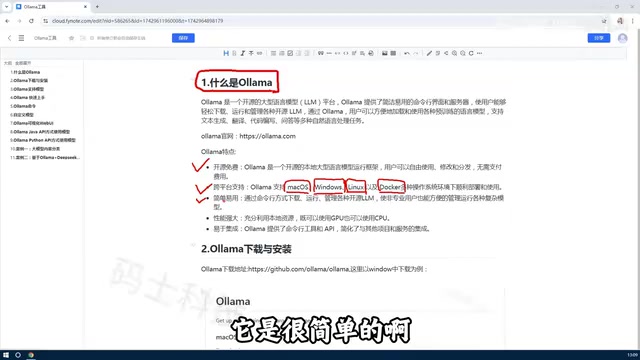
This unlocks a highly valuable use case: after deploying an open-source model locally, you can interact with the model via the API and, building on that, connect it to an enterprise's private knowledge base to quickly build intelligent Q&A systems or knowledge assistants tailored to specific business domains.
How does a RAG private knowledge base work? Such applications typically adopt a RAG (Retrieval-Augmented Generation) architecture: first, internal enterprise documents are split into small passages, which are vectorized and stored in a vector database; when a user asks a question, the system first retrieves the document fragments most relevant to the question from the database, then injects them as background context into the model's prompt, guiding the model to answer based on private knowledge. This architecture combines the LLM's natural language understanding capabilities with the timeliness of private knowledge, and is one of the mainstream technical approaches for enterprise AI implementation. Throughout the process, data never leaves the local environment—making it secure and controllable—and the invocation cost is zero.
In terms of extensibility, Ollama supports integration with multiple programming languages such as Python, Java, and Rust, so no matter your tech stack, you can conveniently integrate local model capabilities.
Summary
Looking back over this article, Ollama's core value can be summarized in the following five points:
- Fundamental positioning: an open-source LLM management tool that helps developers deploy open-source models locally and say goodbye to token billing;
- Ease of use: offers three interaction modes—REST API, command line, and Web UI—making management and invocation highly convenient;
- Hardware-friendly: automatically schedules GPU or CPU resources, significantly lowering the hardware barrier;
- Cross-platform: full support for macOS, Windows, Linux, and Docker;
- Highly extensible: supports multi-language integration, making it ideal for building personalized AI applications such as private knowledge bases and domain-specific Q&A systems.
For developers and enterprises who want to fully leverage the power of LLMs without being constrained by online service costs and data privacy concerns, Ollama is a local deployment tool well worth mastering first. Future articles will further introduce specific command usage, the model download process, and hands-on private knowledge base setup—so stay tuned.
Key Takeaways
Related articles

Disaster and Glory of the Apollo Program: The History We Must Revisit Before Returning to the Moon
From the fatal Apollo 1 fire to Apollo 8's daring lunar orbit to Apollo 11's successful landing—revisiting the disasters, fears, and compromises of the Apollo program and their lessons for today's return to the Moon.
Netflix Trust Exercise Turns Into Firing Trap: Where Are the Boundaries of Corporate Trust?
A Netflix employee was fired after sharing private info in a trust exercise. We analyze the risks of corporate trust exercises and how employees can protect themselves.

AMD CDNA5 Architecture Deep Dive: Technical Evolution and the AI Computing Competition Landscape
Deep analysis of AMD's CDNA5 architecture covering Chiplet packaging upgrades, HBM memory evolution, and low-precision compute optimization, examining how AMD challenges NVIDIA's AI chip dominance.