Getting Started with ROS2: What Is a Robot Operating System, and How Does It Differ from ROS1?

A clear intro to ROS2 — what it is, how it differs from ROS1, and how to pick the right version.
This article introduces ROS (Robot Operating System) for absolute beginners — clarifying that ROS is an open-source SDK and middleware framework, not a traditional OS. It explains the key architectural differences between ROS1 and ROS2 (especially the shift from a centralized ROS Master to DDS-based communication), and guides learners on choosing a stable ROS2 version to avoid compatibility pitfalls.
The Era of Intelligent Robots Has Arrived
From robots dancing gracefully on the Spring Festival Gala stage, to robotic vacuums quietly cleaning our homes, to autonomous food-delivery robots in hotels — intelligent robots are no longer a science fiction concept. They've woven themselves into the fabric of everyday life. As one content creator put it in a tutorial: "The future we used to talk about is already here. The era of intelligent robots is next."
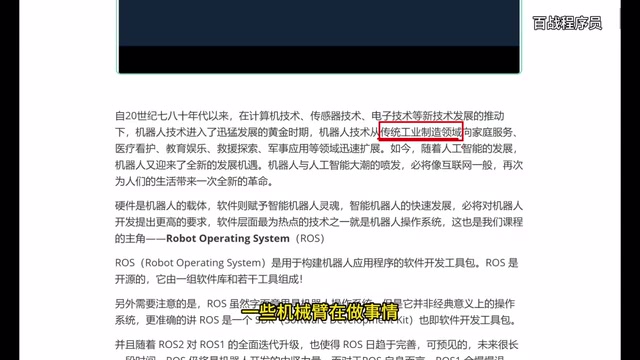
Since the 1970s and '80s, continuous advances in computing, sensor technology, and electronics have propelled robotics into a golden age of rapid development. Applications have expanded far beyond traditional industrial manufacturing into home services, medical care, education and entertainment, search and rescue, military use, and many other domains.
From "Mindless" to "Intelligent"
Understanding intelligent robots starts with distinguishing between a "robot" and an "intelligent robot." Traditional industrial robots — like the robotic arms on an automotive assembly line — execute pre-programmed instructions one by one. They are, in essence, "mindless machines that cannot think." These robots emerged in the 1960s and operate on a "teach-and-playback" model: engineers write fixed programs in advance, and the mechanical arm repeats those motions precisely, unable to respond to any unanticipated change. They excel in structured, highly repetitive assembly-line environments, but they are fundamentally "advanced automation equipment," not intelligent agents.
Intelligent robots, by contrast, possess perception and decision-making capabilities. This leap depends on the convergence of three key technologies: the perception layer (cameras, LiDAR, IMU, and other sensors), the decision layer (AI algorithms, neural networks), and the execution layer (motors, joints).
Take a robotic vacuum as an example: it first explores the entire living space, builds a map, plans a cleaning path based on that map, and automatically navigates around obstacles. The core technology behind all of this is SLAM (Simultaneous Localization and Mapping) — the robot continuously fuses sensor data to construct a real-time map of its environment while tracking its own position. This is the technical foundation of "having a brain," and the engineering embodiment of basic spatial awareness.
With the explosion of artificial intelligence — particularly the maturation of AIGC technologies like ChatGPT, DeepSeek, and ERNIE Bot — robots are now being equipped with a genuine "brain."

The deeper significance of AIGC lies in giving rise to a new field: Embodied AI — the deep integration of cognitive capabilities like language understanding, logical reasoning, and task planning with physically embodied robotic platforms. Large language models based on the Transformer architecture provide a universal "semantic interface," freeing robots from needing a separately written program for every task. Instead, goals can be described in natural language, and AI handles task decomposition and action planning. This paradigm shift from traditional robot programming is comparable to the leap from assembly language to high-level programming languages.
The deep fusion of robotics and artificial intelligence will usher in a new revolution in human life — one as transformative as the internet and the mobile internet before it.
ROS: The Core Tool for Robot Development
If hardware is the robot's "body," then software is what gives it a "soul." In the world of robot software development, one of the most prominent technologies is the subject of this article: ROS (Robot Operating System).
What Exactly Is ROS?
There's a key misconception worth clearing up right away: despite having "Operating System" in its name, ROS is not a traditional operating system.
The operating systems we're familiar with include Android, iOS, and HarmonyOS on mobile, and Windows, Linux, and macOS on desktop — those are operating systems in the classic sense.
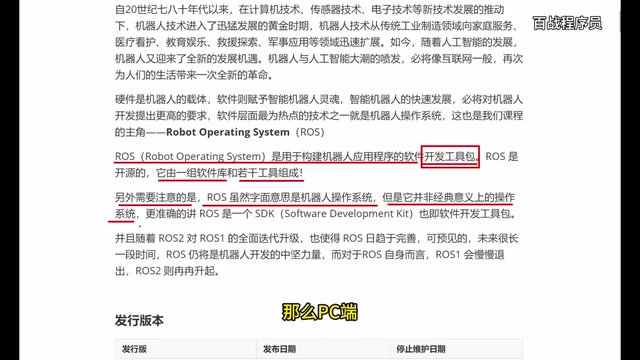
ROS is more accurately described as an SDK (Software Development Kit), and the industry also refers to it as a "Robotics Middleware Framework." The core value of middleware is that it abstracts away low-level hardware differences and provides standardized software interfaces, allowing modules developed by different teams to work together seamlessly.
ROS is architected around three core concepts: Node, Topic, and Service. Each functional module runs as an independent node (e.g., a camera driver node, a navigation node). Nodes communicate asynchronously via topics using a publish/subscribe model, or synchronously via services using a request/response model. This loosely coupled architecture allows sensor drivers, perception algorithms, and motion control modules to be developed and tested independently, dramatically lowering the barrier to building complex robotic systems.
ROS consists of a collection of software libraries and supporting tools, and it is entirely open source. ROS runs on top of an operating system like Linux and provides the standardized framework, communication mechanisms, and toolchain needed to develop robot software.
Grasping this distinction helps beginners avoid a common conceptual pitfall: you're not "installing a new OS" — you're building a specialized development toolkit on top of an existing one.
ROS1 vs. ROS2: A Critical Version Evolution
After years of development, ROS has two major generations: ROS1 and ROS2. ROS1 is gradually being superseded by ROS2 — not because ROS1 has no users, but because the mainstream trend has clearly shifted toward ROS2.
Why Choose ROS2?
ROS2 is not a simple upgrade of ROS1. It is a complete redesign starting from the underlying communication architecture. The most fundamental flaw in ROS1 was its reliance on a central "ROS Master" node for communication. If the Master process crashed, the entire robot system went down — an unacceptable single point of failure in industrial and medical applications.
ROS2 completely abandons this architecture in favor of DDS (Data Distribution Service), an industrial-grade communication standard, as its underlying middleware. DDS is a decentralized publish/subscribe protocol that natively supports automatic node discovery, eliminates central failure points, and provides real-time guarantees through QoS (Quality of Service) policies. ROS2 also adds support for Windows and macOS, along with a more robust security communication mechanism (SROS2) — marking a significant shift for ROS from an academic research tool toward an industrial-grade production system.
Compared to ROS1, ROS2 offers significant improvements in communication architecture, real-time performance, cross-platform support, and security. The ecosystem continues to mature rapidly. The internal landscape is clear: ROS1 is slowly fading out, while ROS2 is on the rise.
For any beginner starting from scratch, choosing ROS2 as your entry point is the smarter decision.
Version Management: A Detail Easy to Overlook
The first version of ROS was released in 2017, and new versions have been released almost every year since, at a fairly rapid pace. ROS2 version names follow an alphabetically incremented animal-name convention (e.g., Humble Hawksbill, Iron Irwini, Jazzy Jalisco), and they are closely tied to the Ubuntu LTS (Long-Term Support) release cycle — each stable ROS2 release is typically paired with a specific Ubuntu LTS version and enjoys a corresponding maintenance window. Understanding the "ROS version — Ubuntu version" relationship is the first lesson in setting up your development environment without running into pitfalls.
A critical trap that beginners frequently fall into: different versions have compatibility issues.
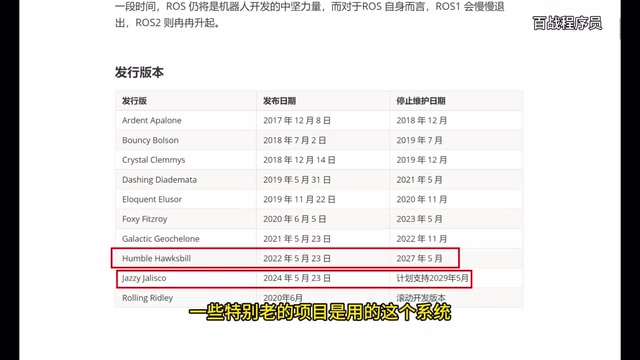
Every ROS version has an End-of-Life (EOL) date, which determines its long-term viability. Current mainstream projects cluster around a few categories:
- Older stable releases: Reached EOL in 2023 — not recommended for new projects
- Intermediate releases: EOL expected May 2027 — still actively maintained
- Latest releases: EOL planned May 2029 — the recommended choice for current tutorials
There is also a special Rolling release (a rolling development version) with no defined EOL date that receives continuous updates. Think of Rolling as the "early access" version, while the dated releases are "stable versions." Although Rolling supports the latest features, for developers who prioritize stability — especially beginners — a stable release is always the right choice.
What To Do About Version Incompatibilities?
If you find a project on the internet that was written for a specific ROS version, it often won't run directly on a different version. There are two approaches: either switch to a matching version, or modify the configuration to be compatible with your current version. Fortunately, many open-source project documentation pages explain how to handle compatibility — reading the docs carefully is an unavoidable part of the learning process.
Summary: Taking Your First Step in Robot Development
From understanding the era of intelligent robots, to grasping ROS's true nature, to clarifying version selection strategy — this introductory article gives beginners a clear conceptual framework. The core takeaway in one sentence: ROS is an open-source software development kit (SDK) for robotics, and you should learn it using a stable release of ROS2.
Once these foundational concepts are in place, the next step is setting up your development environment and beginning the hands-on journey with ROS2. For developers looking to seize the opportunities of the intelligent robot era, this is undoubtedly a starting point well worth your serious investment.
Key Takeaways
Related articles

Disaster and Glory of the Apollo Program: The History We Must Revisit Before Returning to the Moon
From the fatal Apollo 1 fire to Apollo 8's daring lunar orbit to Apollo 11's successful landing—revisiting the disasters, fears, and compromises of the Apollo program and their lessons for today's return to the Moon.
Netflix Trust Exercise Turns Into Firing Trap: Where Are the Boundaries of Corporate Trust?
A Netflix employee was fired after sharing private info in a trust exercise. We analyze the risks of corporate trust exercises and how employees can protect themselves.

AMD CDNA5 Architecture Deep Dive: Technical Evolution and the AI Computing Competition Landscape
Deep analysis of AMD's CDNA5 architecture covering Chiplet packaging upgrades, HBM memory evolution, and low-precision compute optimization, examining how AMD challenges NVIDIA's AI chip dominance.