Getting Started with SRC Bug Bounties: Can You Find Vulnerabilities Without Knowing How to Code?

A practical guide showing beginners how to start earning SRC bug bounties without programming skills.
This article explains how beginners can start finding vulnerabilities on SRC bug bounty platforms without programming knowledge. By mastering tools like Burp Suite, dirsearch, and OneForAll, newcomers can target business logic flaws, information leakage, and weak credentials—three high-yield, low-barrier vulnerability types. Programming becomes important later for code auditing and understanding deeper exploits, but taking action first builds confidence and momentum.
Disclaimer: This article is intended solely for security education and knowledge sharing with a defensive purpose. Unauthorized penetration testing is illegal. Please strictly comply with applicable cybersecurity laws and never use these techniques for illegal purposes. You bear full responsibility for any misuse.
For newcomers looking to break into cybersecurity—especially those hoping to earn bug bounties through SRC (Security Response Center) platforms—a common mental barrier exists: If my programming skills are weak, or I can't code at all, can I still find vulnerabilities? Based on the SRC tutorial series by bilibili creator Teacher Xiaojian, this article systematically examines the real relationship between programming and vulnerability discovery, helping beginners overcome their initial hesitations.
What Are SRC Platforms?
Before diving into the main discussion, it's important to understand what SRC means. SRC (Security Response Center) refers to platforms established by enterprises to receive and respond to security vulnerability reports. Major SRC platforms in China include those built by large internet companies (such as Tencent's TSRC, Alibaba's ASRC, and ByteDance's BSRC) as well as aggregation platforms (such as Butian, Vulnerability Box, and FireWire Security Platform). White-hat hackers, with proper authorization, conduct security testing on target systems and submit discovered vulnerabilities to SRC platforms. Once confirmed by the enterprise's security team, they receive cash rewards, points, or certificates of honor. Bounties are typically tiered by severity: low-risk vulnerabilities earn tens to hundreds of yuan, medium-risk hundreds to thousands, and high/critical severity can reach thousands or even tens of thousands of yuan. The SRC mechanism essentially leverages crowdsourced security expertise to help enterprises discover their own blind spots, forming a "crowdtesting" ecosystem that also provides security practitioners with a legitimate battlefield for hands-on practice.
Is Programming a Must for SRC Bug Hunting?
Let me give you the conclusion upfront: At the beginner stage, programming is NOT a prerequisite for vulnerability discovery—but mastering it will take you further.
Many newcomers feel their programming foundation isn't strong enough and hesitate to start hands-on practice, falling into the trap of "never-ending prerequisites." In reality, what truly matters for beginners isn't finishing programming courses first, but learning the basics of common tools and immediately jumping into real-world practice.
The core logic at the beginner stage is: first become proficient with tools to find some simple vulnerabilities, thereby building confidence and gaining positive feedback. Once you find your first vulnerability and receive your first bounty, you'll have the motivation to find a second and third. Programming knowledge can be gradually supplemented later based on your needs. This "act first, study later" approach actually leads to higher learning efficiency.
Three Core Tools: Your "Weapons" for SRC Bug Hunting
As the saying goes, "A craftsman must first sharpen their tools." When programming skills are lacking, tools become a beginner's most important weapons. The tutorial highlights three core tools with low programming dependencies.
Burp Suite: The Core Tool for Vulnerability Discovery
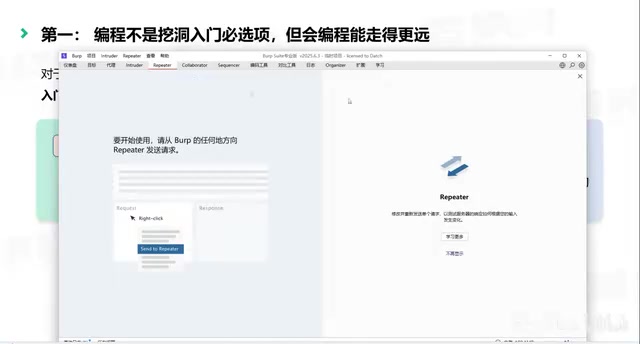
Developed by PortSwigger, Burp Suite is currently the world's most widely used web application security testing platform, often called the "core of the core" in vulnerability discovery. Its fundamental working principle is acting as a Man-in-the-Middle Proxy between the browser and the target server: all HTTP/HTTPS requests from the browser pass through Burp Suite first, where users can intercept, view, and modify request content before forwarding it to the server. It can similarly intercept server responses. This mechanism allows testers to precisely observe and tamper with every detail of each communication. You could say all other tools serve as "support" for it.
Its three key features are:
- Proxy: Intercepts and views HTTP requests—the foundation of the entire tool's operation
- Repeater: Manually modify and resend requests to test the security of specific functions
- Intruder: Automated batch testing, such as password brute-forcing and parameter enumeration
Burp Suite comes in Community Edition (free) and Professional Edition (paid). The Professional Edition offers faster Intruder speeds, an automated Scanner, and richer plugin support. Its BApp Store houses hundreds of community and official plugins covering automated vulnerability detection, encoding/decoding, token tracking, JWT analysis, and more, vastly extending the tool's capabilities.
dirsearch / Yujian: Information Leakage Scanning Tools
These tools scan websites for sensitive files and hidden directories, checking for information leakage, exposed API endpoints, and similar issues.
dirsearch is a Python-based open-source command-line tool. Its principle is to use pre-built dictionary files (containing common directory names, file names, backup file extensions, etc.) to send HTTP requests to the target server one by one, determining whether a path actually exists based on the returned status codes (e.g., 200 means it exists, 403 means access forbidden, 301/302 means redirect). Through these discovered directories or files, you can often find extremely valuable information—such as .git directory leaks (which can be used to reconstruct source code), .env environment variable files (potentially containing database passwords and API keys), backup files (like .bak, .zip), Swagger API documentation (exposing all API endpoints), phpinfo pages (leaking server configuration), or even directly exposed ID numbers, phone numbers, names, and backend login credentials.
Yujian is a similar graphical tool developed by Chinese security researchers, with built-in customized dictionaries targeting common Chinese CMS platforms and frameworks, offering better compatibility with the Chinese internet environment.
OneForAll: A Powerful Subdomain Collection Tool
When you're facing a target website with no idea where to start, you can use OneForAll to discover its subdomains, thereby expanding your attack surface. Finding related sub-sites often reveals new entry points.
OneForAll, developed and open-sourced by Chinese security researcher Shmilylty, is a comprehensive subdomain collection tool. Subdomain collection is crucial in penetration testing because large enterprises typically own numerous subdomains (such as mail.example.com, api.example.com, test.example.com). The systems behind these subdomains may be maintained by different teams with varying security levels—test environments, legacy systems, and internal admin panels often become weak points. OneForAll integrates multiple subdomain discovery techniques: DNS brute-force enumeration, search engine dorking (Google Dorking), Certificate Transparency log queries, DNS zone transfer testing, and data aggregation from various online threat intelligence APIs (such as Shodan, Censys, VirusTotal), maximizing coverage of the target's subdomain assets.
Three "Beginner-Friendly" SRC Vulnerability Types
From a practical standpoint, the tutorial recommends beginners focus on three types of vulnerabilities that have low programming dependency and high yield.
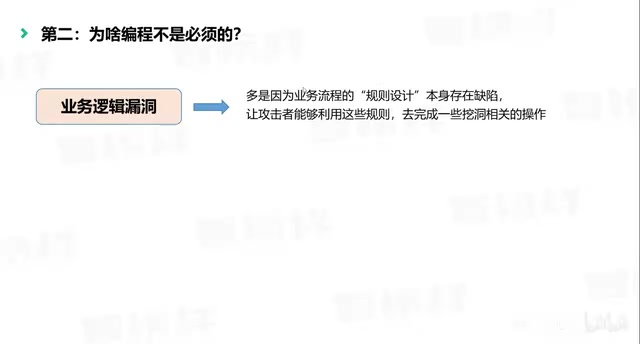
Business Logic Vulnerabilities: Over 50% of Findings
Business logic vulnerabilities stem from flaws in the design of business process rules themselves. They are fundamentally different from traditional technical vulnerabilities (such as SQL injection or XSS): the latter can typically be detected through WAF (Web Application Firewall) rules or automated scanners, while business logic vulnerabilities originate from design flaws in how an application implements its business rules—they are nearly impossible for automated tools to identify. Although they're still code issues at their root, discovering them doesn't require understanding code—you only need to understand the business workflow and find ways to break the rules.
Common examples include:
- Arbitrary user password reset: In a password reset flow, the server might rely solely on the user ID sent from the frontend to determine whose password to reset. An attacker simply needs to tamper with the user ID in the request via Burp Suite to reset any user's password
- Arbitrary user login: Knowing just a username, it may be possible to log into someone else's account by tampering with authentication parameters
- "Zero-cost purchase": Stacking multiple coupons or tampering with price parameters to achieve a final payment of zero—the issue being that the server doesn't strictly validate coupon stacking logic or the final amount
- CAPTCHA bypass: Bypassing verification mechanisms that should exist, such as CAPTCHAs that don't expire, can be reused, or are only validated on the frontend
Discovering these vulnerabilities heavily depends on the tester's deep understanding of business workflows and adversarial thinking—you need to think from an attacker's perspective: "At each step of this process, does the server perform adequate validation? What happens if I skip a step, tamper with a parameter, or replay a request?"
According to the tutorial, business logic vulnerabilities account for 50% or even more of submissions on SRC platforms, and the rewards aren't low—the creator once found an arbitrary user login vulnerability on an SRC platform and received a 1,000 yuan "critical" severity bounty. These vulnerabilities primarily test attention to detail, logical thinking, and tool proficiency, with little relation to programming ability.
Information Leakage Vulnerabilities: Discoverable Through Automated Scanning
By using dirsearch or Yujian to automatically scan a website's hidden directories and files, you can potentially discover leaked sensitive information. These vulnerabilities require virtually no programming—the key lies in proper tool configuration and usage, as well as the comprehensiveness of your dictionary files.
Weak Credentials: Low-Barrier Brute-Force
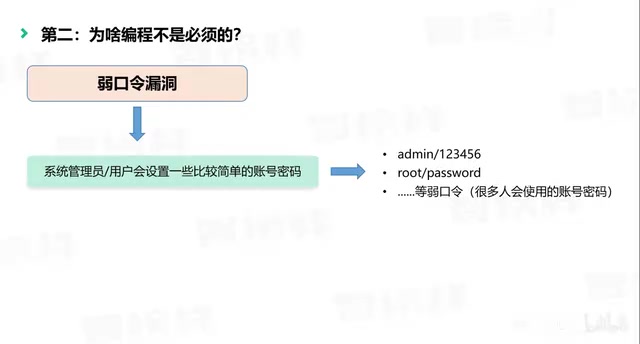
Weak credentials are the most typical low-barrier vulnerability. Some administrators or users set extremely simple passwords, such as admin/123456, root/password, or birthday-related passwords. Using Burp Suite's Intruder brute-force feature with pre-collected default credential lists, you can efficiently automate testing for these weak passwords. The more comprehensive your credential list, the higher your brute-force efficiency.
How Does Learning to Code Help with Bug Hunting?
If you can find vulnerabilities without programming, what's the point of learning to code? The answer is: Programming lets you see deeper and go further on your bug hunting journey.
Code Auditing: The Key to Universal Vulnerabilities
There's a skill called Code Audit—directly analyzing website source code to find deep vulnerabilities that scanning tools and Burp Suite cannot detect. Audit targets typically include open-source CMS platforms (such as WordPress, Discuz, ThinkPHP), open-source components, and proprietary enterprise systems.
Code auditing methods are mainly divided into two approaches: first, the "dangerous function backtracing method," which starts from known dangerous functions (such as PHP's eval(), system(), unserialize()) and traces whether their parameter sources are controllable; second, the "data flow tracking method," which starts from user input entry points and traces the data's path through the program, checking whether it undergoes adequate filtering and validation. This requires a solid programming foundation—at minimum, the ability to understand code logic and programming thinking.
Through code auditing, there's a chance of discovering universal vulnerabilities (those affecting all users of a particular open-source software), and even earning a CNVD original certificate. CNVD (China National Vulnerability Database) is a national-level vulnerability platform operated by China's National Computer Network Emergency Response Technical Team (CNCERT/CC). After submitting a universal vulnerability and passing review, you can receive a CNVD original vulnerability certificate (numbered in the format CNVD-20XX-XXXXX). This certificate carries significant recognition within the cybersecurity industry and has practical value for job applications, professional evaluations, and title assessments. Many CNVD certificates require discovering issues at the code level.
Understanding the Underlying Principles of Vulnerabilities
Let's use SQL injection as an example to illustrate the importance of programming knowledge. SQL Injection is a high-risk vulnerability type that has long ranked near the top of the OWASP Top 10. If a PHP code snippet takes the id parameter directly via GET and concatenates it into an SQL statement without any filtering, an injection vulnerability occurs. For example, if the original query is SELECT * FROM users WHERE id='user_input', an attacker inputs 1' OR '1'='1, making the condition always true and returning all user data.
Deeper exploitation includes: UNION SELECT injection to retrieve data from other tables, error-based injection to extract database version information, blind injection to guess data character by character, stacked queries to execute multiple SQL statements, and even leveraging built-in database functions to achieve OS command execution (such as MySQL's INTO OUTFILE to write a WebShell). The primary defense is using Prepared Statements and ORM frameworks to fundamentally eliminate concatenation-based SQL construction.
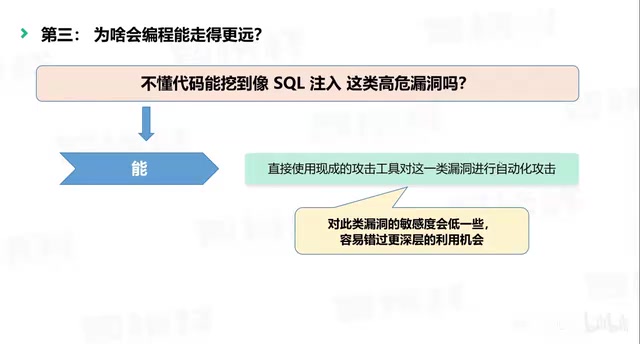
Someone who understands programming can spot the issue immediately, while someone without coding knowledge struggles to understand the root cause of the vulnerability. Although beginners can use ready-made tools to automatically attack high-risk vulnerabilities like SQL injection, due to a lack of understanding of the underlying principles, they often can only "scratch the surface," easily missing deeper exploitation opportunities, and ultimately receiving discounted bounties.
Conclusion: Act First, Level Up Later
The core message of this lesson can be summarized in one sentence: To start finding vulnerabilities, you really don't need to learn programming first.
At the beginning stage, focus on two things:
- Truly master the core tools (Burp Suite, dirsearch, OneForAll)
- Develop a basic methodology for finding vulnerabilities
Start with business logic vulnerabilities, information leakage, and weak credentials—three low-barrier, high-yield vulnerability types. Build confidence through real-world practice first, then gradually work your way toward higher-value targets like SQL injection, RCE (Remote Code Execution—which allows attackers to remotely execute arbitrary system commands or code without directly accessing the target server, making it one of the highest-severity vulnerability types, typically rated "Critical" on major SRC platforms with corresponding top-tier bounties), and deep logic vulnerabilities. Programming is the next hill to conquer once tools and methodology become second nature.
As the saying goes, "Learn by doing, do by learning"—for security newcomers, taking action will always be more valuable than endless preparation.
Related articles

Alguard: Building a Dual-Layer Trust Defense for AI Agent Shopping
Alguard, an Amazon Developer Hackathon project, designs a dual-layer trust architecture for Alexa+ agent shopping. Through physical isolation between an MCP server and a human approval channel, it replaces prompt defenses with structural constraints to block unauthorized purchases caused by prompt injection.

Food Poisoning: Causes, Symptoms, Treatment, and Prevention Explained
Food poisoning is caused by bacteria, viruses, parasites, or toxins contaminating food, with common symptoms including vomiting, diarrhea, and dehydration. This article explains the causes, symptoms, treatment, and prevention of food poisoning to help you safeguard food safety.

Meta Uses LLMs to Make Facebook Feed Customizable
Meta launches LLM-powered algorithm personalization for Facebook and Reels, letting users manage interests via menu and customize feed with a text box.