Getting Started with the JEV-27B-VL Visual Decision Model

JEV-27B-VL maps image input directly to option decisions with calibrated probabilities instead of generating text.
JEV-27B-VL is a 27-billion-parameter vision-language model maintained by Autotrust under the Apache-2.0 license. Its core feature is that System 1 mode reads option probabilities directly from logits, returning a typed decision in a single forward pass without generating and parsing text; System 2 is Qwen3.8-27B, which outputs text and step-by-step reasoning. It has specific evaluations on five tasks: cold-start short-video cover ranking, agent task completion judgment, multimodal answer comparison, screenshot action selection, and early sketch classification, including AUROC 0.91 on AgentRewardBench and 78.3% overall on VL-RewardBench. However, image editing scores only 57.8 and general questions 58.0, and the model card omits key deployment information such as image resolution, VRAM requirements, and quantization options, nor does it provide a complete runnable inference example.
Vision-language models are mostly used as chat tools, but JEV-27B-VL, maintained by Autotrust, takes a different path: it ties image input to "decision outputs with probabilities," letting the model directly output option probabilities in a single forward pass instead of generating text that needs to be parsed. For engineering scenarios that require calibratable scores, this difference matters more than parameter scale.
Two Modes: Decision and Reasoning Separated
JEV-27B-VL is a 27-billion-parameter vision-language model released under the Apache-2.0 license. It adds image input capability on top of autotrust/JEV-27B and exposes two distinct interfaces.
System 1 reads logits and returns a typed decision with calibrated probabilities over given options, supporting yes/no judgments, choices among 2 to 256 options, and ratings from 0 to 5, with prompts up to 256K tokens. System 2 is described as an unmodified Qwen3.8-27B that can accept image input and output text or step-by-step reasoning.
The practical value of this design: System 1 doesn't need to generate an answer and then parse it—probabilities are read directly from a single forward pass. For scenarios like offline evaluation, filtering, and reward signals that need stable numerical values, this is more practical than free-text commentary. The model card doesn't state whether the two modes share weights, nor does it explain the specific implementation of the vision encoder.
Logits and calibrated probabilities: In neural networks, logits refer to the unnormalized real-valued vectors output by the model's final layer (usually a classification head), where each component corresponds to the "raw score" of an option. To obtain probabilities, softmax or sigmoid normalization is applied so outputs fall between 0 and 1 and can be interpreted as confidence. Calibration requires that the probabilities the model gives match true frequencies—for example, among all samples predicted at 0.8, the actual positive rate should be close to 80%. System 1 reads option probabilities directly from logits, bypassing free-text generation and parsing, so values are more stable and reproducible, suitable for evaluation scoring and reward signals; however, calibration quality still depends on training data and post-processing, and the expected calibration error (ECE) in the model card is a key metric for measuring this.
Five Validated Use Cases
Short-Video Cover Ranking
System 1 can compare candidate covers against the user's five most recently watched covers and return the probability that the user will watch the candidate video. In evaluations on MicroLens-100k, cover scoring alone achieved 0.727 AUC and 0.590 HR@5 among 20 candidates; collaborative filtering trained on the histories of 59,045 users achieved 0.728 AUC and 0.490 HR@5. For new videos, this provides a usable cold-start ranking signal. It should be noted that this is an offline evaluation with 200 users and cannot be equated with online performance at feed scale; in the demo, scoring 20 covers on a single GPU takes about 2.6 seconds.
Judging Whether a Web Agent Completed Its Task
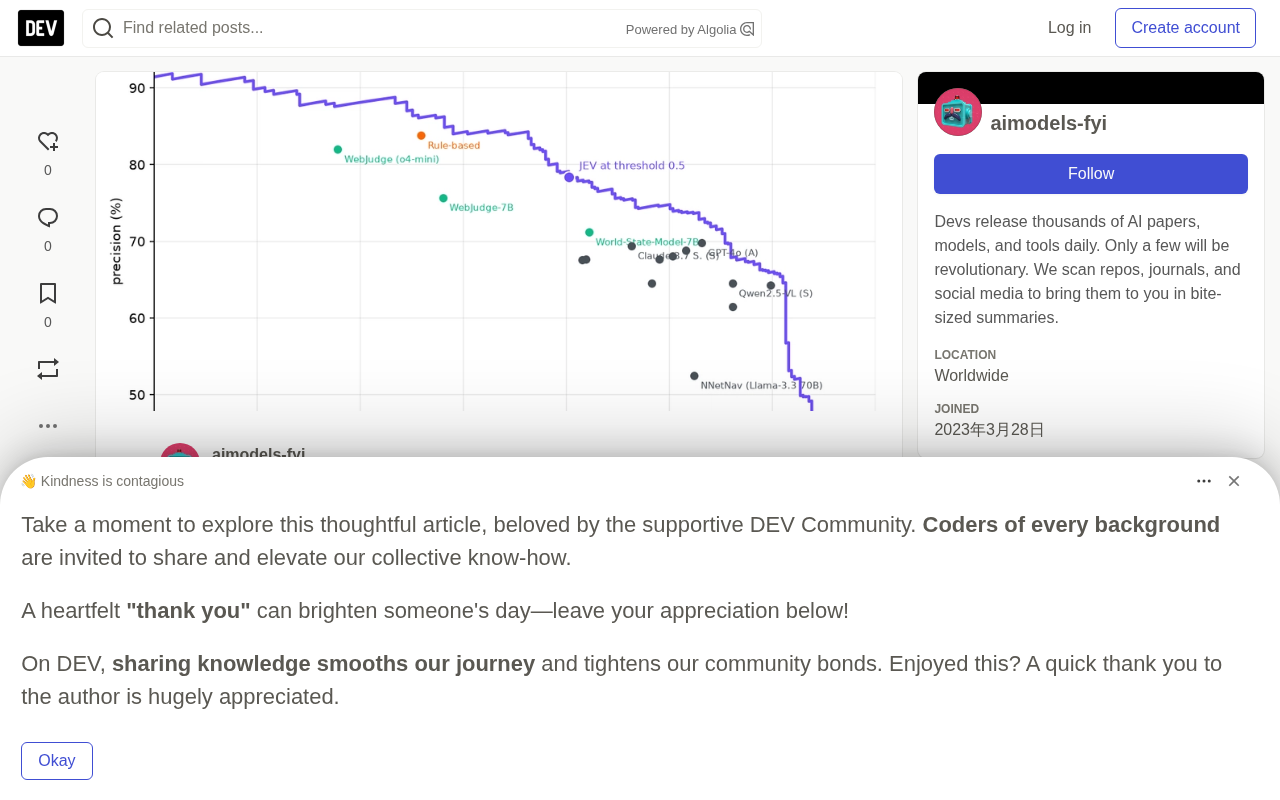
Given a user goal, the agent's actions and final message, plus a final screenshot, System 1 returns the task completion probability in a single forward pass. On 1,302 expert-annotated trajectories from AgentRewardBench, the model reports AUROC 0.91, with precision 78.4 and recall 70.2 at a threshold of 0.5. Its precision is higher at every recall level of each compared judge. This is suitable for offline evaluation, filtering, or reward signals.
Multimodal Answer Comparison
Given an image, a question, and two candidate answers, System 1 can judge which is better. On VL-RewardBench, overall accuracy is 78.3%, hallucination items 83.2%, reasoning items 78.2%, but general questions only 58.0%. On the newer Multimodal RewardBench 2, the average across four tasks is 63.8, close to GPT-4.1 and Qwen3-VL-32B on the same table, but behind GPT-5 and Gemini 3 Pro. Image editing at 57.8 is a clear weak spot; if the primary evaluation target is editing, caution is needed.
Selecting Actions from Screenshots
The README demonstrates game action decisions: movement and jumping in Super Mario, column and orientation in Tetris, and direction in Snake. Reported single-decision latency is about 150 ms for Mario, 122 ms for Tetris, and 300 ms for Snake. Such tasks suit scenarios with a limited action set and visual states expressible as image plus text, but general game capability cannot be inferred from this.
Classifying Unfinished Sketches
In a Quick, Draw! evaluation with 320 real players, the model selected the correct category 88% of the time after drawings were completed, 62% at 60% of strokes completed, versus 6% for random guessing among 16 answers. This shows the model has practical use for classification tasks where candidate labels are known and early prediction is valuable.
Differences among AUC, HR@5, and AUROC: Several ranking metrics in the text are easy to confuse. AUC (area under the ROC curve) measures the model's overall ability to rank positives ahead of negatives, with 0.5 equivalent to random; AUROC is a synonym for AUC in binary classification scenarios, and 0.91 on AgentRewardBench indicates the separability of completed versus incomplete trajectories. HR@5 (Hit Rate at 5) instead focuses on whether the user's actual interacted item appears in the top 5 recommendations; 0.590 means a hit in about 60% of cases, closer to the actual experience of a recommendation list than AUC. Collaborative filtering's 0.728 AUC and 0.490 HR@5 indicate that its overall ranking is not bad but top-of-list hits are low, and cover scoring's advantage in HR@5 is precisely the value in cold-start scenarios.
Limitations You Must Know
The model card doesn't provide maximum image resolution, number of images per request, supported image formats, image preprocessing rules, or minimum GPU or VRAM requirements. Also missing are model file format, quantization options, batch size recommendations, and general throughput benchmarks. The 27B parameter scale and single-GPU demo cannot prove that a specific graphics card can load the model; before deployment, VRAM should be verified against the actual checkpoint and serving configuration.
System 1 targets decisions over given options, not open-ended answer generation. Probabilities vary with the question, state, and option descriptions. The README mentions that a one-line "when to use" description helps distinguish similar options; in the prompt research tested, question wording, JSON versus plain-text format, and extra instructions produced no measurable differences. Selection tasks are capped at 256 options. The 256K token claim comes from a specific test: a sentence hidden at random depth among up to 250K tokens was retrieved correctly in all 20 trials at each tested length—this is a result under narrow conditions and should not be understood as long-context retrieval always being reliable.
Boundaries for interpreting long-context tests: The 256K token prompt length limit comes from a "needle in a haystack"-style test—a sentence hidden at random depth among up to 250K tokens, with the model required to retrieve it. Such tests only verify the ability to locate a single fact and do not cover multi-hop reasoning, cross-paragraph synthesis, or distractor-dense scenarios; all 20 correct is a small sample, and failure rates at different hiding depths are not reported. Therefore, 256K should be understood as "the maximum length supported by the interface," not "retrieval is always reliable at that length." In engineering, if relying on long documents for decisions, stress tests should still be run on your own data distribution, and attention should be paid to recall differences caused by position bias (the model is more sensitive to content at the beginning and end).
Positioning Differences from Other Models
AutoJev-27B reports overall accuracy of 84.60%, but there are no comparable vision benchmarks, speed, or cost data. Choose JEV-27B-VL when image input is needed; consider AutoJev-27B when you value an autonomous agent development workflow, a TypeSafe-compatible API, or a browser playground. Existing data is insufficient to rank the two by quality or speed.
OpenJev is described as a typed decision model for text, web pages, and screenshots, with up to 52 options, processing an isolated web page decision in about 210 ms on a single H100, using about 1,460 prompt tokens and 23 options. This is a concrete speed reference that JEV-27B-VL's general requests lack, but the two have no quality comparison on the same task.
open-jev-deberta-v3-large is an independent reproduction of the typed decision format, supporting up to 255 options, 210 ordered rating levels, and yes/no judgments. Its description explicitly states that because it uses public gold labels rather than private workflows, results cannot be directly compared with TypeSafe results. It does not establish vision support capability, so it is not a like-for-like substitute for screenshot judgment.
imajev-4b's page provides no description, making an informed comparison of quality, speed, cost, input, or use cases impossible. lev is a LoRA adapter on Qwen3.5-4B with zero output tokens, compatible with TypeSafe's /v1/systemone protocol; the smaller base may suit compact typed decision deployment, but it likewise lacks comparable latency or quality results.
Technical Specifications and Integration
The model is listed as an image-to-text pipeline with the Transformers library. The README also describes serve_decide.py, which adds a POST /v1/decide endpoint to the vLLM server. The System 1 HTTP request body is {kind, state, question, options}, but there is no complete request example or exact response schema.
On six public text decision benchmarks, the six-group mean for the JEV-27B / JEV-27B-VL row is 84.07%, higher than the 83.85% of the TypeSafe Jev 1.13 hosted API and 77.70% of NeoHorse-Jev-4B. On the held-out set test_set_30k of jev-distill-corpus-v3, KL divergence from the TypeSafe Jev 1.13 distribution is 0.017, yes/no AUROC 0.995, top-1 agreement 95.8% on rows with a clear preference, 0-5 rating MAE 0.098, and expected calibration error 0.0009. In an independent 800-question stress test, accuracy at 2, 4, 8, and 16 options was 0.876, 0.784, 0.767, and 0.740 respectively.
Model metadata shows 179,237 downloads. The license is Apache-2.0, but the materials do not state additional usage restrictions, safety testing, bias evaluation, or fine-tuning recipes, nor any maintenance plan or future update commitments. The README labels a set of features as "New (1 October 2026)," but this date alone cannot prove ongoing maintenance.
Things to Confirm Before Getting Started
The README documents System 1's vLLM HTTP endpoint but lacks a complete Python loading or inference example, model loading calls, and a complete response schema, so verified, directly runnable Transformers inference code cannot be provided from the existing materials. It is recommended to first read the model's serving code to confirm the values of kind, the image encoding method, the endpoint response format, and server startup parameters before deciding whether to integrate. If what you need is a visual decision interface with calibrated probabilities rather than yet another multimodal chat model, JEV-27B-VL deserves a place on your evaluation list; if the main task is open-ended image understanding or image editing evaluation, the existing data suggests it may not be the optimal choice.
Related articles

Chain of Thought Isn't Just for AI: How Humans Can Use CoT to Improve Thinking Quality
Chain of Thought isn't just a prompt trick for large models. Starting from a Hacker News discussion, this article analyzes why CoT works for human thinking too, breaks down actionable ways to transfer it, and highlights the key differences between human CoT and machine CoT.
Cloudflare Teams Up with OpenAI: Closi…
Cloudflare Teams Up with OpenAI: Closing the Loop from Vulnerability Discovery to Defense with AI
Cloudflare uses OpenAI Daybreak to investigate security vulnerabilities and generate reviewable remediation plans, while developers use Codex to boost coding efficiency and quality.

Orca Multi-Agent Orchestration in Practice: A Guide to Parallel Collaboration with Claude and Codex
Orca is Stable AI's free open-source agent workbench supporting 34 agents like Claude Code and Codex in parallel. Learn its Git worktree isolation, multi-model orchestration, and mobile management.