GhostTrack: An Analysis of the Open-Source IP and Phone Number Tracking Tool

GhostTrack is a popular Python OSINT tool that aggregates public APIs for IP geolocation and phone number lookup, with notable accuracy limits.
GhostTrack is an open-source Python tool on GitHub with 16,848 Stars, focused on aggregating public APIs for IP geolocation and phone number lookups rather than real-time physical tracking. IP accuracy is typically city-level only, and phone lookups return registration data — not current location. Built for Linux, macOS, and Android via Termux, it's widely used for security learning. Unauthorized use to track others is illegal in most jurisdictions.
GhostTrack: An Analysis of the Open-Source IP and Phone Number Tracking Tool
In the world of Open Source Intelligence (OSINT) and security research, tracking tools have always been a hot topic. A GitHub project called GhostTrack has been gaining significant traction recently, picking up over 1,600 Stars in a single week and reaching a cumulative total of 16,848 Stars with nearly 2,300 Forks. These numbers reflect a substantial following within the security enthusiast and penetration testing communities.
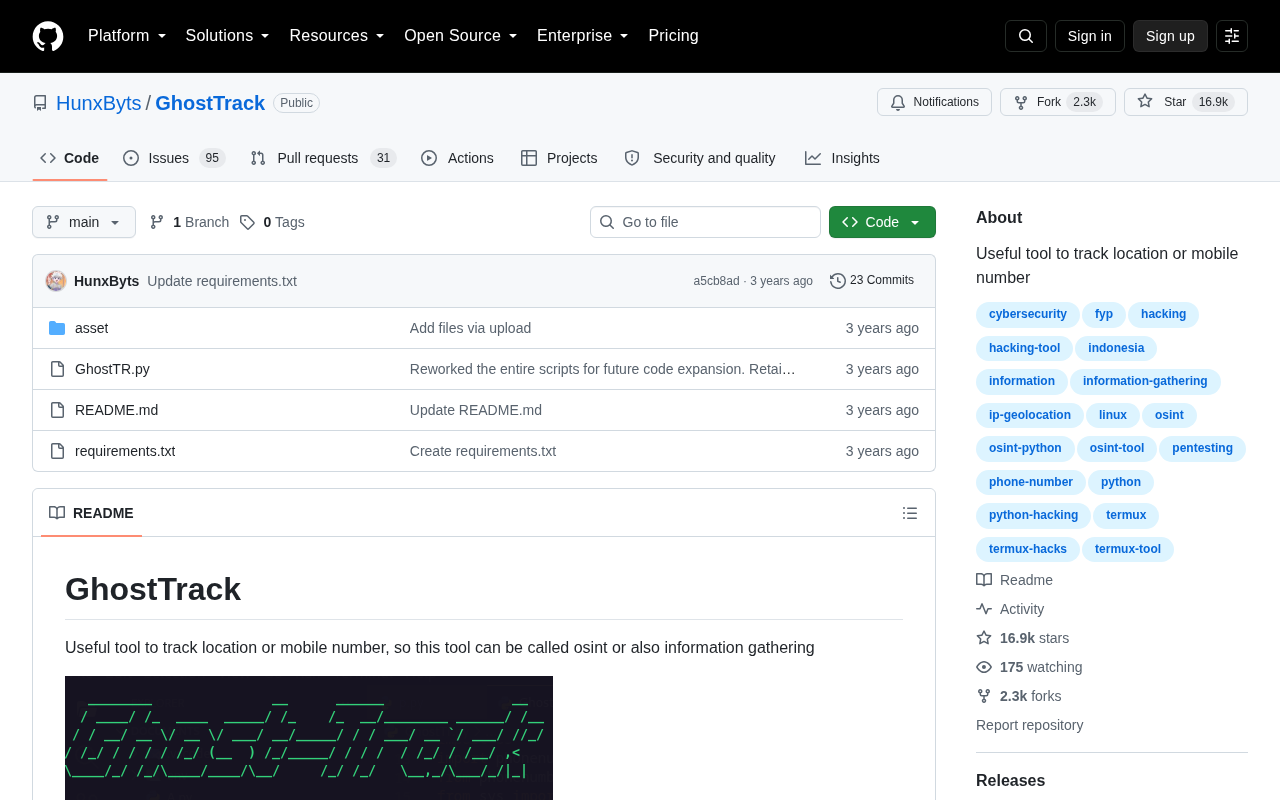
What GhostTrack Does: Location and Phone Number Tracking
GhostTrack is maintained by developer HunxByts and written in Python. It's officially described as "a utility tool for tracking location or phone numbers." From a technical standpoint, tools like this typically rely on publicly accessible data sources and APIs — such as IP-based geolocation databases and phone number lookup services — rather than true real-time physical tracking.
For beginners, it's important to understand a key distinction: IP geolocation returns an approximate region corresponding to an ISP node or network exit point, usually accurate only to the city level. This is fundamentally different from the pinpoint, address-level tracking depicted in movies and TV shows. Phone number lookups similarly return registration details like the number's home region and carrier — not a real-time location.
IP geolocation typically relies on commercial or free databases such as MaxMind GeoIP, ip-api.com, and ipinfo.io. These databases infer geographic location using internet routing information, IP block allocation records from registries like ARIN and APNIC, and voluntarily submitted user data. Since a single public IP address might correspond to hundreds of devices in an office building or an ISP's NAT gateway serving an entire city, location errors of tens or even hundreds of kilometers are common. When a VPN or proxy is in use, query results will point to the server's physical location — completely unrelated to the user's actual whereabouts. Phone number lookups work by retrieving number block allocation records from telecommunications regulators, revealing the province and carrier at the time of registration. They cannot reflect carrier changes due to number portability, and have no connection whatsoever to the phone's current physical location.
Tech Stack and Usability
The project is built entirely in Python, which gives it natural cross-platform compatibility — it can run on Linux, macOS, and Android environments via Termux. Python's rich ecosystem of networking and data-parsing libraries makes it relatively straightforward to build tools that aggregate multiple public APIs, which is one reason why similar OSINT scripts have proliferated on GitHub.
With nearly 2,300 Forks, it's clear that a large number of developers are using it as a base for their own projects or as a learning reference. For those looking to understand how OSINT tools work under the hood, reading through source code like this is a practical way to grasp the logic behind IP geolocation, API calls, and data aggregation.
OSINT (Open Source Intelligence) is an intelligence methodology that collects and analyzes information through legal, publicly available channels. It's widely used in cybersecurity for asset discovery, threat intelligence, and the reconnaissance phase of penetration testing. The broader OSINT tool ecosystem includes projects like Shodan (for discovering internet-exposed devices), Maltego (for relationship graph analysis), and theHarvester (for email and domain enumeration). GhostTrack falls into the relatively simple "aggregated query" category: it doesn't collect new data itself, but rather wraps multiple existing public APIs into a unified command-line interface, reducing the friction of querying each data source individually. Termux is a Linux terminal emulator for Android that can run Python scripts without rooting the device, allowing tools like this to be used directly from a smartphone — further lowering the barrier to entry.
Usage Boundaries and Compliance Risks
Tracking tools always come with legal and ethical controversy. It's worth emphasizing that tracking someone's location or querying their phone number information without authorization is likely illegal in the vast majority of jurisdictions. Legitimate use cases for tools like GhostTrack should be limited to authorized security testing, self-lookup of one's own information, or purely educational purposes.
Users should be aware that:
- Data accuracy from public APIs varies significantly, and results should be treated as reference-only
- Tracking other individuals requires explicit authorization; doing so without it constitutes a privacy violation
- Some query services may have their own data compliance issues
The value of security research lies in understanding offensive and defensive principles in order to better protect yourself and your systems — not in using tools to cross ethical and legal lines.
What the Popularity Tells Us
GhostTrack's growth of over a thousand Stars in a single week reflects sustained public curiosity about personal privacy and network tracking technologies. The popularity of tools like this also serves as a reminder to everyday users: information like IP addresses and phone numbers can readily serve as entry points for queries. Building awareness around personal information protection is just as important as any technical skill.
For those learning security, rather than blindly running pre-built scripts, it's far more valuable to deeply understand the underlying data sources and technical limitations. Only by developing an accurate mental model can you extract genuine educational value from open-source tools like this — while staying within a compliant and ethical framework.
Related articles

Felix Rieseberg Personal Homepage
Felix Rieseberg's personal homepage sparks attention on Hacker News. This article covers the Slack engineer's technical background, the rise and fall of nativefier, and the value of a developer homepage as a tech calling card.

@ai-sdk/vue 3.0.306 Patch Release Syncs with [email protected] Update
@ai-sdk/vue 3.0.306 released, synced with [email protected]. A routine patch release for the Vercel AI SDK ecosystem with no public API changes; the Vue adapter layer stays version-aligned with the core package.

Gemini 4 Argon API Launches: The Era of Million-Token Output Begins
Google launches Gemini 4 Argon with sparse MoE architecture, up to 1M output tokens, and a 68.90% Vals Index score, available across API, AI Studio, and the Gemini app.