GigaChat 4 vs GLM-5.4: A 708B Russian Open-Source Model Takes On the Recurrent Transformer

Sber's GigaChat 4 and Z.AI's GLM-5.4 launched the same week, representing the open-source MoE and recurrent Transformer routes.
Sber's GigaChat 4 and Z.AI's GLM-5.4 launched in the same week, pitting a 708B open-source MoE model (41B activated, MIT license, weights and API available) against a 750B recurrent Transformer model whose weights and API are not yet public. Both offer million-token context; GigaChat 4 reports SWE-bench verified 80.89% and Terminal Bench 2.0 71.26%, while GLM-5.4 cites 200 tokens/s off-peak. Choose GigaChat 4 for local deployment and agents; watch GLM-5.4 for coding workflows and throughput.
Russia's GigaChat 4, built by Sber, and China's GLM-5.4 from Z.AI were released in the same week. The former enters the open-source arena as a heavyweight with 708B parameters under the MIT license, while the latter bets on a recurrent Transformer architecture to explore new paths for coding and long-horizon reasoning. This trans-Eurasian model matchup reflects two very different technical routes in the large-model race.
The Basics of the Two Flagship Models
GigaChat 4 was developed by Sber and released on November 26; GLM-5.4 comes from China's Z.AI and launched three days earlier, on November 23. On parameter scale, GigaChat 4 has 708B while GLM-5.4's base model is 750B, giving the latter a slight edge in total size. However, GigaChat 4 discloses 41B activated parameters and follows a Mixture-of-Experts (MoE) route, calling only a subset into action during actual inference — an information gap versus GLM-5.4, which has not disclosed its activated parameters.
Architecture is the most fundamental divide between the two. GigaChat 4 stacks a combination of MoE, GDN, MLA, and DSA mechanisms, taking a "combo-punch" engineering-optimization approach; GLM-5.4 adopts a recurrent Transformer architecture that compresses inference cost by reusing computation across layers. In a sentence: the former works on sparse activation, the latter finds room in computation reuse.
Mixture of Experts (MoE) and Activated Parameters
MoE (Mixture of Experts) splits a single feed-forward layer into multiple parallel "expert" subnetworks, and a gating network selects only a few experts per token to participate in computation. As a result, the total parameter count can be very large while the number of parameters actually involved in a single forward pass (the "activated parameters") is much smaller. GigaChat 4's 708B total parameters and 41B activated parameters are a typical ratio: ample total capacity, yet per-token computation equivalent to only a dense model in the single-digit-billions range. This scales the model without significantly raising inference cost, at the price of VRAM still being allocated by total parameters and training being prone to uneven expert load, requiring additional load-balancing strategies.
Context, Openness, and Ecosystem Access
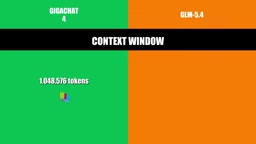
On context window, GigaChat 4 supports 1,048,576 tokens and GLM-5.4 about 1 million tokens — essentially the same order of magnitude, with GigaChat 4 edging ahead on the exact figure. The real gap is openness: GigaChat 4 releases its weights under the MIT license, so developers can download and deploy directly; GLM-5.4's weights are on the release roadmap but not yet publicly available. For teams needing private deployment or further fine-tuning, this difference is nearly decisive.
The same goes for the API layer. GigaChat 4 already offers a developer platform and API access, while GLM-5.4's official API is marked "coming soon." On the consumer side, each has its own entry point — the GigaChat app and the Z.ai chat interface — so that's a draw.
Benchmark Results: One Has Receipts, the Other Awaits Disclosure
On verifiable evaluation data, GigaChat 4 provides concrete numbers: 80.89% on SWE-bench verified in reasoning mode and 71.26% on Terminal Bench 2.0 in reasoning mode. GLM-5.4 has not disclosed comparable verified scores, leaving direct comparison without hard evidence. It's worth noting this doesn't mean GLM-5.4 is weaker — it emphasizes general coding capability and long-horizon reasoning workflows, but simply hasn't presented results under the same benchmarks.
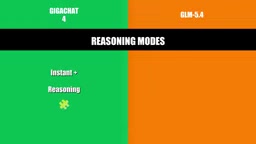
In reasoning-mode design, GigaChat 4 offers instant and reasoning tiers, while GLM-5.4 distinguishes thinking and non-thinking workflows — similar thinking. On tool integration, GigaChat 4 supports MCP and agent harness, while GLM-5.4 is built around Z code and coding workflows: the former is more open on general tool protocols, the latter more focused on its own coding loop.
Speed and Efficiency: The Measured Advantage of the Recurrent Architecture
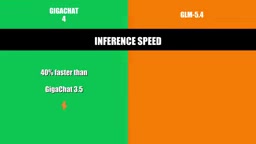
GLM-5.4 has clear data on inference throughput: according to Z.ai, it reaches up to 200 tokens per second during off-peak hours. GigaChat 4 has no directly comparable official throughput figure, so GLM-5.4 takes this category.
Their efficiency optimizations also differ in approach. GigaChat 4 uses D-Flash 2 speculative decoding to accelerate generation; GLM-5.4 relies on its recurrent Transformer architecture and KV cache reuse to reduce redundant computation. The former is speculative sampling at the decoding stage, the latter is cache reuse at the architecture level — same goal, different layers of intervention.
Recurrent Transformer and KV Cache Reuse
A recurrent Transformer means the same set of layers (or the same block of weights) is called repeatedly along the depth dimension, deepening effective computation through iterative "thinking steps" rather than simply stacking more independent layers. This way, parameter count and VRAM overhead don't grow linearly with effective depth — one approach to compressing inference cost. KV cache, meanwhile, stores the key-value pairs of historical tokens during autoregressive decoding, avoiding recomputing the entire context for every new token. If the recurrent structure can reuse some intermediate states across iterations, it can further reduce redundant computation, but more iterations also bring extra latency and memory pressure, requiring a trade-off between throughput and overhead.
Speculative Decoding
Speculative decoding uses a lightweight small model to first "guess" several subsequent tokens, then has the large model verify these candidates in parallel all at once; accepted parts are used directly, and rejected positions are rolled back and recomputed. Since the large model's forward pass is parallel and verification costs far less than token-by-token autoregressive generation, overall generation speed can be significantly improved while the output distribution theoretically remains unchanged (no quality sacrifice). The benefit depends on the draft model's hit rate and the speed difference between the two models; D-Flash 2 belongs to this decoding-acceleration route.
Positioning Differences and Selection Advice
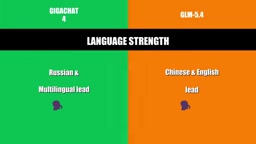
Looking across all dimensions, the two models have quite distinct personalities. GigaChat 4's strengths are open-source weights, autonomous multi-step tasks, long context, and Russian-language capability; its weakness is limited coverage by independent global benchmarks. GLM-5.4's strengths are general coding and the efficiency dividend from its recurrent Transformer; its weaknesses are that weights and API are not yet fully open, and long reasoning loops may bring extra overhead.
Choosing between them isn't hard: for teams that need MIT-licensed weights right now for local deployment, building autonomous agents, or handling ultra-long documents, GigaChat 4 is the more pragmatic choice today; developers focused on coding workflows, who value inference throughput and can wait for API access, should put GLM-5.4 on their watchlist. Model competition is never a single-dimension contest — the tension between open and closed source, sparse and recurrent, is precisely the most interesting part of this round.
One-line Summary
Sber's GigaChat 4 and Z.AI's GLM-5.4 launched the same week, representing the open-source MoE and recurrent Transformer routes.
Paragraph Summary
Sber's GigaChat 4 and Z.AI's GLM-5.4 were released in the same week, setting up a trans-Eurasian flagship model showdown. GigaChat 4 arrives with 708B total parameters, 41B activated parameters, and the MIT open-source license; both weights and API are available, following a combined engineering route of MoE plus GDN, MLA, and DSA. GLM-5.4 has a 750B base scale and bets on recurrent Transformer and KV cache reuse, but its weights and API are not yet public. Both context windows are in the million-token range. On benchmarks, GigaChat 4 reports 80.89% on SWE-bench verified and 71.26% on Terminal Bench 2.0, while GLM-5.4 has no same-benchmark data yet; on throughput, GLM-5.4 reaches 200 tokens/s off-peak. The choice depends on openness and use case: local deployment and autonomous agents favor GigaChat 4, while coding workflows and throughput favor watching GLM-5.4.
Related articles

Xenon Flash Bug Returns: Radxa Dragon Q8B Affected
The Xenon flash bug resurfaces, this time on the Radxa Dragon Q8B board. This article reviews early Hacker News discussion and analyzes the potential impact and community concerns.

ChatGPT Plus Subscription Guide for Users in China: Official Top-Up Channel Walkthrough and Comparison
A complete guide to subscribing to ChatGPT Plus from China via official top-up platforms: plan selection, account login, copying account info, payment verification, plus a comparison of top-up, proxy, and self-supplied card channels.

The Complete Guide to Subscribing to ChatGPT Plus in China: Hands-On Walkthrough of Third-Party Top-Up Channels and Risk Analysis
How can users in China subscribe to ChatGPT Plus? This article breaks down the complete process of third-party top-up platforms, analyzes account security, renewal sustainability, and risk-control risks to help you decide which subscription option suits you better.