GigChain Keys: A Free, Open-Source MainStage Alternative

Introducing GigChain Keys, a free open-source MainStage alternative, with a rational assessment of its potential and limitations.
The article introduces GigChain Keys, an open-source project on Hacker News positioned as a free, open-source alternative to Apple MainStage, targeting patch switching, keyboard splits, and effects chain management for live performance. The author notes that open-source solutions offer zero licensing costs, high customizability, and cross-platform potential, but their weaknesses are sound library ecosystems and hardware compatibility that depend on community maintenance. The article also emphasizes that public information about the project is currently very limited—only 3 points and no comments on HN, untested by the community—and that live performance tools prioritize stability, so it's advisable to test latency and long-run performance in non-critical settings before considering replacing MainStage.
A New Option for Live Performance Tools
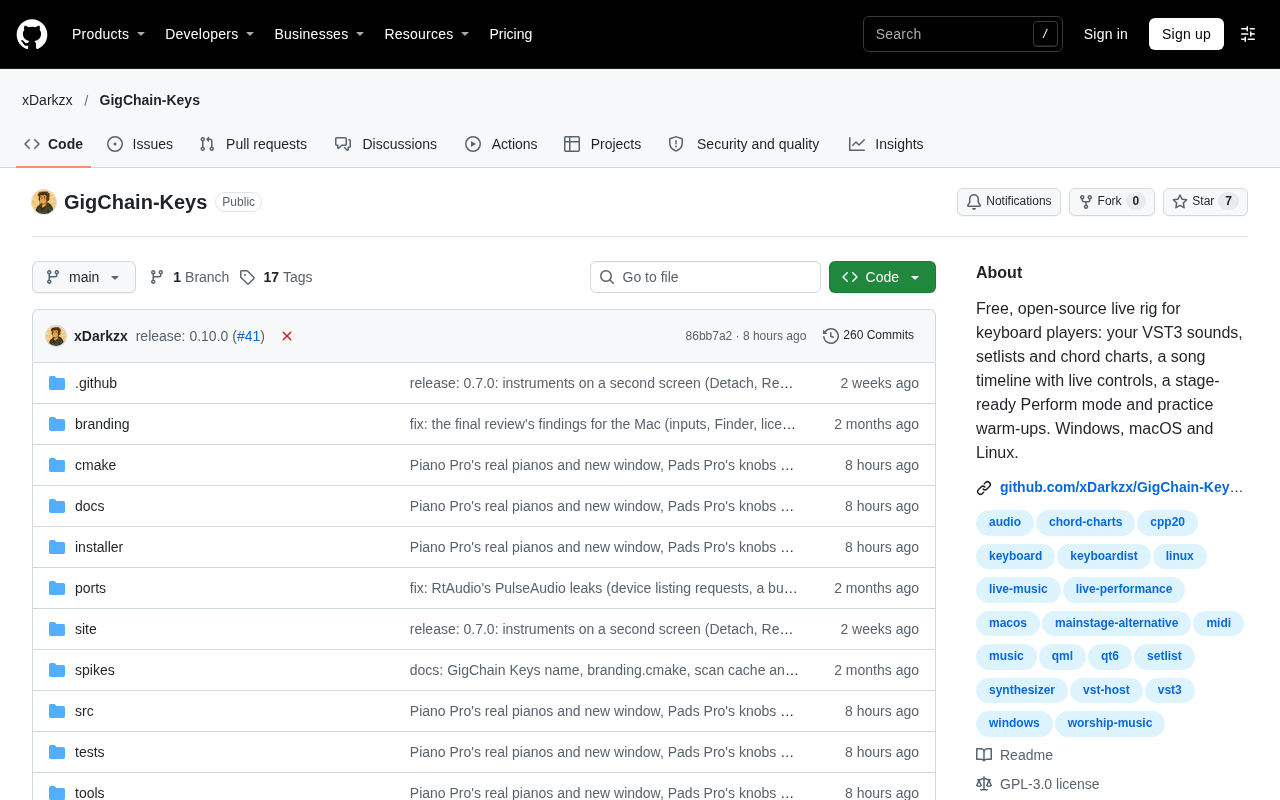
For live musicians, Apple's MainStage has long been the benchmark for performance keyboards and sound source management, but it's macOS-only and expensive. A project called GigChain Keys was introduced on Hacker News as a "free, open-source MainStage alternative," offering another approach for performers who need a cross-platform or zero-cost solution.
The project's positioning is clear: reimplement the core needs of live performance—patch switching, keyboard splits, and effects chain management—in an open-source way. Although the project currently has only 3 points and no comments on HN, making it a typical early-stage project, the direction itself is worth watching.
How Open Source Changes Live Performance Tools
The advantage of commercial live performance software lies in its complete ecosystem, rich presets, and deep hardware integration. The shortcomings of open-source solutions are usually here too: no official sound libraries, and driver compatibility depends on community maintenance. But the benefits of open source are equally obvious—customizable, auditable, and free of subscription fees.
For touring musicians or small bands, software licensing costs add up with each device—a stage keyboard, a backup machine, and a rehearsal laptop may each require a separate license. Tools like GigChain Keys are valuable because they reduce this cost to zero while allowing users to modify the interface and signal chain to match their own performance workflow.
Which Scenarios It Suits
- Rehearsals and small gigs: need to quickly switch between a few patch groups and do simple keyboard splits.
- Custom workflows: users who want full control over MIDI routing and effects order.
- Cross-platform needs: MainStage only serves macOS, while open-source solutions are typically easier to port across platforms.
MainStage's Host and Plugin System
MainStage itself is a "host"—it doesn't generate sound directly but loads and manages various virtual instruments and effects plugins (such as AU format). Performers combine multiple plugins into Patches and then map knobs and buttons via MIDI controllers for one-touch patch switching. Understanding this is key: "replacing MainStage" essentially means replacing this host, Patch management, and MIDI mapping mechanism, not replacing a specific sound source. To be practical, an open-source solution must be able to stably load mainstream plugin formats or include enough usable built-in sound sources; otherwise, musicians still need to buy sound libraries separately.
VST and AU Plugin Formats
VST, proposed by Steinberg, is the most universal cross-platform audio plugin standard, supported on Windows, macOS, and Linux; AU (Audio Units) is Apple's native format on macOS, deeply integrated with the system audio stack. The difference directly affects cross-platform feasibility: an open-source project that only supports AU is naturally locked to macOS, while supporting open formats like VST or CLAP better matches a "cross-platform" positioning. When evaluating GigChain Keys, its plugin format support list will say more about its actual scope than feature marketing.
Audio Buffering and Latency
In live performance, the latency from key press to sound output is determined by buffer size: smaller buffers mean lower latency but higher CPU load and greater risk of audio dropouts. Live performance typically requires total latency under 10 milliseconds, which demands low-latency optimization at the audio driver layer (such as Core Audio on macOS, JACK/ALSA on Linux, ASIO on Windows). Open-source projects often struggle here due to insufficient driver adaptation, so latency performance is a key indicator of whether it can make it to the stage.
Keyboard Splits and Patch Switching
Keyboard split/layer refers to dividing the key range of a single MIDI keyboard into several zones, with different zones triggering different sound sources—for example, the low range for bass and the high range for piano; layering means triggering multiple sound sources simultaneously across the same key range. Patch switching requires switching an entire group of sound sources and effects without interrupting sound, and without pops or dropouts. These two are the most fundamental and quality-critical capabilities of live performance software, involving MIDI routing, voice management, and seamless switching logic—far more decisive for usability than a pretty interface.
An Early Stage That Warrants Rational Expectations
It must be noted that public information about GigChain Keys is currently very limited: the original material consists only of the project name and a one-line positioning statement, with no feature list, supported platforms, latency performance, or whether it supports VST/AU plugins and other key technical details. The 3 points and 0 comments on Hacker News also indicate it has not yet been tested at scale by the community.
For live performance tools, stability is the overriding metric: a single crash mid-show can cost far more than the software itself. Therefore, before considering replacing MainStage with it, it's advisable to test thoroughly in non-critical settings, paying attention to audio buffer latency, MIDI hot-plug stability, and resource usage during long runs.
A Direction Worth Following
Open source is spreading from developer tools and AI models into professional audio. GigChain Keys is currently more a signal than a mature product—it represents some musicians' demand that performance software should be more open and more affordable.
If your performances depend on MainStage's deep ecosystem, there's no need to migrate in the short term; but if you're looking for a lightweight solution you can tinker with and customize, or simply want to study the internals of live performance software, open-source projects like this are worth adding to your watchlist. The project's real capabilities will ultimately be verified by actual performance scenarios.
Related articles

Prompt Engineering for Beginners: From Writing Prompts to Engineering Thinking
Starting from the essence and four functions of prompts, this article systematically explains the six-step process, four success criteria, learning value, and practical limitations of prompt engineering to help you build a complete understanding.

Anthropic Launches Nasdaq IPO: AI Giant's Listing and Risk Disclosures
Anthropic officially launches its Nasdaq IPO under ticker ANT, with market valuation expected to potentially exceed SpaceX's record. The prospectus devotes nearly 100 pages to AI risks, while first-half revenue grew over 14x but net losses widened sharply, reigniting the AI bubble debate.

Rust cURL Clone Uses 4,832 unsafe Blocks—Is the Memory Safety Myth Broken?
A Rust cURL clone uses 4,832 unsafe keywords, challenging Rust's memory safety narrative. We analyze what unsafe really means, compare Fil-C, and examine rewrite motives.