GitBot: Turn Your Coding Assistant into Reusable Automation Bots
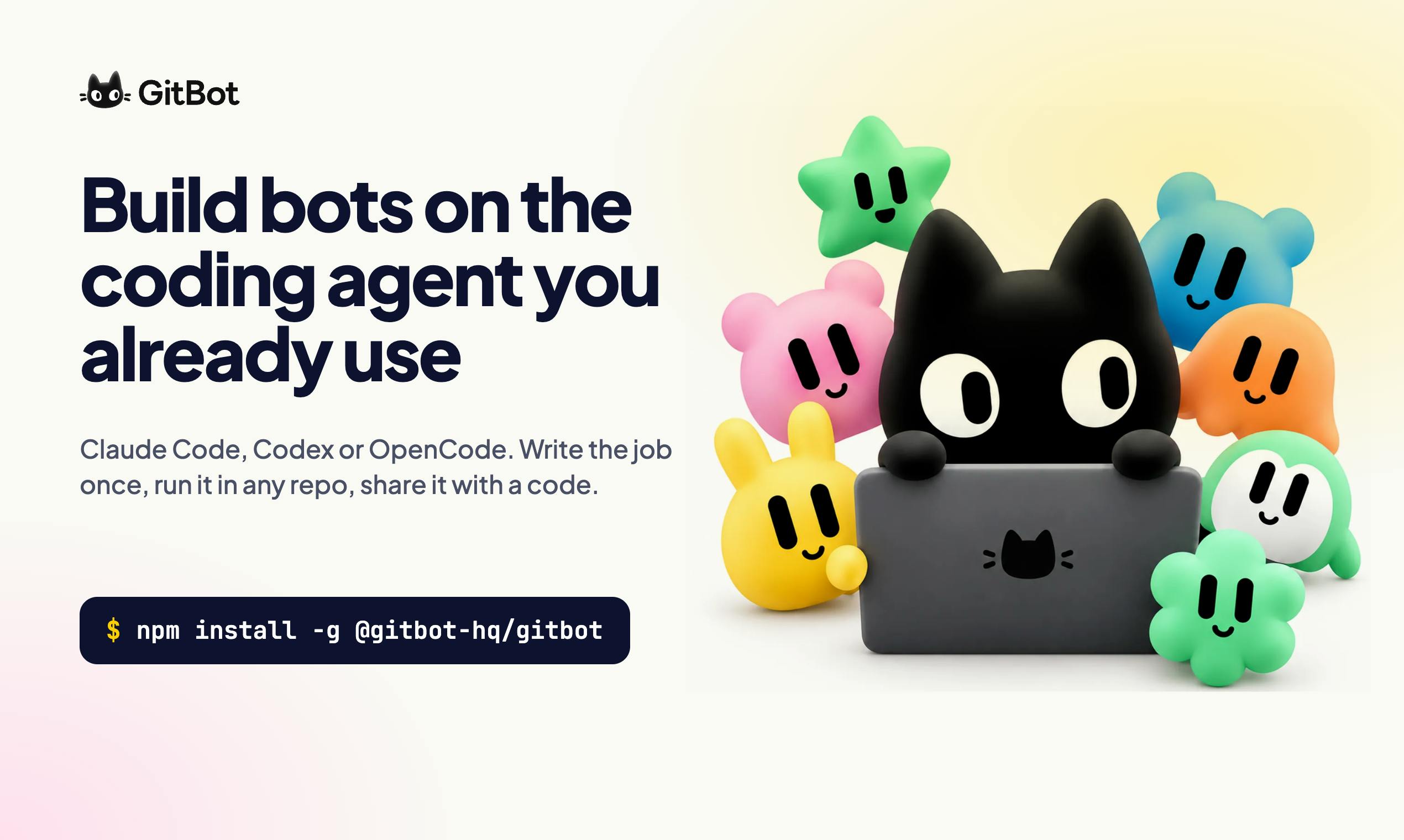
GitBot packages repetitive coding agent tasks into reusable, local-first bots with no telemetry.
GitBot is an open-source tool addressing a pain point that emerged as coding agents became widespread: developers repeatedly issue similar instructions to AI tools like Claude Code and Codex with no way to reuse or standardize them. Its core idea is to codify one-off conversational tasks into portable bots — written once, scoped with permission boundaries, and runnable across any repository, with each execution saved as a traceable thread. The example bot ShipGuard reads a branch and delivers merge/block verdicts backed by file and line evidence, showcasing semantic code review in action. GitBot also offers a Library for community sharing and takes a privacy-first stance: fully local, no account required, and no telemetry.
As coding agents like Claude Code, Codex, and OpenCode become everyday tools for developers, a new challenge has emerged: can the repetitive tasks you keep delegating to AI be codified once and run anywhere? GitBot, an open-source tool, answers that question by packaging them into reusable "bots."
What Problem Does GitBot Solve?
If you use coding agents regularly, you've probably found yourself issuing similar instructions over and over: review this branch, check code style, generate tests, clean up commit messages. Re-describing your requirements every time is inefficient. GitBot's core idea is to take "the work you keep handing off to Claude Code, Codex, or OpenCode" and transform it into a reusable bot.
The approach is simple: write your instructions once, define the scope of what the bot can touch, then run it across any repository. This turns one-off conversational tasks into standardized, portable automation units. The project launched on Product Hunt with 88 upvotes and a #9 ranking, listed under tags including Open Source, Artificial Intelligence, GitHub, and Bots.
Core Mechanics: Instructions, Permissions, and Threads
There are a few design details in GitBot worth paying attention to.
Write Once, Run Anywhere
You write your task instructions once, configure what the bot is "allowed to touch" (its permission boundary), and it can execute across different repositories. This permission-scoping design is especially important for developers — it means an automation script won't overstep and modify files it shouldn't.
Every Run Is a Traceable Thread
Every execution is saved as a "thread," which you can revisit at any time to inspect its context. This means bot behavior is no longer a black-box one-shot operation — it becomes a traceable record you can audit and review, making it easier to debug and learn from.
Library and Sharing
GitBot provides a Library where you can install bots made by other developers or share your own bots via a code. This community-driven sharing model could, in theory, allow high-frequency, general-purpose development tasks (like code review or merge gating) to quickly crystallize into ready-made tools.
The "coding agent" paradigm that GitBot builds on represents one of the most significant shifts in AI-assisted development over the past two years. Unlike earlier Copilot-style tools that only completed code snippets, coding agents can receive high-level natural language instructions (e.g., "review this PR and flag potential security issues"), autonomously break tasks into steps, call tools (read/write files, run terminal commands, search documentation), and iteratively achieve goals. Claude Code is Anthropic's command-line coding agent, Codex is OpenAI's equivalent, and OpenCode is a community-led open-source implementation. These tools essentially combine large language models with tool use and multi-step reasoning, enabling them to perform sustained tasks in real codebases. GitBot's value is built on this foundation — it doesn't ship its own AI engine, but rather provides a standardized task-packaging layer for these agents.
Example: ShipGuard Merge Gatekeeper
The official example bot is called ShipGuard. Its job is to read your current branch and deliver a "merge" or "block" verdict, backed by specific file and line evidence.
This example effectively illustrates GitBot's practical value. Traditional code review relies either on manual inspection or fixed-rule CI checks, whereas a bot powered by a coding agent can deliver more targeted judgments using semantic understanding — and provide verifiable evidence rather than a vague "pass/fail" result. For a team's merge workflow, this kind of gatekeeper automation has real, concrete use cases.
The design detail of "file and line evidence" points to a core challenge in AI code review tools: explainability. Automated systems that simply output "approve" or "reject" give developers no basis to evaluate whether the reasoning is sound, or to make targeted fixes. By citing exact file paths and line numbers, ShipGuard's review conclusions become verifiable — human reviewers can quickly locate the issues the AI flagged and decide whether they agree. This kind of "verifiable automation" design is gaining increasing attention in AI-assisted development tools. It shifts AI from being a "black-box decision maker" to a "clue-providing assistant," with the final call still resting with the developer. Traditional CI/CD static rule checks (like lint and unit tests) can't operate at the semantic level, while LLM-based review, though flexible, often produces vague, sweeping conclusions when it lacks this kind of precise citation.
Local-First and Privacy by Default
GitBot takes a notably restrained stance on privacy and execution model — one that sets it apart from many cloud-based AI tools:
- Runs on your machine: All tasks execute locally, using the logins you already have, with no extra authentication setup required.
- Open source: The project is fully open source, with transparent, auditable code.
- No account, no telemetry: No registration required, and no usage data is collected (no account, no telemetry).
For developers who care about data sovereignty and don't want their code or usage behavior uploaded to third-party servers, this combination of local execution, open source, and zero telemetry is a compelling proposition. It keeps the capabilities of AI coding assistants within an environment the developer controls.
"Telemetry" is a sensitive topic in the developer tools space. Many modern IDE plugins and CLI tools silently send anonymous usage data to vendor servers by default — including command invocation frequency, error stacks, and even code snippets — ostensibly for product improvement. This kind of data collection, when users aren't fully aware of or in control of it, creates privacy and intellectual property risks, particularly for enterprise teams working with proprietary code. GitBot's explicit "no telemetry" stance, combined with local execution and an open-source codebase, means developers can audit the data flow themselves without relying on vendor trust. This aligns with the "privacy-first" and "local-first" design philosophy that has been gaining traction in the developer tools space in recent years.
Who Is It For?
GitBot's target users are clearly defined: developers who are already using coding agents. It doesn't try to replace Claude Code, Codex, or OpenCode — instead, it adds an orchestration layer on top of these tools, turning scattered conversational tasks into a systematic workflow.
If your team has established consistent development standards (like unified review criteria or commit conventions), turning them into GitBot bots and sharing them internally via the Library could be a worthwhile path. And as the community accumulates ready-made bots, everyday users will be able to quickly access battle-tested automation the way they'd install a plugin.
Conclusion
GitBot identifies a genuine pain point that emerged as coding agents became widespread: repetitive AI tasks lack any means of reuse or standardization. Through the combination of bots, permission boundaries, traceable threads, and a community library, it transforms one-off conversations into portable automation assets — while holding firm to a local-first, open-source, zero-telemetry privacy stance. As an open-source project that just debuted on Product Hunt, its real-world maturity and ecosystem scale still need time to prove themselves. But directionally, it's clearly aligned with where AI-assisted development is heading.
Related articles

Chain of Thought Isn't Just for AI: How Humans Can Use CoT to Improve Thinking Quality
Chain of Thought isn't just a prompt trick for large models. Starting from a Hacker News discussion, this article analyzes why CoT works for human thinking too, breaks down actionable ways to transfer it, and highlights the key differences between human CoT and machine CoT.
Cloudflare Teams Up with OpenAI: Closi…
Cloudflare Teams Up with OpenAI: Closing the Loop from Vulnerability Discovery to Defense with AI
Cloudflare uses OpenAI Daybreak to investigate security vulnerabilities and generate reviewable remediation plans, while developers use Codex to boost coding efficiency and quality.

Orca Multi-Agent Orchestration in Practice: A Guide to Parallel Collaboration with Claude and Codex
Orca is Stable AI's free open-source agent workbench supporting 34 agents like Claude Code and Codex in parallel. Learn its Git worktree isolation, multi-model orchestration, and mobile management.