GitHub 8K Stars: Deep Dive into the Most Comprehensive LLM Resource Repository

awesome-LLM-resources: A comprehensive analysis of GitHub's top-starred LLM resource aggregation project
The awesome-LLM-resources project on GitHub (8,200+ Stars) is one of the most popular LLM resource repositories in the Chinese-speaking community, covering multimodal generation, AI Agents & MCP protocol, AI-assisted programming, model training & inference optimization, o1 reasoning scaling, and small language models. Spanning from theoretical research to engineering practice, it forms a complete knowledge graph that stays current with the frontier and serves as a high-quality technical map for LLM learners and practitioners.
Project Overview
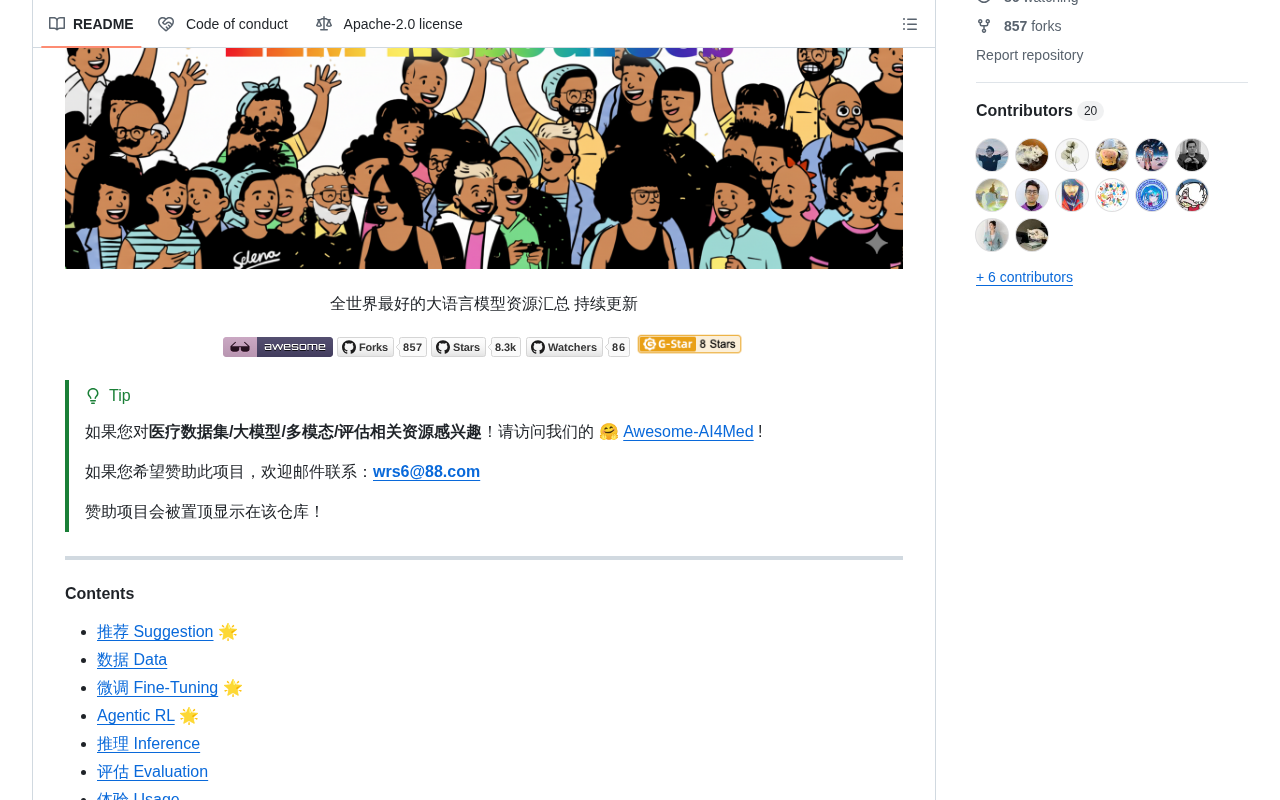
The pace of Large Language Model (LLM) technology evolution is staggering. How to systematically track and learn cutting-edge technical materials has become an unavoidable daily challenge for AI practitioners and researchers. The awesome-LLM-resources project maintained by WangRongsheng on GitHub, with over 8,200 Stars and 843 Forks, stands as one of the most popular LLM resource aggregation repositories in the Chinese-speaking community.
The project positions itself as "the world's best LLM resource collection," covering the complete technology stack from foundational model training to frontier applications — essentially a high-density learning roadmap and reference index.
Core Content Sections Analyzed
Multimodal Generation and Vision-Language Models
Multimodal capability is one of the primary directions in current LLM development. "Multimodal" refers to a model's ability to simultaneously understand and generate multiple information modalities — text, images, audio, video — which more closely mirrors how humans perceive the world. The core technical challenge lies in mapping information from different modalities into a unified semantic space. The landmark early work CLIP (Contrastive Language-Image Pre-training) aligned images and text into a shared vector space through contrastive learning, laying the foundation for subsequent vision-language models. Current mainstream VLM architectures typically adopt a three-stage design of "vision encoder + projection layer + language model": the vision encoder (e.g., ViT) extracts image features, the projection layer converts visual features into token sequences that the language model can understand, and finally the large language model handles reasoning and generation.
The project has dedicated sections for Multimodal Generation and Vision-Language Models (VLM), collecting technical materials ranging from GPT-4V and Gemini to open-source models like LLaVA and Qwen-VL. Among these, LLaVA (Large Language and Vision Assistant) is a benchmark open-source VLM project that achieves multimodal understanding capabilities approaching commercial models through visual instruction tuning at relatively low training costs, significantly advancing open-source community research in this direction. Whether you're interested in image-text understanding, video generation, or cross-modal retrieval, these two sections provide systematic references from paper interpretations to engineering practice.
AI Agent and MCP Protocol
AI Agent is undoubtedly the hottest technical direction of 2024-2025. Unlike traditional "question-and-answer" style conversations, AI Agents emphasize autonomous planning and action capabilities — they can decompose complex tasks into multiple steps, invoke external tools (such as search engines, code interpreters, databases) to gather information or perform operations, and dynamically adjust strategies based on intermediate results. Current mainstream Agent architecture paradigms include ReAct (Reasoning + Acting, alternating between reasoning and action), Plan-and-Execute (formulating a complete plan first, then executing step by step), and multi-agent collaboration (multiple specialized Agents working together to accomplish complex tasks).
The project collects core resources on Agent architecture design, tool calling, and multi-agent collaboration. Particularly noteworthy is the dedicated MCP (Model Context Protocol) section — this is a model context protocol proposed by Anthropic in late 2024 that is rapidly becoming the de facto standard for Agent-to-external-tool interaction. Before MCP, every AI application that needed to integrate external tools required custom integration code for different APIs — as inefficient as every appliance needing its own proprietary outlet. MCP's core value lies in defining a standardized communication protocol: it abstracts tool providers as "MCP Servers" and AI applications as "MCP Clients," with both interacting through a unified JSON-RPC protocol. This means developers only need to write tool adaptations once for them to be callable by any MCP-supporting AI application, dramatically reducing integration costs in the Agent ecosystem. The fact that MCP gets its own dedicated section demonstrates the maintainer's keen awareness of technological trends.
AI-Assisted Programming and AI Paper Review
At the application layer, the project focuses on two high-value scenarios:
- AI-Assisted Programming: Aggregates usage tips and underlying principles for mainstream AI coding tools like Cursor, GitHub Copilot, and Cline, helping developers genuinely boost coding efficiency. These tools differ in their underlying approaches: GitHub Copilot primarily provides real-time completions based on code context, Cursor deeply integrates AI capabilities into the IDE editing workflow (supporting multi-file editing and codebase-level context understanding), while Cline as an open-source solution allows developers to drive code generation and modification through natural language commands in VS Code. Understanding these differentiated positions helps developers choose the most suitable solution for their workflow.
- AI Paper Review: This is a relatively niche but highly practical direction, primarily targeting automated review and writing assistance for academic papers. Current AI review tools can automatically check logical consistency, citation standards, experimental design rationality, and even generate structured review comments. For journal editors and reviewers who handle large volumes of manuscripts annually, these tools can significantly improve efficiency — something researchers should pay close attention to.
Model Training and Inference Optimization
Engineering practice is another major highlight of this project, with remarkably solid resources:
- Data Processing: Covers data cleaning, data annotation, synthetic data generation, and other critical steps in the pre-training and fine-tuning stages. Data quality is often the primary factor determining a model's final performance — there's an industry consensus of "garbage in, garbage out." In recent years, synthetic data (training data generated by models themselves) has become an important trend. For example, Meta's Llama 3 extensively used synthetic data generated by Llama 2 during training to enhance specific capabilities. This "training models with models" strategy is reshaping data engineering methodology.
- Model Training: Provides comprehensive training pipeline references from pre-training, SFT (Supervised Fine-Tuning) to alignment techniques like RLHF/DPO. It's worth clarifying the distinctions between several key concepts here: SFT (Supervised Fine-Tuning) fine-tunes a pre-trained model using human-annotated "instruction-response" pairs, teaching the model to follow instructions; RLHF (Reinforcement Learning from Human Feedback) goes further by first training a reward model to simulate human preferences, then optimizing the language model's outputs through reinforcement learning (typically PPO algorithm) to better align with human expectations; DPO (Direct Preference Optimization) is an RLHF alternative proposed in 2023 that skips the reward model training step, directly optimizing the language model using human preference data, greatly simplifying the alignment process with more stable training — it has since been widely adopted.
- Model Inference: Includes practical materials on quantization, distillation, and inference acceleration (vLLM, TensorRT-LLM, etc.). Quantization refers to compressing model parameters from high-precision floating point (e.g., FP16) to low-precision representations (e.g., INT8, INT4) to reduce memory usage and accelerate inference, with common methods including GPTQ, AWQ, GGUF, etc.; Distillation involves having a small model (student) learn the output distribution of a large model (teacher), retaining most capabilities with fewer parameters; vLLM efficiently manages KV Cache memory allocation through PagedAttention technology, multiplying inference throughput several times over, and has become the de facto standard for open-source inference engines.
These three sections together form the core knowledge system for LLM engineering deployment. For teams that need to build or optimize model pipelines from scratch, the resources here can save enormous amounts of searching and filtering time.
o1 Model and Inference Scaling
OpenAI's o1 series models pioneered a new paradigm of "test-time compute." To understand the revolutionary significance of this paradigm, one must first understand the previous primary path for improving LLM performance — train-time scaling, which involves increasing model parameters, training data volume, and compute to enhance capability, as described by the famous Scaling Law. However, the o1 model proposed a complementary path: investing more computational resources during the inference phase, allowing the model to "slow down and think." Specifically, o1 generates a lengthy internal reasoning process before answering questions (similar to humans "working on scratch paper"), improving final answer quality through step-by-step derivation, self-verification, and backtracking to correct errors. The theoretical foundation of this mechanism traces back to Chain-of-Thought (CoT) prompting — Google's 2022 research showed that merely adding "Let's think step by step" to prompts could significantly improve model performance on math and logical reasoning tasks. o1 internalized this idea into the model's training process, enabling it to autonomously learn when deep reasoning is needed and how to allocate reasoning compute.
The project has a dedicated o1 section collecting research materials on chain-of-thought, slow thinking, and inference scaling. This direction is fundamentally expanding LLM capability boundaries — it means model performance no longer depends solely on parameter count but also on how long the model is willing to "think" during inference. This opens entirely new possibilities for continuously improving intelligence levels at fixed model scales, making it one of the most worthwhile technical bets for 2025.
Small Language Models (SLM)
While large models keep getting larger, the practical value of Small Language Models is also rising rapidly. "Small language models" typically refer to models with 1B-7B parameters (by comparison, GPT-4's parameter count reportedly exceeds 1 trillion). Small models have surged in prominence over the past two years thanks to three areas of technical progress: first, curated high-quality training data strategies — Microsoft's Phi series models demonstrated that "textbook-quality" curated data can enable small models to far exceed same-scale competitors in reasoning ability; second, the maturation of knowledge distillation and data synthesis techniques, allowing small models to "inherit" capabilities from large models; third, training methodology optimizations such as longer training steps and more refined learning rate schedules, ensuring every parameter is utilized more fully at small parameter counts.
The project collects materials on lightweight models like Phi, small-parameter versions of Qwen2.5, Gemma, and others, focusing on efficient deployment under limited compute. For example, a quantized 3B-parameter model can run smoothly on consumer-grade GPUs or even mobile chips, opening enormous possibilities for edge computing, mobile deployment, and cost-sensitive applications. For small and medium teams with limited budgets but AI needs, small language models are often the most cost-effective choice — this section's reference value should not be overlooked.
Project Value and Usage Recommendations
Why This Project Deserves a Bookmark
- Comprehensive Coverage: From theoretical research to engineering practice, from foundational models to application scenarios, it forms a complete LLM knowledge graph.
- Cutting-Edge Tracking: Latest directions including MCP protocol, o1 reasoning paradigm, and small language models are all covered, with relatively frequent updates.
- Chinese-Friendly: As a Chinese-community resource aggregation project, it significantly lowers the learning barrier for non-native English speakers.
Three Tips for Efficient Use
- Index On-Demand: No need to read everything — select the relevant sections based on your technical focus for deep study.
- Combine with Practice: Pair papers and projects from the resource lists with your current development tasks — learning by doing yields the best results.
- Track Continuously: Star and Watch the repository to receive update notifications for newly added resources immediately.
Conclusion
The awesome-LLM-resources project, through its systematic categorization and precise curation of cutting-edge content, provides LLM learners and practitioners with a high-quality "technical map." In today's AI information explosion, a human-curated resource aggregation like this is no less valuable than a carefully designed course. Whether you're a beginner AI enthusiast or an engineer tackling specific technical challenges, it deserves a place in your bookmarks.
Related articles
 Tutorials
ChatGPT Plus Subscription Guide: Are GPT-5.5, image-2, and Codex Worth the Upgrade?
A detailed look at ChatGPT Plus features — GPT-5.5, image-2, and Codex — with a Plus vs Pro comparison and a complete step-by-step subscription guide for users outside the US.
 Tutorials
Harness AI Engineering in Practice: Using Claude Code to Master Enterprise-Level E-Commerce Development
Deep dive into Harness AI Engineering: master enterprise e-commerce development with Claude Code using the Rules, Skills, Wiki, and Changes framework.
 Tutorials
Cursor + Codex Dual-IDE Collaboration: A Practical Methodology for Open-Source Project Customization
A complete methodology for open-source project customization based on real-world experience, detailing the Cursor+Codex dual-IDE workflow, seven-stage process, MVP validation, and AI source code reading techniques.