GitHub 8K+ Stars Project: Deep Dive into the Most Comprehensive LLM Learning Resource Repository

A deep analysis of GitHub's most comprehensive LLM learning resource repository with 8K+ stars.
This article provides an in-depth analysis of the awesome-LLM-resources GitHub project, a community-validated repository with 8,200+ stars that systematically indexes LLM learning materials. Covering model training, inference optimization, AI Agents, MCP, multimodal generation, small language models, o1 models, and more, it serves as an essential knowledge map for researchers, engineers, and beginners in the AI field.
Project Overview
In an era of rapid iteration in Large Language Model (LLM) technology, systematically accessing high-quality learning resources has become a core challenge for every AI practitioner and researcher. The awesome-LLM-resources project on GitHub (maintained by WangRongsheng) was created to address this exact pain point. With over 8,200+ Stars and 839 Forks, it stands as one of the most comprehensive LLM resource indexes in the Chinese-speaking community.
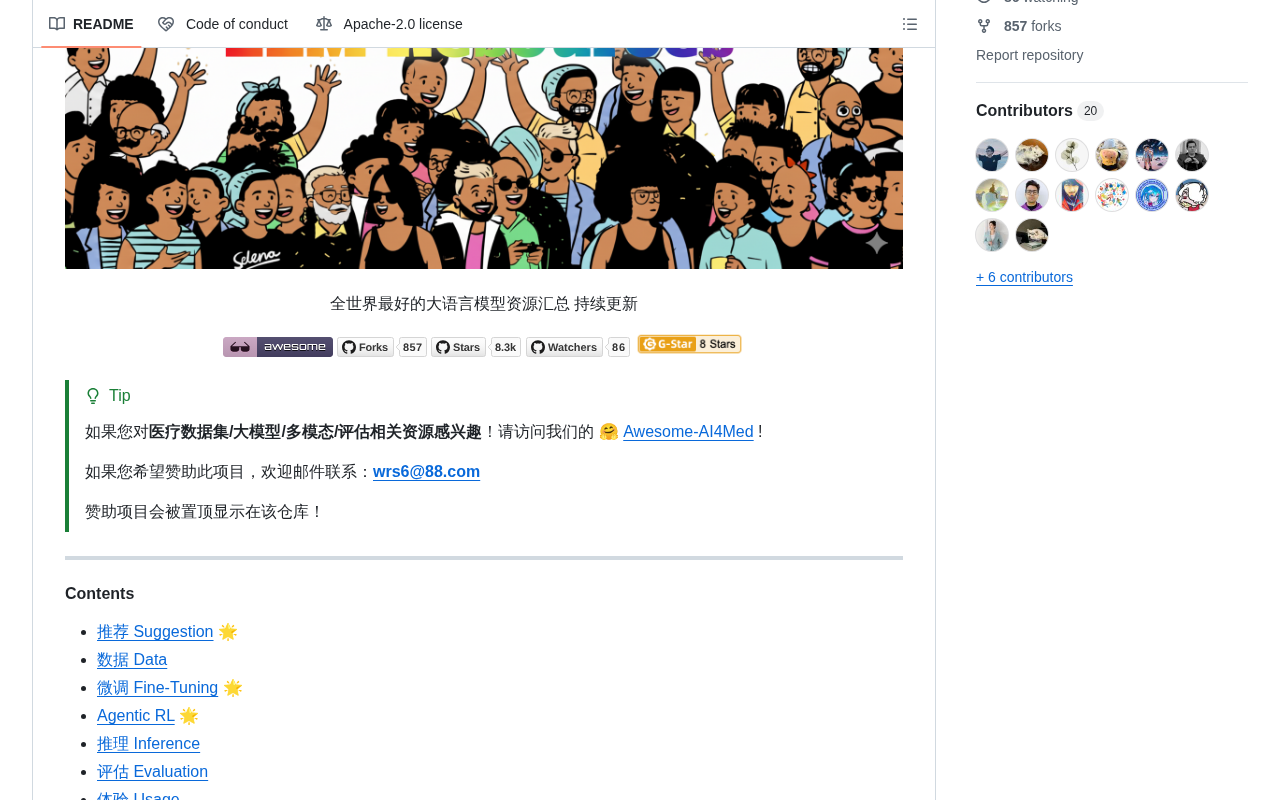
Positioned as "the world's best LLM resource compilation," the project covers a complete knowledge graph from foundational theory to cutting-edge applications, spanning multimodal generation, Agents, AI-assisted programming, AI paper review, data processing, model training and inference, o1 models, MCP, small language models, vision-language models, and over ten other core directions.
Core Content Sections Analysis
Model Training and Inference
Model training and inference form the bedrock of the LLM technology stack. This section of the repository organizes full-pipeline resources ranging from pre-training, fine-tuning (SFT/RLHF/DPO), to efficient inference deployment. For developers looking to build LLM training workflows from scratch, these resources can dramatically reduce technical research time and prevent getting lost in the sea of papers and tools.
On the inference optimization front, the project covers materials on mainstream acceleration approaches including Quantization, Distillation, and Speculative Decoding — all critical for deploying large models into production environments.
Agents and MCP
AI Agents represent one of the hottest technical directions in 2024-2025. The project dedicates a specific section to Agents, collecting systematic resources from theoretical frameworks to practical tools. Notably, the project also lists MCP (Model Context Protocol) as a separate topic — this is the model context protocol proposed by Anthropic that is becoming the de facto standard for Agent-to-external-tool interactions. Including MCP as an independent section demonstrates the maintainer's keen judgment on technology trends.
Multimodal Generation and Vision-Language Models
Multimodal capabilities have become a key metric for evaluating the comprehensive strength of large models. The project establishes separate sections for multimodal generation and Vision-Language Models (VLMs). The former focuses on cross-modal content generation across text, images, video, and audio, while the latter concentrates on the fusion of visual understanding and language reasoning. From GPT-4V to Gemini, from LLaVA to Qwen-VL, this field evolves at breakneck speed, making a continuously updated resource index particularly valuable.
AI-Assisted Programming and AI Paper Review
These two sections showcase LLM's deep applications in vertical scenarios. In AI-assisted programming, from GitHub Copilot to Cursor, from code generation to code review, AI is reshaping every aspect of software development. AI paper review addresses an urgent need in academia, covering automatic paper reviewing, writing assistance, and related directions that offer direct practical value to researchers.
Small Language Models and o1 Models
The Small Language Models (SLM) section reflects an important industry trend: not every scenario requires hundred-billion-parameter models. Smaller variants from the Phi, Gemma, and Qwen series demonstrate enormous potential in on-device deployment and low-cost inference scenarios.
The o1 model section focuses on OpenAI's reasoning-enhanced model series. Through chain-of-thought deep reasoning, o1 achieves qualitative leaps in complex tasks such as mathematics, programming, and science, representing a crucial shift in LLMs from "fast thinking" to "slow thinking."
Project Value and Usage Recommendations
Why It Deserves Your Attention
- Systematic Organization: Unlike scattered blog posts or paper lists, this project provides systematic categorization by technical direction, forming a complete knowledge map
- Timeliness: Continuously maintained and updated, keeping pace with the latest technical trends like MCP and o1
- Chinese-Friendly: Primarily in Chinese, lowering the learning barrier for Chinese-speaking developers
- Community-Validated: 8,000+ stars signify real-world usage and recognition from a large developer community
How to Use It Efficiently
Choose your entry point based on your role:
- Researchers: Focus on model training, o1 models, multimodal generation, and other frontier sections
- Engineers: Prioritize model inference, AI-assisted programming, MCP, and other deployment-related resources
- Beginners: Start with data processing and model training fundamentals, then gradually expand to Agents and multimodal directions
Conclusion
The value of awesome-LLM-resources lies not only in the aggregation of resources but also in providing LLM learners with a clear panoramic view of the technology landscape. In an age of information overload, a carefully curated and continuously maintained resource index is often more valuable than any single tutorial. Whether you're a newcomer to AI or a seasoned researcher with years of experience, this project is worth bookmarking and revisiting regularly.
Project URL: GitHub - WangRongsheng/awesome-LLM-resources
Related articles
 Product Reviews
The Programmer's Desk Setup Guide: Building a Workspace That Feels Like Home
Discover how programmers build productive, comfortable workspaces. From multi-monitor setups to ergonomic design, explore the desk philosophy that drives focus and flow.
 Product Reviews
Qoder vs Cursor Real-World Comparison: Which $20/Month AI IDE Is Better?
Hands-on comparison of Qoder vs Cursor AI IDEs: Agent autonomy, human interaction count, and architecture decisions. Qoder needed only 2 interactions vs Cursor's 8.
 Product Reviews
Cursor Cloud Agent Demo: Eliminating Bottlenecks Across the Entire Software Development Lifecycle
Deep analysis of Cursor's Cloud Agent demo showing how cloud VMs, automated test artifacts, and a full-chain control plane systematically eliminate human bottlenecks across the software development lifecycle.