GitHub Copilot Parallel Agents: Running Multiple AI Agents Simultaneously to Boost Development Efficiency
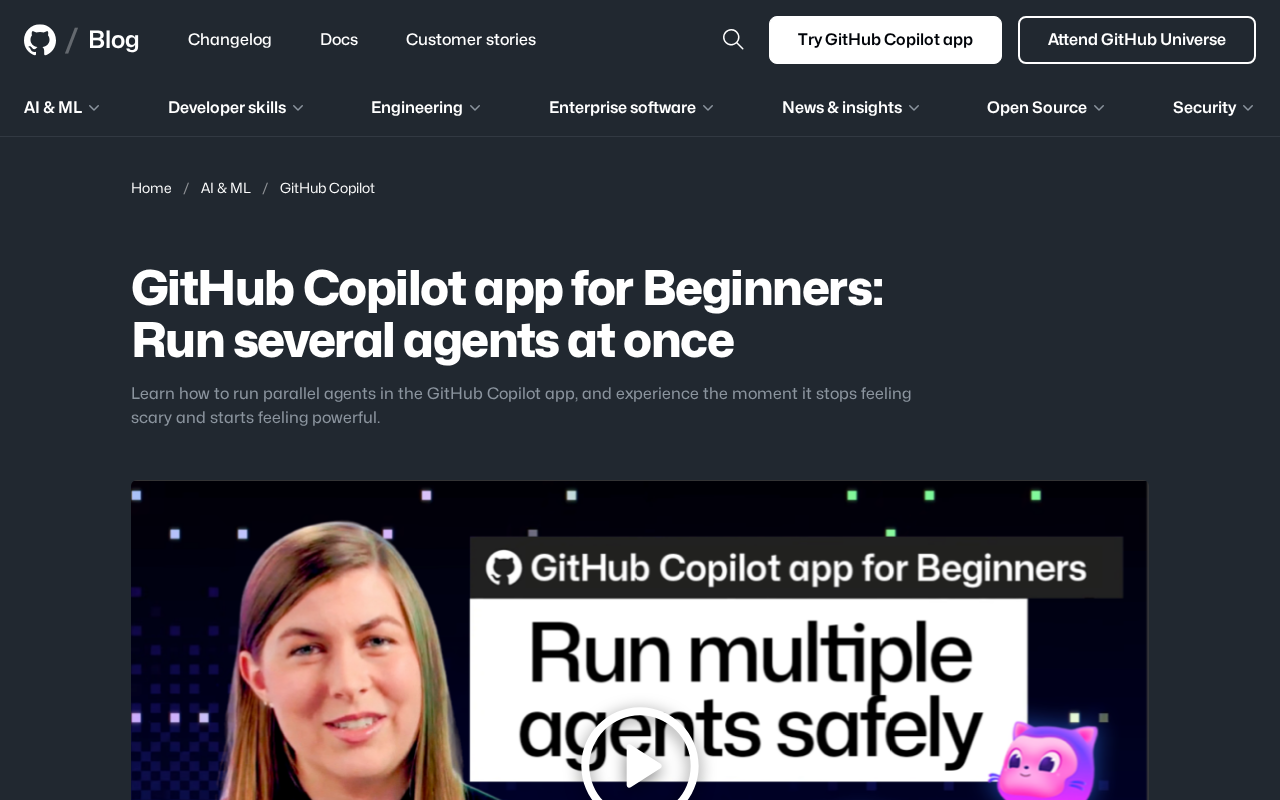
GitHub Copilot parallel agents enable simultaneous AI-powered task execution for faster development.
GitHub Copilot's parallel agents feature allows developers to run multiple AI agents simultaneously on independent subtasks, significantly boosting efficiency. Success requires strong task decomposition skills and awareness of potential code conflicts and review burdens.
From Single Assistant to Multi-Agent Collaboration
GitHub Copilot is no longer just an autocomplete tool that fills in code snippets in your editor. As GitHub Copilot's capabilities continue to evolve, it's transforming into a true "AI agent platform." The newly introduced parallel agents feature is redefining how developers collaborate with AI.
The "agent" here is not simply a chatbot or code completion engine. An AI agent refers to an artificial intelligence system capable of autonomously perceiving its environment, formulating plans, executing actions, and adjusting strategies based on feedback. Unlike traditional "input-output" AI models, agents have the ability to run continuously, invoke tools, access external resources, maintain contextual memory, and make autonomous decisions in multi-step tasks. In the programming domain, this means agents can not only generate code snippets but also understand project structure, run tests, analyze error logs, and autonomously fix issues. This concept originates from Multi-Agent System (MAS) research, a field with decades of academic foundation in distributed artificial intelligence, now finally landing in software engineering powered by the strong reasoning capabilities of large language models.
For developers new to this concept, having multiple AI agents working simultaneously sounds both cool and somewhat intimidating. But as the official GitHub blog puts it, once you actually get hands-on experience, that "intimidation" quickly transforms into a sense of control—"the moment it stops feeling scary and starts feeling powerful."
What Are GitHub Copilot Parallel Agents
The Mental Shift from Serial to Parallel
In traditional AI-assisted programming workflows, developer interaction with Copilot is often linear and serial: submit a request, wait for AI to complete it, check the results, then move to the next one. This mode works well enough for single tasks, but becomes inefficient when facing complex projects containing multiple independent subtasks.
The core idea of parallel agents is straightforward: decompose a large task into multiple independent subtasks and have multiple AI agents process them simultaneously in parallel. For example, you can have one agent write unit tests, another refactor a module, and a third update project documentation—they work independently without interfering with each other, then consolidate results at the end.
This design philosophy has deep connections to parallel computing and concurrent programming in computer science. In operating systems, multithreading and multiprocessing mechanisms allow CPUs to handle multiple tasks simultaneously; in distributed systems, frameworks like MapReduce accelerate massive data processing through task decomposition and parallel execution. GitHub Copilot's parallel agents essentially apply this classic "divide and conquer" approach to AI-assisted development workflows—each agent acts as an independent worker thread with its own execution environment and context, pushing forward their respective subtasks without blocking each other. The difference is that these "threads" aren't executing predefined program instructions, but rather AI systems with comprehension and decision-making capabilities autonomously completing open-ended programming tasks.
Real-World Significance for Developers
The greatest value of parallel agents isn't about showing off, but about genuinely reducing the cognitive load of task management. You no longer need to mentally queue tasks waiting for each to finish sequentially; instead, you can delegate work like a project manager, letting your AI team advance tasks in sync. This working style more closely resembles real software engineering team collaboration and better fits the rhythm of actual projects.
How to Run Multiple Parallel Agents in Copilot
Basic Operation Flow
According to the official GitHub tutorial, the core steps to launch parallel agents in Copilot are:
- Clarify task boundaries: Break down project requirements into several relatively independent, non-dependent subtasks. The less coupling between tasks, the higher the parallel efficiency.
- Assign agents: Launch an independent agent session for each subtask, providing clear, specific instructions.
- Monitor progress: View the execution status and staged outputs of each agent simultaneously in the application interface.
- Review and merge: Code review each agent's output, and merge into the main branch after confirming correctness.
Task Decomposition Is a Key Skill
It's important to emphasize: the effectiveness of parallel agents heavily depends on the developer's task decomposition ability. If the tasks you assign are highly coupled (for example, one task's output is another task's input), parallelization will instead create chaos and code conflicts.
Therefore, learning to think like an architect—identifying which work can be parallelized and which must be serialized—is a prerequisite for effectively using multiple agents. In software architecture design, this capability is called "Separation of Concerns," which requires developers to clearly define responsibility boundaries between different parts of the system. When facing parallel agent scenarios, developers need a mindset similar to designing microservice architectures: each agent is responsible for a work unit with clear boundaries and well-defined interfaces, minimizing implicit dependencies between agents.
Advantages and Potential Risks of Parallel Agents
Significant Efficiency Gains
The most intuitive benefit is time savings. Three tasks that originally needed to be completed sequentially can now be advanced synchronously within the same time window, theoretically compressing development cycles significantly. For projects requiring large amounts of repetitive or modular work (such as batch fixing code style or generating multi-module boilerplate code), efficiency improvements are particularly noticeable.
Challenges to Watch For
However, parallelization doesn't come without costs. Multiple agents operating on the codebase simultaneously may introduce these issues:
- Code conflicts: Different agents modify the same files or interdependent logic, causing merge difficulties. This is essentially the classic concurrent write problem in distributed version control. In Git workflows, when multiple branches make different modifications to the same region of a file, merge operations produce conflicts requiring manual intervention. In traditional team collaboration, developers mitigate this issue through code ownership divisions, feature branch strategies (like Git Flow), and frequent code reviews. In multi-agent scenarios, this challenge is further amplified because AI agents modify code far faster than humans, and different agents currently lack real-time communication mechanisms. Future solutions may require introducing intelligent merge strategies or inter-agent coordination protocols to automatically resolve conflicts.
- Increased review burden: The faster AI produces output, the heavier the manual review load. Parallelization means you need to review multiple code outputs simultaneously.
- Context consistency issues: Different agents may have varying understandings of the overall project design, producing inconsistencies in code style or architecture.
This is why GitHub recommends developers proceed gradually—start by trying two or three simple, independent tasks, gradually building intuition and feel for multi-agent collaboration, rather than immediately assigning dozens of complex tasks.
The Agentic Trend in AI Programming
Parallel agents aren't an isolated experiment by GitHub, but rather a microcosm of the entire AI programming field's evolution toward Agentic approaches. From GitHub Copilot to various autonomous programming agents, the industry is exploring how to evolve AI from "passive code completion tools" to "proactive, collaborative development partners."
Agentic AI is one of the most important technical trends in the AI industry during 2024-2025. From OpenAI's GPT series introducing Function Calling and Code Interpreter capabilities, to Anthropic's Claude launching Computer Use functionality, to the emergence of autonomous programming agents like Devin and SWE-Agent, the industry is undergoing a comprehensive transformation from "conversational AI" to "action-oriented AI." Research firms like Gartner predict that by 2028, over 15% of daily work decisions will be autonomously completed by agents. In software development, this means AI will gradually evolve from a supporting role to a collaborative partner capable of independently undertaking end-to-end development tasks. GitHub Copilot's parallel agents feature is a specific product manifestation of this macro trend.
This transformation is also quietly changing capability requirements for developers: in the future, excellent engineers may no longer be measured by "speed of hand-writing code," but rather by "ability to efficiently design tasks, orchestrate agents, and control output quality." This role shift resembles the leap from "individual contributor" to "technical lead"—where core competitiveness shifts from execution ability to judgment and architectural thinking. Mastering tools like parallel agents is the first step into this new paradigm.
Getting Started Recommendations: Begin Small with Practice
GitHub Copilot's parallel agents feature essentially puts "AI team management" capabilities into the hands of every developer. It may feel complex at first, but like any powerful tool, the real value lies in the sense of control gained through hands-on practice.
It's recommended to start with a small project, try simultaneously assigning two independent tasks to Copilot agents, and personally experience that journey "from unfamiliar to proficient." Once you become comfortable with this multi-agent collaboration approach, you'll find that your way of thinking about software development has upgraded as well.
Key Takeaways
Related articles
Cerebras Runs Qwen3 at 1,500 Tokens/Sec: Why Inference Speed Matters
Cerebras runs Qwen3-27B at 1,500 tokens/sec on its Wafer-Scale Engine—an order of magnitude faster than mainstream GPUs. We break down the architecture, impact, and community concerns.
Agents Supervising Agents: Four Principles for Safe AI-Automated Collaboration
Explore a safety framework for multi-agent collaboration. Learn WorkOS's four design principles — headless supervision, scoped tasks, cost visibility, and human-gated merges — for trustworthy AI Agent automation.
OpenClaw In-Depth Analysis: Agent Framework Capabilities and Three Critical Pitfalls to Avoid
In-depth analysis of OpenClaw Agent framework's core mechanisms, including Skill system, tool calling, and Channels remote control, plus three critical pitfalls: token costs, security risks, and intelligence limitations.