GitHub Daily · August 11: Agent Skills Ecosystem Explosion & AI Video Production Industrialization

AI Agents go industrial: skills (standards), orca (orchestration), and OpenMontage (application) form a full stack.
Today's GitHub Trending reveals AI Agents evolving from demos to production pipelines. Anthropic's skills repo defines a standard library for Agent capabilities, OpenMontage delivers the first open-source agentic video production system with 700+ skill files, and orca surges +881 Stars as an Agent fleet management environment. Together they form a complete industrialization stack, while classics like transformers, nvm, and manim prove that solving real pain points never goes out of style.
GitHub Daily · August 11: Agent Skills Ecosystem Explosion & AI Video Production Industrialization
Today's Trending list reveals a stark divide: on one side, timeless classic infrastructure tools (nvm, transformers, awesome-mac); on the other, a rapidly rising wave of new forces centered around the AI Agent narrative. Particularly noteworthy is Anthropic's official skills repository sitting near the top with 160K+ Stars, while OpenMontage and orca — two "Agent industrialization" projects — each gained hundreds of Stars in a single day, signaling that AI Agents are rapidly evolving from "toy-level demos" to "production-grade pipelines."
If last year the debate was "can Agents actually be useful," today's trending list tells us the conversation has shifted to "how do we organize a group of Agents to get real work done." This is the inevitable result of maturing model capabilities from Claude 4, Fable 5, GPT-5, and others — the tooling and framework layer is now catching up to the model layer. Let's break down each project in depth.
anthropics/skills: The "Standard Library" Movement for Agent Capabilities
Project Positioning: An official Anthropic-maintained public repository of Agent Skills, curating reusable Agent skill definitions.
Problem Solved: Previously, every developer building an Agent had to write tool calls, prompts, and workflow logic from scratch — massive duplication of effort with wildly inconsistent quality. The skills repository aims to abstract Agent "capabilities" into shareable, composable standard units — just as programming languages have standard libraries, Agents should have a skills standard library too.
Core Features: Skills are defined in a structured format, with each skill containing clear trigger conditions, execution logic, and knowledge files. This design allows official CLI tools like Claude Code to load community-contributed capabilities in a plug-and-play fashion, eliminating the need for lengthy prompt engineering every time.
Use Cases: If you're using Claude Code or building Agent applications on the Anthropic ecosystem, you can directly reuse skills from the repository instead of implementing them yourself. If you're a tool developer, you can contribute your own skills back to the community.
Tech Stack: Primarily Python with a clean structure. Its reference value lies in demonstrating the organizational paradigm of "skills as code, skills as documentation."
Star Analysis: 167K Stars, +468 in a single day. As an official repository, its high Star count reflects both brand endorsement and the community's strong demand for "Agent standardization." This isn't a flashy tech demo — it's a land grab for ecosystem standards.
calesthio/OpenMontage: The World's First Open-Source Agentic Video Production System
Project Positioning: Claims to be the world's first open-source, Agent-driven video production system.
Problem Solved: Video production is a complex workflow that relies heavily on multi-stage collaboration — scripting, editing, voiceover, color grading, subtitles, rendering — each step requiring specialized tools and human effort. OpenMontage asks: can we turn an AI coding assistant into a complete video production studio?
Core Features: The official description includes some staggering numbers — 12 production pipelines, 100+ tools, 700+ Agent skills and production knowledge files. It decomposes video production into a complete set of processes, letting Agents collaborate along pipeline stages rather than relying on a single model to "generate everything in one shot." This approach of "engineering decomposition + Agent orchestration" offers more control and customization than relying solely on end-to-end video generation models like Sora.
Use Cases: Content creators, social media teams, and educational institutions that need to batch-produce explainer/tutorial videos can all use it to transform AI coding assistants into video production pipelines.
Tech Stack: Python, with deep dependency on the Agent Skills system — note that it's a product of the same trend as the skills repository above.
Star Analysis: 46K Stars, +436 in a single day. For such a vertical-specific project, this growth rate is remarkably impressive. It validates the market appetite for the "Agent + domain knowledge files" industrialization approach.
stablyai/orca: An ADE for Managing a Fleet of Parallel Agents
Project Positioning: Orca is an ADE (Agent Development Environment) for operating a fleet of parallel-running Agents.
Problem Solved: When you need to run many coding Agents simultaneously, how do you manage, schedule, and monitor them all? A single Agent is straightforward, but "a group of Agents working in coordination" is an entirely new engineering challenge. Orca positions itself as this orchestration and management infrastructure layer.
Core Features: You can use your own subscriptions (e.g., Claude, GPT) to power any coding Agent, with support for desktop, mobile, and VPS deployment. The "use your own subscription" aspect is crucial — it hands compute cost control back to the user rather than locking them into a SaaS platform.
Use Cases: Teams that need to process large volumes of code tasks in parallel — such as refactoring dozens of repositories simultaneously, batch-fixing issues, or running large-scale automated experiments.
Tech Stack: TypeScript, with strong cross-platform capabilities. A great reference for developers looking to learn how multi-Agent orchestration systems are designed.
Star Analysis: 42K Stars, a massive single-day surge of +881 — the fastest-growing project on today's list. This number shows that "Agent fleet management" is hitting a real pain point for developers.
3b1b/manim: The Evergreen Math Animation Engine
Project Positioning: An explanatory math video animation engine developed by renowned math educator 3Blue1Brown.
Problem Solved: Precisely generating visualizations of mathematical concepts through code, making abstract formulas, geometry, and transformations intuitive and tangible.
Core Features: Animations are defined programmatically with precise control over every frame's mathematical object transformations. It's the de facto standard tool for math explainer videos.
Use Cases: Educators, science communicators, and developers wanting to create high-quality technical presentations. Interestingly, in an era where AI video systems like OpenMontage are on the rise, manim represents an alternative path — "precise, controllable, code-driven" — and the two approaches are not mutually exclusive.
Tech Stack: Python. 89K Stars, +381 in a single day. As a "classic utility tool," its sustained popularity proves that demand for quality visualization is evergreen.
huggingface/transformers: The Infrastructure That Defines AI Models
Project Positioning: A unified framework for defining text, vision, audio, and multimodal models, covering both inference and training.
Problem Solved: Enables developers to load and use SOTA models through a unified API without rewriting code for each model. It's the bedrock of the entire open-source AI ecosystem.
Core Features: Provides a consistent interface from Llama 4 to various multimodal models, with integrated inference and training. Most of the Agent projects on today's list ultimately depend on the model capabilities that transformers provides under the hood.
Use Cases: Virtually every developer building AI applications. Its sheer scale of 163K Stars and 34K Forks speaks for itself.
nvm-sh/nvm, awesome-mac & project-based-learning: The Steady Base of Classic Tools
These three projects represent the power of "evergreens" on the Trending list:
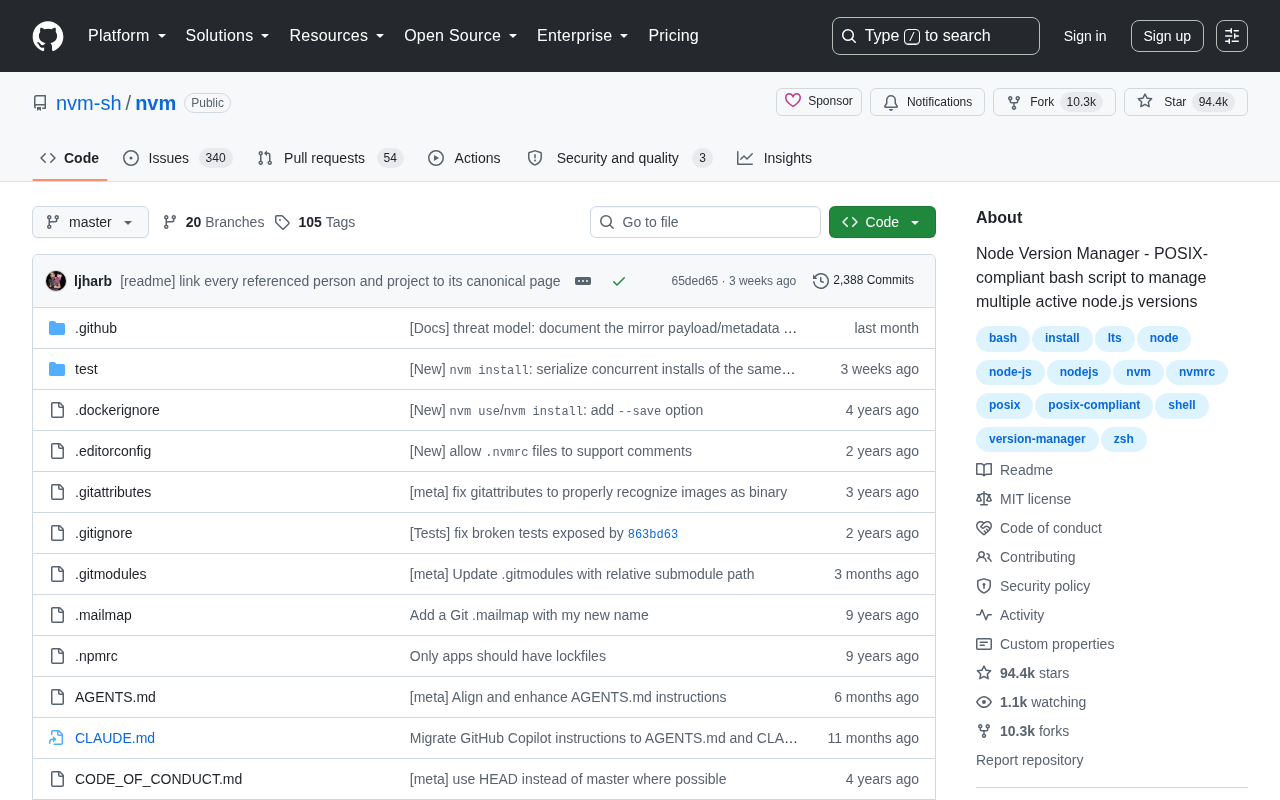
- nvm (94K Stars): A Node.js version manager — a POSIX-compliant Bash script that's practically essential for every frontend/Node developer. Its long-standing presence on the list reminds us that a small tool solving a real pain point can outlast countless flash-in-the-pan frameworks.
- awesome-mac (110K Stars): A systematically curated list of high-quality macOS software, written in Swift. It serves the eternal need of "discovering great software."
- project-based-learning (278K Stars): A curated collection of project-driven programming tutorials — the highest-starred project on today's entire list. It reflects developers' strong preference for "learning by building" — in an age when AI can write code, hands-on practice becomes even more precious.
Today's Trend Observation: Agents Are Being "Industrialized"
Connecting the dots across today's list, a clear narrative emerges: AI Agents are evolving from monoliths to clusters, from demos to pipelines.
anthropics/skillsis building the standards layer — defining a universal format for Agent capabilities;OpenMontageis building the application layer — arming Agents with 700+ skill files to create a production system for a vertical domain (video);orcais building the orchestration layer — managing a fleet of parallel Agents.
These three layers form the complete stack for Agent industrialization. When model capabilities (GPT-5, Claude Fable 5) are already powerful enough, the competitive focus naturally shifts to "how to organize and reuse those capabilities." This mirrors software engineering history's evolution from "hand-written assembly to standard libraries, frameworks, and IDEs" in a strikingly similar way.
Another thought-provoking contrast is the two paths in the video domain: manim represents precise code-driven control, while OpenMontage represents automated Agent orchestration. The future will likely see a convergence of both — Agents calling precise tools like manim to handle localized rendering tasks.
Today's Must-Watch TOP 3
- stablyai/orca — The growth champion at +881 Stars in a single day. "Agent fleet management" is the next infrastructure battleground and deserves study by anyone doing Agent engineering.
- anthropics/skills — The official Agent capability standard library. The best entry point for understanding the future Agent ecosystem — bookmark it and follow along.
- calesthio/OpenMontage — "The world's first open-source agentic video production system" showcases the complete paradigm of Agent industrialization landing in a vertical domain. A must-see for content creators.
Looking Ahead: As the standards layer, orchestration layer, and application layer take shape as a triumvirate, we'll most likely see more "Agent fleet + domain skill pack" combinations appearing across vertical industries in the second half of 2026. The competition in the Agent space is shifting from "how smart is the model" to "how efficient is the engineering organization."
Related articles

VICE Platform: An AI Security Scanning Tool Review for Indie Developers
VICE Platform scans web app vulnerabilities from an attacker's perspective, with open-source CLI and GitHub Action integration. Covers leaked secrets, Supabase RLS misconfigs, and exposed APIs for indie developers.

ScreenMark: A Mac Screen Annotation Tool with iPhone Remote Control for Freer Presentations
ScreenMark is a macOS menu bar screen annotation tool with live drawing, zoom, whiteboard overlay, recording, and a free iPhone remote app for teachers, presenters, and developers.

Switchy: One-Click Switching of Magic Keyboard, Mouse, and Trackpad Between Multiple Macs
Switchy is a macOS menu bar tool that lets you switch Magic Keyboard, Trackpad, and Mouse between multiple Macs with one click—no manual Bluetooth re-pairing needed.