GitHub Daily · July 4th: The Agent Skills Ecosystem Explodes

AI Agent ecosystem fully erupts on GitHub with specs, frameworks, and vertical apps forming a complete stack.
The AI Agent ecosystem explodes across GitHub Trending with a clear layered stack: agentskills defines standards, superpowers/ECC provide frameworks, and agency-agents/video-use/Vibe-Trading deliver vertical applications. MCP becomes the de facto standard for Agent capability extension as Chrome DevTools officially ships an MCP service. Vendor walls crumble with OpenAI's codex-plugin-cc enabling Codex-Claude Code interop, signaling the rise of multi-model collaborative workflows.
GitHub Daily · July 4th: The Agent Skills Ecosystem Explodes
If the keyword dominating GitHub Trending over the past year was "large models," then as we enter the second half of 2026, the winds have completely shifted — today's leaderboard is almost entirely dominated by the AI Agent ecosystem. From Agent orchestration frameworks and Agent Skills specifications to agent-driven transformations across verticals like browsers, video, and trading, we're witnessing the rapid formation of an era where "everything can be an Agent."
Notably, today's trending projects exhibit a clear layered structure: at the base layer, there's agentskills defining specifications; at the middle layer, there are frameworks and methodologies like superpowers and ECC; and at the application layer, there are vertical implementations like agency-agents, Vibe-Trading, and video-use. This is no longer a scattered collection of tools — it's a complete tech stack taking shape. Meanwhile, classic projects like PyTorch, Clean Code, and Machine Learning Systems remain steadily on the charts, showing that engineering fundamentals continue to be the community's enduring foundation.
Let's dive deep into each one.
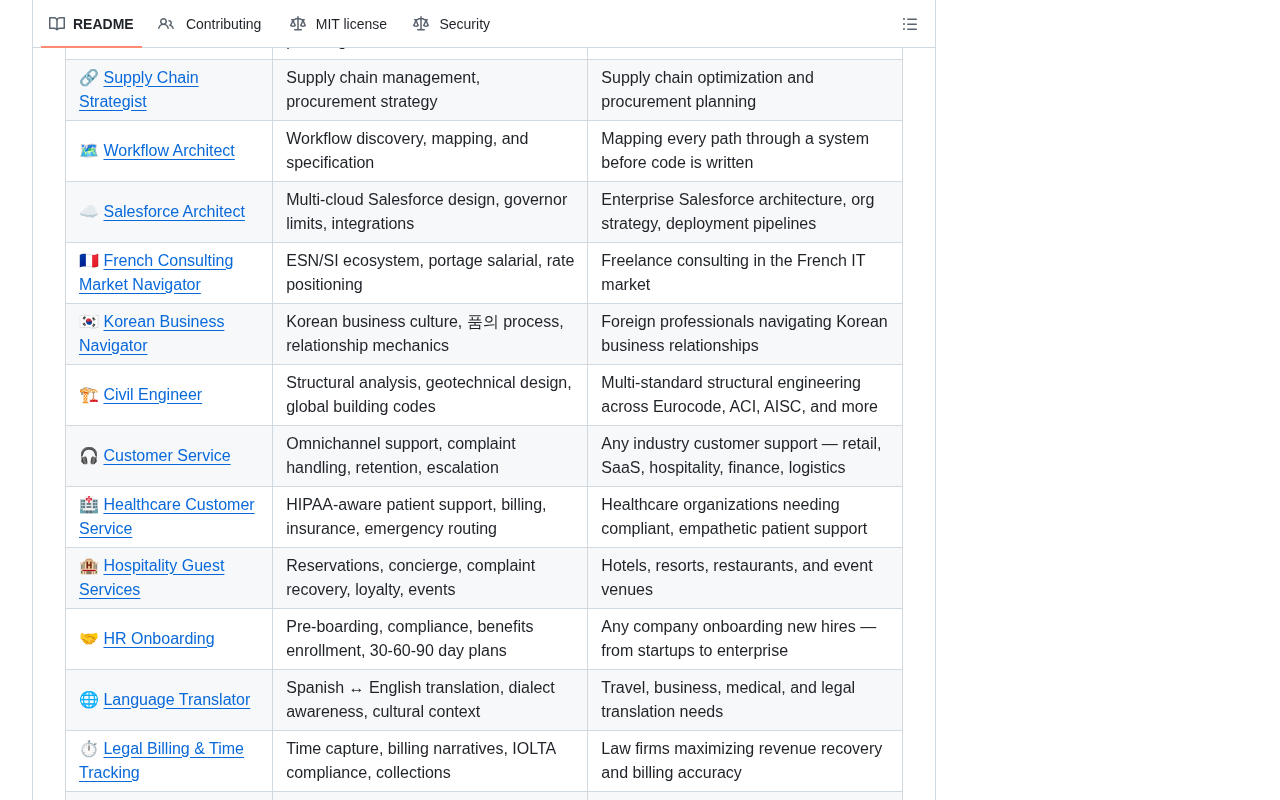
agency-agents: An Entire AI Agency in Your Terminal
Project positioning: A ready-to-use "AI agency" with a full suite of professional Agents equipped with personalities, workflows, and deliverables.
Soaring to the top today with 3,032 stars in a single day and 125K cumulative stars. Its selling point is refreshingly straightforward — you're not configuring a solitary assistant, but hiring an entire team: a front-end wizard, a Reddit community ops ninja, a creative injector, a reality checker... Each Agent has a clearly defined role, workflow, and deliverable.
Problem it solves: The biggest pain point with Agents has been "broad but shallow" — a general-purpose assistant can chat about anything but can't deliver professional-grade work on anything. agency-agents solves this with a "specialist division of labor" approach, breaking complex tasks down to roles with specific capabilities and personalities.
Core highlights: Implemented in Shell scripts, meaning an extremely low barrier to entry — no complex Python environments or cloud dependencies needed, just fire it up in your terminal. This combination of "lightweight + strong personalities" is exactly why it's spreading virally.
Use cases: Solo developers, small startup teams, content creators. When you're one person doing the work of an entire team, this pre-configured Agent agency can significantly boost your output.
Tech stack value: Shell as the primary language is worth pondering — it proves that the core of Agent orchestration is really about "prompts + workflow scheduling" rather than heavyweight code. For developers, this is an excellent case study in "how to organize complex Agent collaboration with the simplest possible tech stack."
superpowers: An Agent Skills Framework That "Actually Works"
Project positioning: An agentic skills framework that doubles as a software development methodology.
With 244K cumulative stars, it's the largest project on today's leaderboard, still pulling in 897 stars per day. Its tagline "that works." carries a subtle jab at the flashy-but-hollow frameworks flooding the market.
Problem it solves: Many Agent frameworks stall at the demo stage and collapse once deployed in real engineering scenarios. superpowers emphasizes reproducible, maintainable development methodology, pushing Agents from "toy" to "production tool."
Core highlights: It's not just a codebase — it's a methodology for organizing skills and enabling Agents to reliably complete software development tasks. This dual positioning as "framework + methodology" has earned it an exceptional reputation in the community.
Use cases: Engineering teams looking to deeply embed AI into their development workflows, especially those already using tools like Claude Code or Cursor who want to further systematize their approach.
agentskills: The Standard Specification for Agent Skills
Project positioning: Specification and documentation definitions for Agent Skills.
21K stars. This project doesn't deliver flashy features, but its significance lies in "setting the standard." When the entire ecosystem is building Agent Skills, a unified specification enables interoperability across different frameworks and tools.
Problem it solves: Fragmentation. Without a specification, every framework defines its own skill format and the ecosystem can't interoperate. agentskills aims to become the "protocol layer" for this domain.
Why it matters: History has repeatedly shown that the winner of the standards game often defines the trajectory of the entire ecosystem. If Agent Skills becomes a universal protocol like MCP, this project will occupy an extremely critical position.
chrome-devtools-mcp: Giving Coding Agents Browser Debugging Superpowers
Project positioning: An MCP service that provides Chrome DevTools capabilities to coding Agents.
Built by the official ChromeDevTools team, 45K stars. It exposes Chrome Developer Tools capabilities to AI coding assistants through MCP (Model Context Protocol).
Problem it solves: The biggest blind spot when AI writes front-end code is "not being able to see the running result." With this MCP, Agents can actually open a browser, inspect the DOM, read console errors, and analyze performance — transforming from "blind code writing" to "a developer who can debug."
Tech stack value: Implemented in TypeScript, it serves as an official-grade reference for learning MCP service development. Essential reading for any developer who wants to add browser capabilities to their Agent.
video-use: Video Editing with Coding Agents
Project positioning: From the browser-use team, giving coding Agents video editing capabilities.
554 stars in a single day, implemented in Python. The browser-use team previously made a name for themselves by "letting Agents operate browsers" — now they've extended the same concept to the video domain.
Problem it solves: Video editing has always been high-barrier work involving tons of repetitive manual operations. video-use lets you describe your needs in natural language while the Agent handles the editing automatically, "agent-ifying" the non-linear editing workflow.
Use cases: Short-form video creators, marketing teams needing to batch-process videos. This kind of "vertical-specific Agent-ification" is the most imaginative direction right now.
Vibe-Trading: Your Personal Trading Agent
Project positioning: A personal trading Agent from HKU Data Intelligence Lab (HKUDS).
939 stars in a single day, ranking among the top gainers on the leaderboard. It brings Agent capabilities into financial trading, giving users a personal trading assistant that can understand intent and execute strategies.
Core highlights: HKUDS is an active academic team whose work typically combines engineering quality with research depth. The name "Vibe-Trading" rides the current "vibe coding" trend — emphasizing intuition and natural language to drive complex tasks.
A word of caution: Agent applications in finance carry extremely high risk — treat it as an assistive tool, not an automated money printer. Its real value lies in demonstrating the possibility of Agent deployment in highly specialized domains.
codex-plugin-cc: Making OpenAI Codex and Claude Code Work Together
Project positioning: An official OpenAI plugin that lets you invoke Codex within Claude Code to review code or delegate tasks.
22K stars, 352 stars per day. The most interesting aspect is how it embodies the "tool interoperability" trend — OpenAI's Codex and Anthropic's Claude Code are no longer competing silos but collaborative nodes that can call upon each other.
Problem it solves: Developers often juggle multiple AI tools simultaneously, with high switching costs. This plugin lets models from different vendors each play their role within the same workflow: Claude Code handles primary orchestration, Codex handles code review.
Trend significance: Tool interoperability between major players signals that AI-assisted programming is evolving from "point competition" to "ecosystem collaboration."
ECC: The "Superstructure" for Agent Performance Optimization
Project positioning: An Agent harness performance optimization system covering skills, intuition, memory, safety, and research-first development methodology.
225K cumulative stars — a staggering number. Compatible with mainstream tools like Claude Code, Codex, Opencode, and Cursor, it's positioned to equip these Agents with a "more powerful brain shell" — complete with memory management, safety mechanisms, and skill systems.
Use cases: Power users and teams pursuing peak Agent performance. When basic Agents can't meet the demands of complex, long-running tasks, ECC provides an enhancement layer for memory and safety.
The "Evergreens" on the Leaderboard
Beyond the Agent army, several classic projects remain steadily on the charts and deserve mention:
- PyTorch (101K stars): The underlying foundation of all these Agents and large models. Its continued activity reminds us that no matter how fancy the upper-layer applications get, deep learning frameworks remain the load-bearing walls of the entire AI edifice.
- cs249r_book (Machine Learning Systems): Harvard's machine learning systems textbook, 25K stars. Amid the Agent craze, solid systems knowledge is more precious than ever.
- clean-code-javascript (94K stars): The JS adaptation of Clean Code principles. Interestingly, as AI generates massive amounts of code, the question of "what constitutes good code" becomes even more important — humans need to judge the quality of AI output.
- exercises-dataset: A structured dataset of 433 fitness exercises, 938 stars in a single day. Its appearance on the leaderboard shows that high-quality structured data is a scarce resource in its own right, especially today when AI applications demand vast amounts of domain-specific data.
Today's Trend Observations
Connecting the dots across today's leaderboard, three clear themes emerge:
First, the Agent ecosystem is maturing in layers. From specifications (agentskills) to frameworks (superpowers, ECC) to vertical applications (video-use, Vibe-Trading), a complete tech stack is forming. This means Agents have moved past the "proof of concept" phase and entered the "engineering deployment" phase.
Second, MCP has become the de facto standard for extending Agent capabilities. chrome-devtools-mcp is built by an official team, showing that even browser vendors are embracing MCP. The standard interface for "plugging capabilities into Agents" has been established.
Third, vendor walls are crumbling. codex-plugin-cc enables OpenAI and Anthropic tools to call upon each other, foreshadowing a future where AI workflows are multi-model, multi-vendor collaborations.
Today's Must-See TOP 3
- agency-agents — Achieves the most complete Agent team experience with the lightest Shell implementation. The best entry point for understanding the "Agent division of labor" paradigm.
- chrome-devtools-mcp — An official-grade MCP implementation. Essential reading for developers who want to give their Agents real debugging capabilities.
- agentskills — The "protocol layer" of the ecosystem. Whoever controls the standard controls the future — worth tracking long-term.
If 2025 was the year of large model capability explosions, then 2026 is shaping up to be the year of Agent engineering deployment. Today's leaderboard is the best footnote — tools are maturing, standards are being established, and the ecosystem is converging. For developers, now is the perfect time to dive deep into this tech stack.
Related articles

The Era of AI Capability Overhang: Why You Need to Reset Your Ambition Every 3 Months
Understanding Capability Overhang in the AI era: when model capabilities far exceed application imagination, how teams should reset feasibility boundaries quarterly to avoid ceding advantages to competitors.

Firemaps Spain: Real-Time Wildfire Monitoring Map with Wind Flow Visualization
Firemaps Spain is an open-source real-time wildfire monitoring tool for Spain and Portugal, combining fire hotspot data with wind flow visualization to help assess fire spread direction.

Google AI Studio Hiring TPM Lead: Decoding the Three Key Criteria Including 'AI Pilled'
Google DeepMind's AI Studio team is hiring a TPM lead with three key criteria: AI pilled, high agency, and pushing the frontier. A deep dive into Google's acceleration strategy and AI talent trends.