GitHub Launches Replica and Accessibility Framework: How Open Source Collaboration Drives Inclusion

GitHub launches Replica and an open source accessibility framework, driving the open source ecosystem through collaboration and inclusion.
GitHub published the blog post "The best things in open source are built together," officially introducing two new open source projects: Replica and the Open Source Accessibility Framework. Replica targets collaboration scenarios, though the original text did not disclose specific features; it is presumed to relate to code replication, collaboration synchronization, or distributed collaboration. The Open Source Accessibility Framework is dedicated to providing developers with tools, guidelines, and best practices so that accessibility design becomes part of daily development workflows, serving visually impaired, hearing impaired, and other groups. The article argues that the two correspond respectively to the two core open source values of efficiency and inclusion, complement each other, and reflect GitHub's response to community needs. Developers can contribute through GitHub repositories via code, documentation, tests, and feedback, and gain early insight into the direction of toolchain evolution.
Open source software success often depends on collaboration and inclusion. GitHub recently published a blog post titled "The best things in open source are built together," officially introducing two brand-new open source projects: Replica and the Open Source Accessibility Framework. These two projects focus respectively on collaboration efficiency and inclusive design, aiming to help developers worldwide build more usable and open tools.
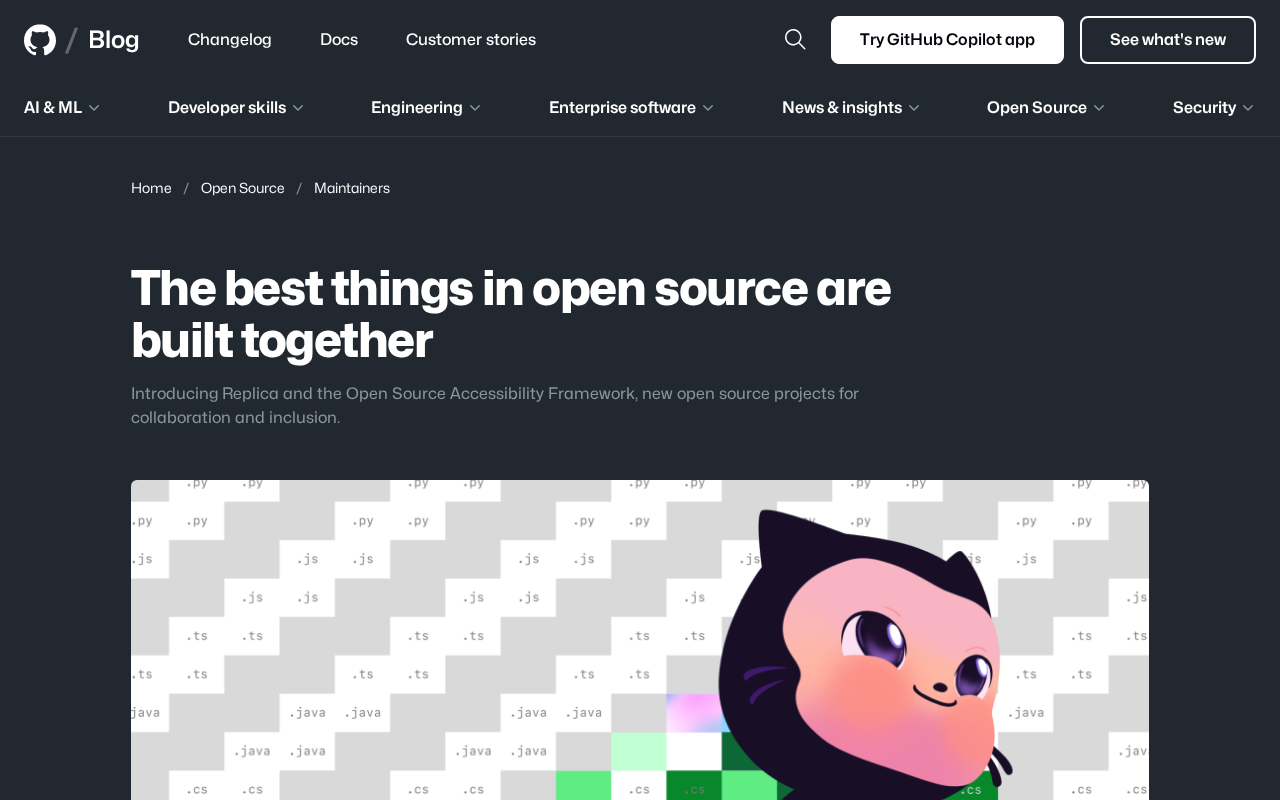
Replica: Making Collaboration Simpler
According to the GitHub blog, Replica is an open source project for collaboration, but the original text did not provide specific feature details. Judging from the project name and context, it may be related to code replication, collaboration synchronization, or distributed collaboration. GitHub emphasizes that innovation in the open source community often comes from building together, and Replica is an embodiment of this philosophy. Despite the lack of detailed explanation, it is foreseeable that Replica will lower the barrier to collaboration and enable teams to share and iterate on code more efficiently.
"The best things in open source are built together." — GitHub Blog
Distributed collaboration and code synchronization are long-standing challenges for open source collaboration tools: developers are distributed across different time zones and network environments and need to share code state without fully relying on a central server. Relevant technical approaches include Git-based remote mirrors, optimistic synchronization models such as CRDTs (Conflict-free Replicated Data Types), and peer-to-peer (P2P) transport protocols. CRDTs allow multiple replicas to modify independently without a central coordinator and eventually converge to a consistent state, and they have been widely used in collaborative editing and offline-first applications. If Replica adopts a similar approach, its value may lie in enabling teams to maintain collaboration continuity under weak network, offline, or cross-organizational scenarios, which complements the traditional model centered on GitHub-hosted repositories.
Open Source Accessibility Framework: Advancing Inclusive Design
The other project is the Open Source Accessibility Framework, which is dedicated to providing accessibility support for open source projects. The framework's goal is to help developers create software that is friendly to everyone, including visually impaired, hearing impaired, and other groups. GitHub points out in the blog that inclusiveness is one of the core values of the open source community, and this framework will provide tools, guidelines, or best practices to make accessibility design a natural part of the development process. Although the original text did not disclose the specific components of the framework, it can be expected to cover automated testing, design patterns, or community standards.
Accessibility design refers to making software products usable by as broad a population as possible, including users with visual, hearing, mobility, and cognitive impairments. In web and mobile development, common practices include semantic HTML, ARIA attributes, keyboard operability, and sufficient color contrast. The internationally recognized reference standard is WCAG (Web Content Accessibility Guidelines) published by the W3C, with the current mainstream compliance target being WCAG 2.1/2.2 Level AA. Many countries and regions have incorporated accessibility into legal requirements, such as Section 508 in the United States and the European Accessibility Act in the EU. For open source projects, accessibility is often neglected due to a lack of dedicated manpower and testing resources, which is precisely the context for GitHub launching a unified framework—lowering the barrier for individual projects to achieve accessibility by sharing testing tools and design specifications.
Why Are These Two Projects Worth Watching?
The prosperity of the open source ecosystem cannot be separated from collaboration and inclusion. The launch of Replica and the Open Source Accessibility Framework reflects GitHub's response to community needs. Collaboration tools can improve development efficiency, while the accessibility framework ensures that software benefits a broader population. The two complement each other and jointly drive open source projects toward a healthier and fairer direction.
For developers, paying attention to these two projects can provide early insight into the future evolution of the toolchain. Accessibility design in particular is gradually becoming an important indicator of software quality, and early adoption of relevant frameworks helps avoid the high cost of later retrofitting.
The sustainability of open source projects is another backdrop for understanding the value of these two projects. A large amount of critical open source infrastructure is maintained part-time by a small number of maintainers, facing the "maintainer burnout" problem caused by insufficient funding and manpower. Collaboration tools expand the contributor base by lowering the barrier to participation and reducing repetitive communication costs; the accessibility framework reduces the additional burden of compliance retrofitting on projects by providing ready-made specifications and automated testing. Both are essentially about reducing the consumption of maintainers by "non-core functions," allowing the community to focus energy on core innovation—a direction repeatedly emphasized in recent open source governance discussions.
How to Participate and Follow Up
GitHub encourages community members to participate in these projects. Although the original text did not provide specific ways to participate, open source projects typically accept contributions through GitHub repositories, including code, documentation, tests, and feedback. Developers can follow the official GitHub blog or related repositories for the latest updates.
The essence of open source is building together, and the birth of Replica and the Open Source Accessibility Framework once again confirms this. With more developers joining, these two projects are expected to become important infrastructure in the fields of collaboration and inclusion.
Related articles

AI Role-Play in a Barbershop: How Veda Builds Immersion Through Dialogue
From a Bilibili Veda barbershop video, explore how AI role-play builds immersion through task dialogue, relationship maintenance, and improvisation.

Why Does Python Endure? A 20-Year Developer's Firsthand Account
A senior developer shares his journey from C, Java, and other languages to Python: convinced by its concise code in 2006, he asks himself every year whether to keep using Python, and the answer is always yes. Python's flexibility and versatility are the key to its enduring popularity.

Conductive Dye Turns Hair into EEG Electrodes, Opening a New Path for Wearable Brain-Computer Interfaces
Can conductive dye turn hair into EEG electrodes? This article explains the principles, potential applications, and deployment challenges of this new wearable brain-computer interface approach.