GitHub Open Source Week Picks: 5 Practical Open Source Projects to Boost Your Productivity

5 GitHub open source projects covering AI social media management, 3D modeling, Go scaffolding, and full-stack frameworks.
This article highlights four open source projects: Post-its is an AI-driven social media management tool supporting multi-platform scheduling, AI content creation, and team collaboration; FreeCAD is a professional-grade free parametric 3D modeling software based on the OpenCASCADE kernel, supporting mechanical design, architecture, and engineering simulation; GoBlueprint is a Go project scaffolding tool with pre-configured templates integrating popular frameworks and databases; Keystone is a full-stack TypeScript framework based on Next.js.
AI-Powered Social Media Management: Post-its
Social media management is a daily necessity for many businesses and individual creators, and Post-its is an open-source solution built precisely for this purpose. It's a comprehensive social media management tool whose biggest highlight is its deep integration of AI capabilities.
The core technical challenge of a Social Media Management Platform lies in interfacing with each platform's official APIs, such as Meta Graph API and TikTok for Developers API — these APIs typically have strict permission reviews and rate limits. Commercial tools like Buffer and Hootsuite usually charge subscription fees ranging from tens to hundreds of dollars per month, creating a significant barrier for small and medium teams. The rise of open-source alternatives, combined with the API-ification of Large Language Models (LLMs) and image generation models (such as Stable Diffusion and DALL-E), has made AI-assisted content creation a standard feature that can be integrated at low cost.
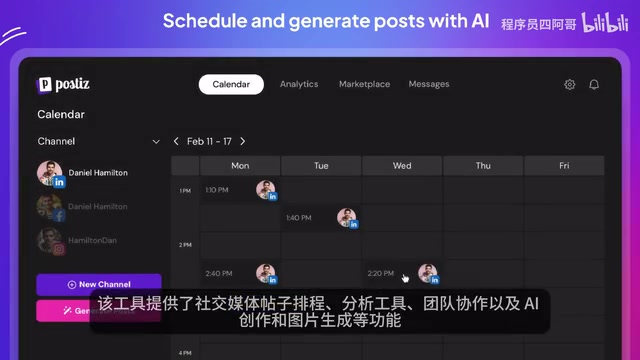
Post-its supports multi-platform operations, covering mainstream social platforms like Facebook, Instagram, TikTok, and YouTube. Core features include:
- Post Scheduling: Plan ahead and publish content on a schedule — no more manual posting
- AI Content Creation & Image Generation: Leverage AI to generate copy and visuals, dramatically lowering the content creation barrier
- Analytics Tools: Track post performance and optimize content strategy
- Team Collaboration: Support multi-user collaborative management, ideal for team-based operations
For small businesses and independent creators, Post-its offers an alternative to paid commercial tools (like Buffer and Hootsuite), while AI-powered features take content production efficiency to the next level.
Professional-Grade Free 3D Modeling: FreeCAD
FreeCAD is the benchmark project in open-source CAD, focusing on parametric design of 3D models. For individual developers, students, and small studios who can't afford the expensive licensing fees of commercial software like SolidWorks or AutoCAD, FreeCAD is an extremely competitive choice.
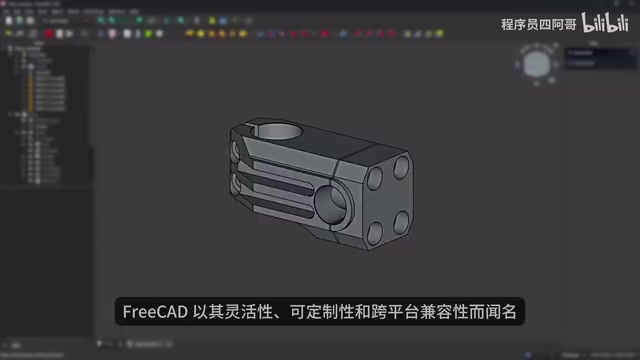
The Technical Principles of Parametric Modeling
Parametric Modeling is the core paradigm of modern CAD software. Its essence is expressing geometric shapes as a Directed Acyclic Graph (DAG) of variable parameters and constraint relationships. Unlike direct modeling, parametric design records the complete operation history (Feature Tree) — when early parameters are modified, all downstream dependent features are automatically recalculated. FreeCAD's underlying engine is based on the OpenCASCADE geometric kernel, an industrial-grade open-source geometric modeling engine also adopted by scientific computing platforms like Salome. The Finite Element Analysis (FEA) module relies on open-source solvers like CalculiX, enabling stress, thermal field, and other physical simulations on structural components — capabilities that typically require additional paid modules in commercial software.
Core Advantages
FreeCAD provides a wide range of tools and modules, supports multiple 3D model formats, and offers excellent extensibility to adapt to different engineering domains:
- Mechanical Design: Part modeling, assembly design
- Architectural Design: BIM workflow support
- Engineering Simulation: Finite Element Analysis (FEA) and other simulation capabilities
Its parametric design philosophy means users can go back and modify design parameters at any time, and the model updates automatically — this is extremely important during iterative design processes. Cross-platform compatibility (Windows, macOS, Linux) further broadens its applicability.
Quick-Start Go Projects: GoBlueprint
For Go developers, repeatedly configuring project structures, choosing frameworks, and integrating databases every time a new project is created is a tedious task. GoBlueprint is a project initialization tool born to solve exactly this pain point.
Since Go's release in 2009, it has gained widespread adoption in cloud-native and microservices domains thanks to its fast compilation speed, elegant concurrency model (goroutine/channel), and single-binary deployment. However, Go's team intentionally keeps the standard library minimal — web frameworks, ORMs, and other infrastructure are all community-provided, resulting in high technology selection costs during project initialization. The value of a Scaffolding Tool lies in codifying community best practices into reusable templates, similar to Spring Initializr in the Java ecosystem or create-next-app in the Node.js ecosystem. The frameworks integrated by GoBlueprint — Chi, Gin, and Fiber — represent different design philosophies: Chi extends the standard library's net/http, Gin focuses on high-performance routing, and Fiber draws from Node.js's Express style, catering to different teams' technical preferences.
Pre-configured Templates, Ready Out of the Box
GoBlueprint provides pre-configured project templates integrating the most popular technology stacks in the Go ecosystem:
- Web Frameworks: Chi, Gin, Fiber, etc.
- Database Support: MySQL, PostgreSQL, MongoDB, etc.
- Frontend Technologies: Support for modern frontend framework integration
Developers simply interact through a command-line interface, select their desired framework and database combination, and generate a well-structured, fully configured Go project skeleton. This not only saves project initialization time but, more importantly, ensures consistency in project structure and adherence to best practices — particularly suitable for team collaboration scenarios.
Full-Stack TypeScript Framework: Keystone
Keystone is a full-stack framework based on Next.js, with a design philosophy of "code-first"
Related articles
 Product Reviews
The Programmer's Desk Setup Guide: Building a Workspace That Feels Like Home
Discover how programmers build productive, comfortable workspaces. From multi-monitor setups to ergonomic design, explore the desk philosophy that drives focus and flow.
 Product Reviews
Qoder vs Cursor Real-World Comparison: Which $20/Month AI IDE Is Better?
Hands-on comparison of Qoder vs Cursor AI IDEs: Agent autonomy, human interaction count, and architecture decisions. Qoder needed only 2 interactions vs Cursor's 8.
 Product Reviews
Cursor Cloud Agent Demo: Eliminating Bottlenecks Across the Entire Software Development Lifecycle
Deep analysis of Cursor's Cloud Agent demo showing how cloud VMs, automated test artifacts, and a full-chain control plane systematically eliminate human bottlenecks across the software development lifecycle.