GitHub's 75K-Star Open-Source AI Reverse Engineering Tool: Letting Agents Tear Apart Software Binaries

GitHub's 75K-star open-source AI reverse engineering tool RIA scores high but only 5/10 on security.
RIA is an MIT-licensed open-source AI reverse engineering tool with over 75,000 GitHub stars. Through a unified interface, AI Agents can analyze binaries, Java, C#, .NET, Electron, and even APK software across multiple platforms to reconstruct their logic. It highlights three case studies: rebuilding an old game's audio phase function with 3,205 test cases passed, tracing Notion's Electron memory bridge, and calculating bullet loops in an old shooter. Overall score 81.3/100, with strong community health and technical value, but security/supply chain only 5/10 and deployment readiness only 6. The community also notes native Windows support limitations in security scenarios. The article stresses it is a legitimate research tool requiring user authorization, and recommends isolated testing before workflow integration.
GitHub's 75K-Star Open-Source AI Reverse Engineering Tool: Letting Agents Tear Apart Software Binaries
An open-source project has surpassed 75,000 stars on GitHub — and it isn't another chatbot. It lets AI Agents "dissect" other people's software, working all the way down from application behavior to binary files, and then reconstructing its operating logic. What really makes you stop and think is this: your competitors may have already started using it.
The project is called RIA (according to a YouTube video introduction, the project name may be RiA or a similar spelling due to voice transcription). In one sentence, its capability is: reverse engineer everything, from application behavior down to the lowest-level binaries.
Project Scale and License
According to the project's GitHub page, RIA has earned over 75,000 stars, roughly 16,000 forks, 236 watchers, and more than 2,200 commits. It uses the MIT license and is completely free.
The core idea is simple: when users spot an interesting feature in some application, they have an AI Agent investigate it, explain how it works, provide evidence, and then help them write a corresponding version for their own product.
What draws particular attention from developers is its breadth of coverage — a single interface that can analyze raw binaries, Java applications, C# and Electron, .NET libraries, and even web pages. Later updates to the project (the original mentions a date of October 6) added GUI-less APK analysis, more precise evidence collection, and permission extraction tools.
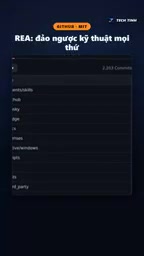
What binary reverse engineering is: Reverse engineering means reconstructing a program's data structures, algorithmic logic, and call relationships by analyzing its machine code, bytecode, or runtime behavior without access to source code. A binary is the set of machine instructions a compiler translates source code into; it's nearly impossible for humans to read directly, so traditionally this relies on disassembly/decompilation tools like IDA Pro and Ghidra, requiring extensive manual expertise. The value of AI Agents stepping in is that they can automatically traverse call chains, identify function semantics, generate readable explanations with evidence (such as disassembly snippets and memory snapshots), compressing manual investigation that used to take days into an interactive Q&A workflow. RIA's claim of going "from application behavior down to binaries" is precisely the automation of this chain.
What the MIT license means: MIT is one of the most permissive open-source licenses, allowing users to freely use, modify, distribute, and even commercially use the software in closed source, as long as they retain the copyright notice. For reverse engineering tools, this is critical — enterprises can integrate RIA into internal workflows without having to disclose derivative code. But note: the license only governs how the software itself is used; it does not grant you legal authorization to analyze someone else's software. Compliance responsibility remains with the user.
Installation and Supported Platforms
Installation is lightweight: a single command completes initialization, you choose an AI Agent, review the changes, and restart. The support list covers scenarios like loading code, firmware, and codecs.
But talk is cheap — can it actually do the work? The project itself offers three research case studies.
Three Real-World Case Studies
Case One: Audio restoration for an old game. The AI Agent traced an audio call chain and reconstructed the function that calculates the left-right channel phase difference. The reconstructed version passed 3,205 test cases on the original x86 platform, matching all 63 test cases of the compiled function exactly.
Case Two: Tracking Notion's in-memory cache bridge on Electron. Following it from the interface all the way down to the main process.
Case Three: Bullet loop calculations in an old shooter game. Here's a valuable detail: the entire analysis ran locally, and the conclusions always came with evidence and a note of the limitations of each judgment.
Phase difference and audio channels: The "left-right channel phase difference" mentioned in Case One is a core concept in stereo processing. If the waveforms of both channels are identical, the stereo image sits in the center; if one channel is delayed or inverted, a wider sense of space is produced. Reversing this calculation function is equivalent to reconstructing the game audio engine's spatialization algorithm. The reason it's measured with "3,205 test cases" and "matching all 63 test cases exactly" is that the correctness of a reverse-engineering result can't be judged by eye — it can only be verified by comparing outputs bit by bit against the original compiled function given the same inputs. This is also the key criterion for judging whether AI reverse engineering is "actually useful" rather than "plausible-looking."
Electron's in-memory cache bridge: Electron applications consist of a renderer process (the web layer) and a main process (the Node.js layer), which communicate via IPC. The so-called "in-memory cache bridge" refers to the fact that data the renderer layer wants to read is actually stored in the main process's memory and requires a bridging layer to pass it along. Reverse engineering this kind of application requires understanding both the JavaScript bundle and the native binary — precisely the pain point RIA claims to solve with "a single interface covering multiple formats."
Community Buzz and Score Analysis
In terms of spread, it once gained 800 stars in a single day. Star counts, fork counts, and contributor numbers differ across screenshots because GitHub data changes hourly. The direction is clear: the community is pouring in rapidly. But lots of stars doesn't mean it's safe to put into production.
Now let's look at the scores. According to a GitHub-related score summary, the overall score is 81.3/100, an average of three dimensions: explosive appeal is highest at 87.5, community health at 85.9 (governance and maintenance reached 14 days out of 17), while technical expertise is only 70.4 — because architecture, developer experience, documentation, and security scored only 50 out of 71.

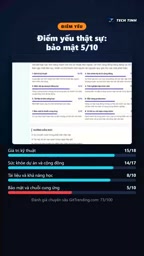
This total score masks what really deserves caution. Digging into the in-depth review, the total across 8 criteria is 73/100, with technical value strongest at 15/18, followed by project and community health at 14/17, and documentation at 8/10. Yet "actual deployment readiness" is only 6 points.
The Hidden Weak Spot: Security and Supply Chain
This is where the key weakness lies: security and supply chain scored only 5/10 — a rather glaring number for a tool that touches other people's binary code. This is exactly the part that most needs repeated deliberation before introducing it into a company workflow.
What has the community reflected? One discussion cited an unresolved issue (number 287), noting that native Windows support may struggle in certain security scenarios. The project documentation also notes that driver write support on Windows remains experimental.
Supporters emphasize the advantage of "a unified interface covering multiple platforms." One comment explicitly states: this is a tool for legitimate research, and users bear the responsibility for obtaining authorization themselves. There's also a practical warning: certain products named with "VR" have nothing to do with this project (to prevent confusion).

Supply chain risk: A supply chain attack occurs when attackers don't directly attack the target but instead contaminate its third-party dependencies, build process, or update channel. For a tool like RIA, the risk has two layers: first, if the tool itself has vulnerabilities or is maliciously tampered with, users are effectively handing sensitive binaries to an untrustworthy program; second, when it invokes an AI Agent it typically goes online, and analyzed code snippets may be uploaded — equivalent to data exfiltration for closed-source commercial software. So "security and supply chain only 5/10" isn't nitpicking; it's a reminder that teams should conduct dependency audits, restrict network egress, and run it in an isolated sandbox before use.
Deployment readiness: This metric measures whether a tool can go directly into a production workflow, typically examining deployment complexity, stability, error handling, permission models, and operational support. A score of 6 means it can run through a demo, but it's still far from being something a team relies on daily.
A Rational View of This AI Reverse Engineering Wave
This wave of AI-driven reverse engineering is spreading extremely fast. Those who understand it early will gain a real advantage, but caution must accompany it. Three key points are worth remembering:
- RIA turns an AI Agent into a software "dissector," running locally through a unified interface.
- The overall score of 81.3 is attractive, but security is only 5/10 — test it in an isolated environment first.
- Only use it on software you have the right to analyze.
For developers and security teams, RIA's value and risks are equally prominent. It lowers the barrier to reverse engineering, and at the same time lowers the barrier to misuse and supply chain risk. Among the review data, the two numbers "deployment readiness 6 points" and "security 5/10" may deserve more attention than the 75,000 stars.
One-line Summary
GitHub's 75K-star open-source AI reverse engineering tool RIA scores high but only 5/10 on security.
Paragraph Summary
RIA is an MIT-licensed open-source AI reverse engineering tool that has earned over 75,000 stars on GitHub. Through a unified interface, it lets AI Agents analyze binaries, Java, C#, .NET, Electron, and even APK software across multiple platforms, reconstructing their operating logic. The project describes three real-world case studies, including reconstructing an old game's audio phase function and passing 3,205 test cases, tracing Notion's Electron memory bridge, and calculating bullet loops in an old shooter game. Its overall score is 81.3/100, with standout community health and technical value, but security and supply chain scored only 5/10 and actual deployment readiness only 6 points. The community also notes that native Windows support has limitations in security scenarios. The article emphasizes that it's a tool for legitimate research, users must obtain authorization themselves, and recommends testing in an isolated environment before introducing it into a workflow.
Related articles

How Big Can Stars Really Get? The Physical Limits of the Largest Stars
Red supergiants are the largest stars by volume, with radii up to 2,000 times the Sun, engulfing the inner solar system. But there is no precise upper limit on stellar size—models predict up to 15,000 solar radii. The most massive blue stars are far smaller than red supergiants—biggest and heaviest are two different things.

Apple HomeView Smart Display Full Feature Breakdown: Wall-Mount or Desktop, $299
Apple launches HomeView, a $299 smart display with wall-mount and desktop options, 12MP camera for facial recognition, smart home control, music playback, and recipe step-by-step cooking. Full breakdown of watch faces, apps, privacy, and cooking integration.

Where Did the Promised New Studio Go? Craft Computing Answers After Five Years
Craft Computing's host responds to viewer questions: the new studio promised five years ago was shelved as construction costs soared from $30,000 to $75,000, and was replaced by a 168-square-foot garage conversion.