GL.iNet Releases Security Notice: Router Vulnerabilities Draw Attention

GL.iNet router security notice sparks community discussion; users should harden devices promptly and watch for firmware updates.
GL.iNet published a security notice on its official blog disclosing security issues affecting some router products, drawing 170 points and 80 comments on Hacker News. The article surmises that the vulnerability may involve firmware-level or default configuration risks; since GL.iNet devices often ship with OpenWrt and rich management interfaces, the attack surface is large. If remote code execution or authentication bypass exists, devices could be compromised, traffic intercepted, or conscripted into botnets. Before official patches arrive, users are advised to change default passwords, disable unnecessary remote management, and restrict public access to the management interface. The incident underscores the importance of edge network device security: vendors need transparent disclosure processes, and users should regularly update firmware. Follow-up should track CVE IDs, patch coverage, and evidence of exploitation in the wild.
Event Overview
GL.iNet has published a security notice (Security Notice 2026-11-20) on its official blog, disclosing security issues affecting some of its router products. The notice sparked widespread discussion on Hacker News, garnering 170 points and 80 comments, demonstrating the community's strong interest in network device security.
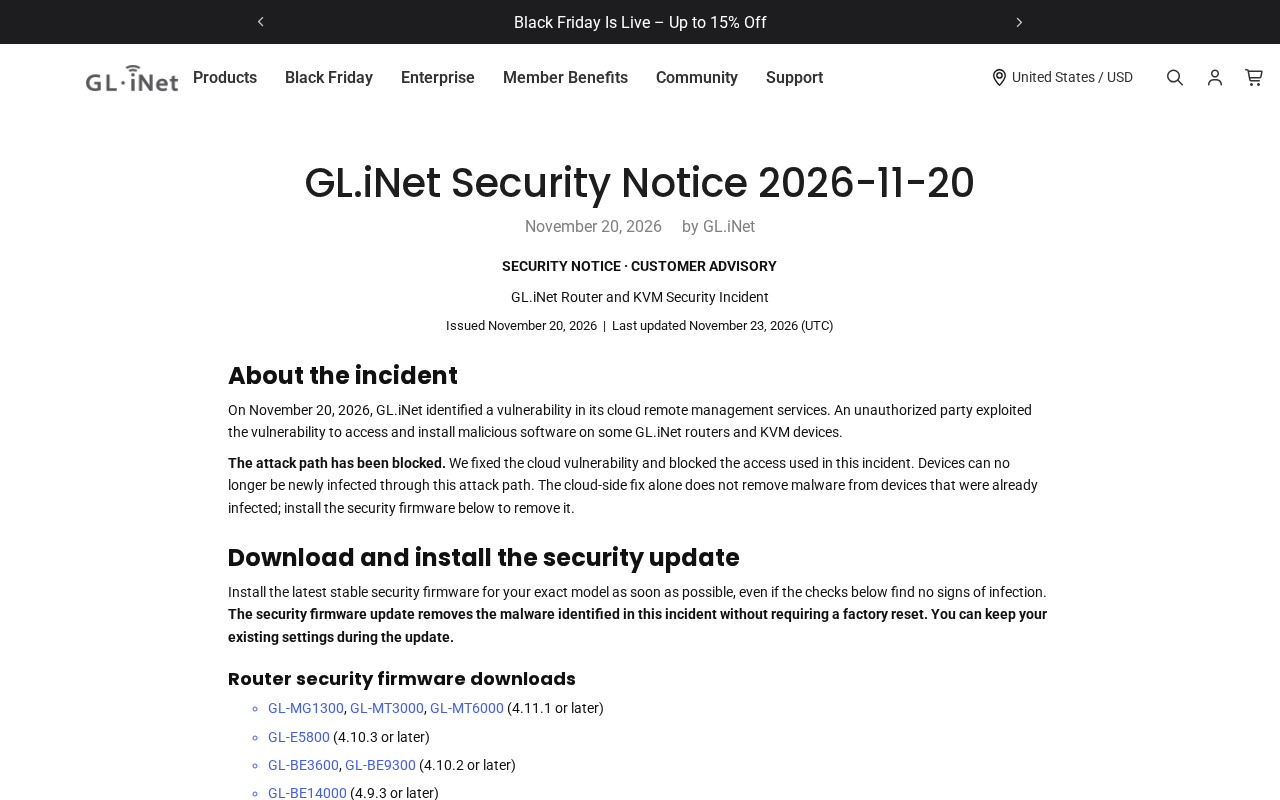
Although the specific technical details of the notice are not expanded upon in the summary, given GL.iNet products' widespread use in the travel router and portable networking device space, this security incident may involve firmware-level vulnerabilities or default configuration risks. For users who rely on such devices for remote work or travel, promptly understanding the situation and taking mitigation measures is crucial.
Scope of Impact and Potential Risks
Based on the notice title and the level of community discussion, it can be inferred that this security issue is not an isolated incident. GL.iNet devices typically ship with OpenWrt and come with rich management interfaces and plugins, which enhances ease of use but also expands the attack surface. If the vulnerability involves remote code execution or authentication bypass, attackers could use it to take control of devices, intercept traffic, or conscript them into botnets.
The comments on Hacker News (80 in total) indicate that the technical community is actively analyzing the exploitation conditions and scope of impact. Some discussions may focus on the vendor's response speed, patch distribution mechanisms, and the feasibility of user self-hardening. For enterprise users and advanced enthusiasts, it is recommended to closely monitor GL.iNet's subsequent firmware updates and temporarily restrict public internet access to the management interface.
OpenWrt and the Attack Surface
OpenWrt is an open-source Linux-based embedded operating system designed for routers and other network devices. It provides a complete package manager (opkg), a writable filesystem, and a web management interface (LuCI), allowing users to freely install plugins to extend functionality. GL.iNet devices typically use OpenWrt as their foundation, layered with the company's own GL management interface. This openness means devices have SSH, HTTP/HTTPS management, and several network services enabled by default; if these services are exposed to the public internet or have weak credentials, the attack surface expands significantly. Additionally, third-party plugins that are not updated in a timely manner may introduce known vulnerabilities. Therefore, when assessing the risk of such devices, one must not only check the vendor firmware version but also examine installed plugins and open ports.
Remote Code Execution (RCE) and Authentication Bypass
Remote code execution refers to an attacker being able to run arbitrary commands on a target system over the network without physical access to the device, typically stemming from missing input validation, command injection, or deserialization flaws. Authentication bypass allows an attacker to skip login verification and directly access the management interface. Combined, these can lead to complete router compromise: attackers can eavesdrop on traffic, tamper with DNS, implant malicious firmware, or conscript the device into a botnet. For devices like GL.iNet's that are often used for travel and remote work, the risk is particularly acute once the management interface is exposed to the public internet. Mitigation measures include restricting access sources to the management interface, enabling strong passwords and multi-factor authentication, and promptly applying vendor patches.
User Recommendations and Industry Implications
Before official patches are fully rolled out, users can take the following temporary measures to reduce risk: change default management passwords, disable unnecessary remote management services, and enable firewall rules to restrict access sources. GL.iNet's past security notices typically provide detailed mitigation steps; users are advised to consult the original notice directly for accurate information.
From an industry perspective, this incident is another reminder that security management of edge network devices cannot be overlooked. With the proliferation of IoT and remote work, often-overlooked nodes such as routers are becoming prime targets for attackers. Vendors need to establish more transparent vulnerability disclosure processes, and users should develop the habit of regularly updating firmware.
CVE IDs and the Vulnerability Disclosure Process
CVE (Common Vulnerabilities and Exposures) is the standard identifier for publicly disclosed vulnerabilities, maintained by MITRE. When vendors publish security notices, applying for a CVE ID for the vulnerability helps the security community uniformly track it, assess severity, and drive patch distribution. A transparent disclosure process typically includes: confirming the vulnerability, assigning a CVE, releasing patches and a notice, and acknowledging the reporter. The absence of a CVE ID makes it harder for users to determine the scope of impact and prioritize, and also hinders automated vulnerability scanning tools from identifying the issue. For incidents like this one involving GL.iNet, whether a CVE has been assigned and whether the notice clearly states the affected firmware versions are important indicators for evaluating the maturity of the vendor's response.
Community Reaction and Follow-up Observations
The level of discussion on Hacker News (170 points, 80 comments) reflects the developer community's interest in GL.iNet products. Comments may include assessments of vulnerability severity, evaluations of the vendor's communication approach, and temporary solutions shared by users. This kind of community collaboration helps accelerate the mitigation process.
Aspects worth monitoring going forward include: whether GL.iNet has published a detailed CVE ID, the range of firmware versions covered by patches, and whether there is evidence of the vulnerability being exploited in the wild. We will continue to track official notices and community feedback to provide readers with the latest developments.
One-line Summary
GL.iNet router security notice sparks community discussion; users should harden their devices promptly and watch for firmware updates.
Paragraph Summary
GL.iNet published a security notice on its official blog disclosing security issues affecting some router products, garnering 170 points and 80 comments on Hacker News and drawing widespread attention from the technical community. The article surmises that the vulnerability may involve firmware-level or default configuration risks; since GL.iNet devices often ship with OpenWrt and feature rich management interfaces, the attack surface is large, and if remote code execution or authentication bypass exists, devices could be compromised, traffic intercepted, or conscripted into botnets. Before official patches are released, users are advised to change default passwords, disable unnecessary remote management, and restrict public internet access to the management interface. The incident highlights the importance of security management for edge network devices; vendors need to establish transparent vulnerability disclosure processes, and users should develop the habit of regularly updating firmware. Follow-up attention should be paid to CVE IDs, patch coverage, and evidence of exploitation in the wild.
Related articles

Prompt Engineering for Beginners: From Writing Prompts to Engineering Thinking
Starting from the essence and four functions of prompts, this article systematically explains the six-step process, four success criteria, learning value, and practical limitations of prompt engineering to help you build a complete understanding.

Anthropic Launches Nasdaq IPO: AI Giant's Listing and Risk Disclosures
Anthropic officially launches its Nasdaq IPO under ticker ANT, with market valuation expected to potentially exceed SpaceX's record. The prospectus devotes nearly 100 pages to AI risks, while first-half revenue grew over 14x but net losses widened sharply, reigniting the AI bubble debate.

Rust cURL Clone Uses 4,832 unsafe Blocks—Is the Memory Safety Myth Broken?
A Rust cURL clone uses 4,832 unsafe keywords, challenging Rust's memory safety narrative. We analyze what unsafe really means, compare Fil-C, and examine rewrite motives.