Glassmail: A Mac Email Client with AI Running Entirely Locally

Glassmail is a native Mac email client with AI running entirely locally and a one-time purchase model.
Glassmail is a native Mac email app that goes against mainstream cloud AI email clients: the AI runs entirely locally, email content is never uploaded to servers, and it uses a one-time purchase model instead of a subscription. It supports Gmail, iCloud, Outlook, and any IMAP account, with features like natural-language inbox queries, replies in your personal tone, and one-key cleanup. The article analyzes the trade-off between local and cloud AI and the commercial viability of the one-time purchase model, noting it suits Mac users who manage multiple mailboxes, value privacy, and are tired of subscriptions.
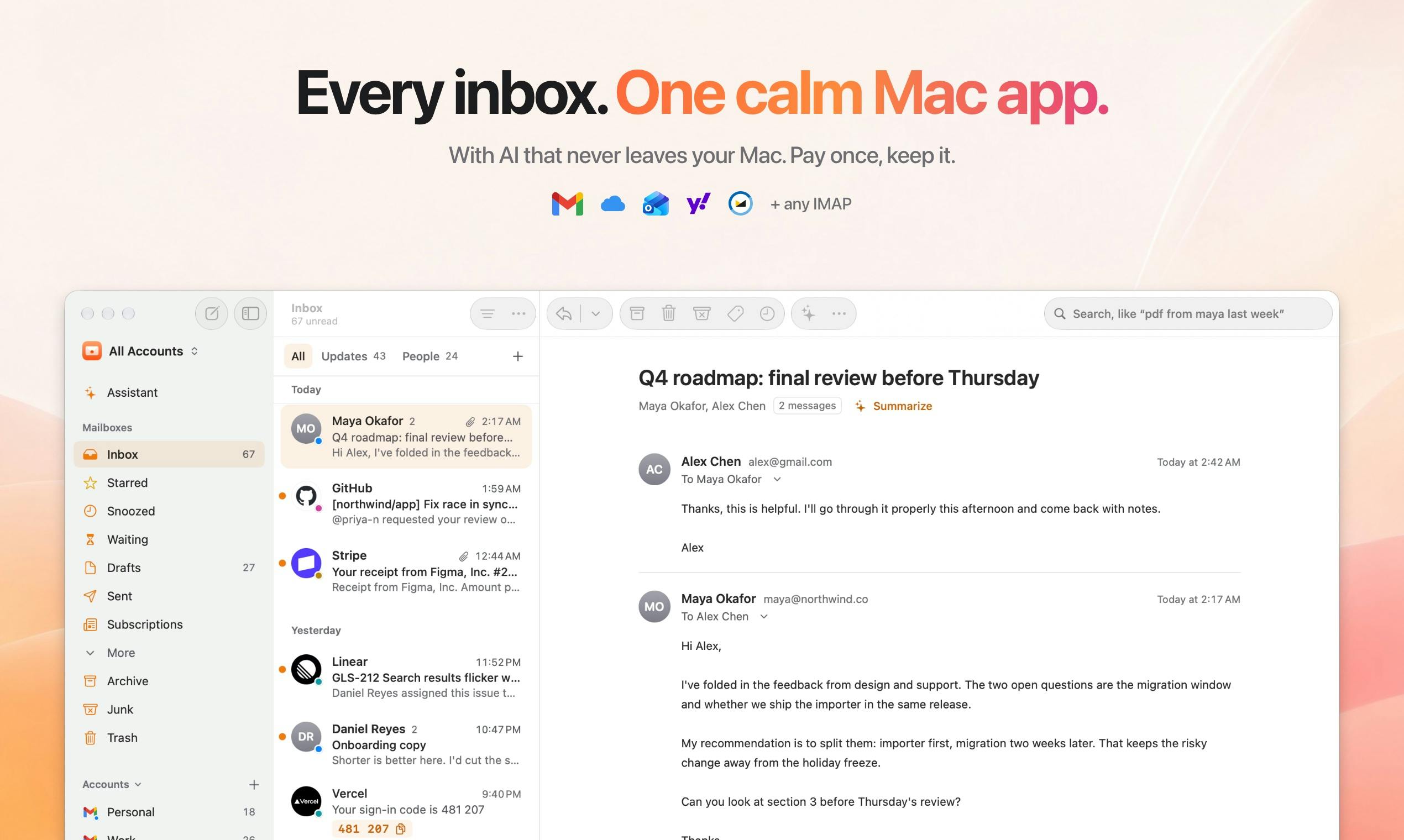
Most modern email apps are doing the same thing: syncing your email to their own servers, using cloud AI to read the content, and charging you a monthly fee. Glassmail takes the opposite path—it's a native Mac app where the AI runs entirely on your computer, with no email server and no subscription.
A Product Bet That Goes Against the Grain
Glassmail launched on Product Hunt at #4, collecting 86 upvotes. That's not a blockbuster result, but it hits a very specific pain point: privacy-conscious users don't want third-party servers reading their email, yet they still want the efficiency that AI brings.
The product is built by Junaid Shaukat and supports Gmail, iCloud, Outlook, and any IMAP account. Its core selling point comes down to one sentence—the AI never leaves your Mac. That means email content is processed locally, never uploaded to vendor servers, and never routed through third-party inference APIs.
By contrast, most AI-powered email clients on the market use cloud processing, and the price users pay is data hosting plus an ongoing subscription fee. Glassmail replaces subscriptions with a one-time purchase model, changing both the cost structure and the privacy model at once.
IMAP (Internet Message Access Protocol) is a standard email access protocol that allows clients to read and manage email from a mail server without having to download messages locally and then delete the server copy. Unlike proprietary APIs from vendors like Gmail and Outlook, IMAP is an open protocol that any email provider can support. This means Glassmail can connect to virtually any mailbox account via IMAP, rather than being limited to a single vendor—this is the technical basis for its claim of supporting "any IMAP account." The openness of IMAP lets third-party clients read email without relying on vendor authorization, but it also means email content still has to be pulled from the provider's server to the local machine before it can be processed.
AI Features: Built Around "Processing Email" Rather Than "Generating Text"
Glassmail's AI isn't a chat toy; it's an assistant embedded in concrete actions. Several typical scenarios the official materials highlight are worth breaking down:
- "what needs me today?": Ask in natural language which emails need your attention today, and the AI summarizes and prioritizes your inbox locally.
- "yes, but next week": Enter a short intent, and the AI generates a reply in your own tone, turning vague expressions like "let's talk next week" into polished email.
- One-key inbox cleanup: Process email one by one with the keyboard, with AI judgment reducing decision overhead.
What these features share is that they put AI in the "decision and drafting" stage rather than making users face a blank input box. For people drowning in email every day, what's reduced is cognitive load, not just typing time.
It's worth noting that running AI locally has implicit hardware requirements. The Mac's chip performance determines model size and response speed, which also explains why Glassmail chose to be a native Mac app rather than a cross-platform web tool—it needs to directly use local compute.
The Trade-Off Between Local AI and Cloud AI
Glassmail's model isn't without costs. Cloud AI can use larger models and update capabilities more frequently, while local models are constrained by device compute and are usually at a disadvantage in complex reasoning. Choosing the local route is essentially an explicit trade-off between privacy and capability.
This trade-off appeals strongly to a certain type of user: professionals handling contracts, customer information, and internal communications, and anyone unwilling to hand their inbox to a third party. For them, "slightly weaker AI but data that never leaves home" is an acceptable exchange.
Another design worth noting is the absence of an email server. This means Glassmail doesn't play the role of email relay or storage, making the architecture lighter and further reducing the data exposure surface.
Running AI locally typically relies on on-device inference frameworks, such as using Metal or Core ML on Apple chips to call the GPU/neural engine to accelerate model computation. Unlike cloud AI, local models are constrained by device memory and compute and cannot run extremely large parameter models, so trade-offs are often needed among model size, quantization precision, and response speed. Apple Silicon's unified memory architecture makes local inference feasible on Mac, but performance differences between chip models (such as M1 versus M3 Pro) directly affect the size of usable models and processing speed—which is also why local AI apps usually have clear hardware requirements.
The Business Logic of One-Time Purchase
Subscriptions are the mainstream monetization model for email clients today, and Glassmail goes the opposite way: pay once, use forever. This model is user-friendly, but it places higher ongoing revenue demands on the developer—without recurring revenue, what supports subsequent feature iteration and model updates is a question this kind of product needs to answer over the long term.
From a positioning standpoint, Glassmail is more of a "tool-type" app than a "service-type" platform: it doesn't depend on continuous investment in cloud infrastructure, its marginal costs are low, and only then does the one-time purchase model hold up financially.
A subscription model (recurring revenue) means users pay continuously by month or year, providing vendors with predictable recurring income suited to products that rely on ongoing investment in cloud infrastructure. A one-time purchase model is pay once, use forever; the vendor's marginal costs are lower, but there's no continuous cash flow. For a local app that doesn't rely on server hosting, one-time purchase is a better financial fit: the developer doesn't bear ongoing cloud inference and storage costs for each user, and revenue mainly comes from new user purchases rather than renewals from existing users. The challenge of this model is that subsequent feature iteration and model updates need to be supported by new sales, and revenue pressure becomes apparent when user growth slows.
Who Should Use It
If you fit the following profile, Glassmail is worth a try: you use a Mac, manage multiple email accounts, have real concerns about email privacy, and are tired of repeatedly paying for AI features.
If you prioritize the strongest AI capabilities, need a consistent cross-device experience (Windows, mobile), or rely on cloud collaboration features, then a local-first solution may not be optimal.
Glassmail's value isn't in the number of features but in proving the feasibility of another path: AI can be good enough without the cost of handing over your data. In a trend where email clients are becoming increasingly cloud-based, this direction itself is worth watching.
One-line Summary
Glassmail is a native Mac email client with AI running entirely locally and a one-time purchase model.
Paragraph Summary
Glassmail is a native Mac email app that goes against mainstream cloud AI email clients: the AI runs entirely locally, email content is never uploaded to servers, and it uses a one-time purchase model instead of a subscription. It supports Gmail, iCloud, Outlook, and any IMAP account, offering natural-language inbox queries, replies generated in your personal tone, and one-key cleanup. Built by Junaid Shaukat, it launched at #4 on Product Hunt. The article analyzes the trade-off between local and cloud AI—local models are constrained by device compute and may be weaker than cloud solutions in complex reasoning, but for privacy-sensitive professionals this is an acceptable exchange. It also discusses the commercial viability of a one-time purchase model within a serverless architecture, and notes that the product suits users who use a Mac, manage multiple mailboxes, value privacy, and are tired of subscriptions.
Related articles

Hero or Luck? Technical Reflections Sparked by an Arizona Grandfather Finding a Missing Toddler in the Desert
An Arizona grandfather finding a missing toddler in the desert hits Hacker News. This article analyzes emergency search, drone thermal imaging, child location devices, and community collaboration, exploring the boundaries of technology and human effort in extreme environments, while noting the material's limitations.

Run Agentic Coding on Mac with One Command: The Localcode Open-Source Tool
Localcode is an open-source agentic coding tool for Mac that launches with a single command. This article examines its local, open-source, minimal-install positioning, who it suits, and the information gaps to consider before adoption.

Lean Formalization of Masullo Manuscript: Progress Map Sparks Discussion
A public progress map for a Lean formalization project of Alessandro Masullo's manuscript sparks Hacker News discussion on formalization costs, collaboration, and AI-assisted proving.