Lean Formalization of Masullo Manuscript: Progress Map Sparks Discussion

A Lean formalization project for Masullo's manuscript published a progress map, sparking discussion on costs, collaboration, and AI assistance.
This article covers a Hacker News discussion on the Lean formalization of Alessandro Masullo's manuscript. The project translates the manuscript's definitions, lemmas, and theorems into Lean code with machine-verifiable proofs and publishes a progress map. It analyzes the map's value for project management and community collaboration, and discusses formalization costs, the Lean toolchain, and AI-assisted theorem proving.
From Manuscript to Machine Verification: New Progress in Lean Formalization
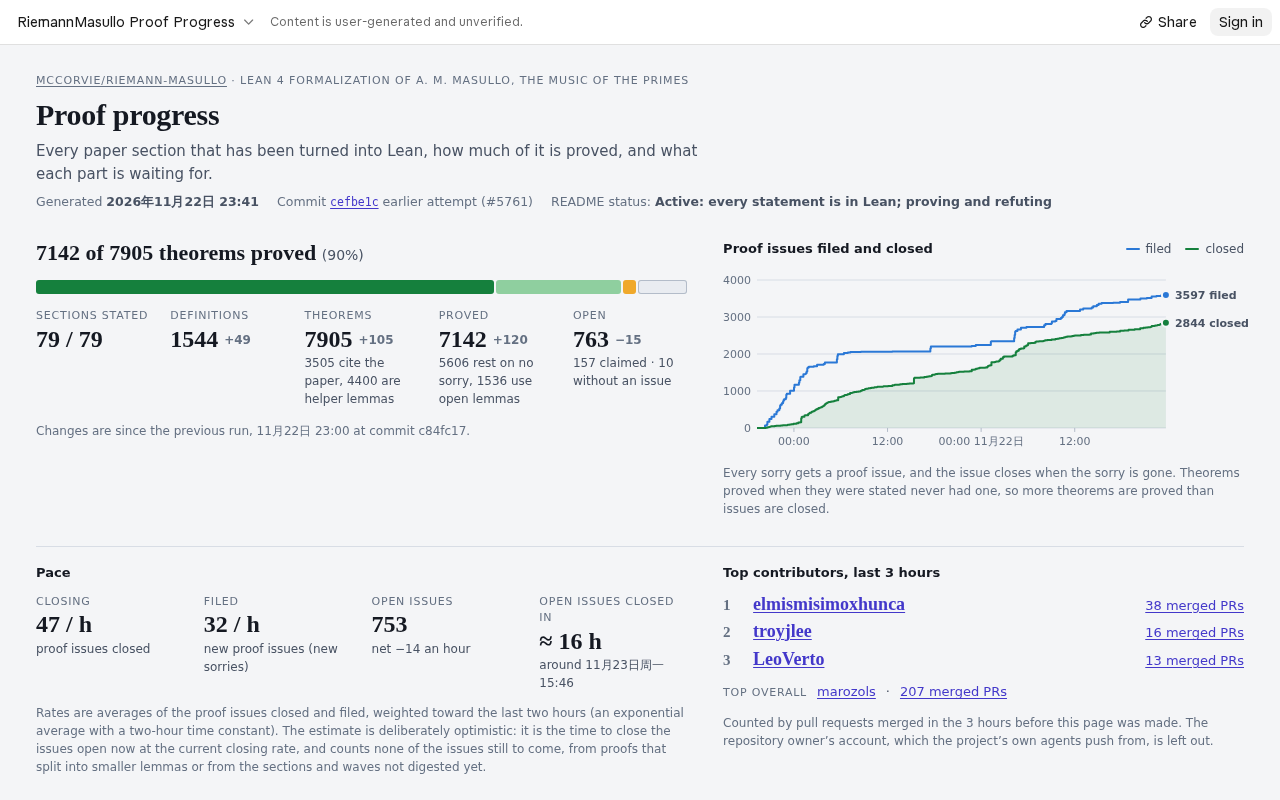
A discussion thread on Hacker News about a Lean formalization project has drawn attention. The project's core goal is to fully formalize Alessandro Masullo's manuscript using the Lean theorem prover, and it has published a progress map showing the current state of the formalization work. The post received 81 points and 32 comments, indicating that community interest in mathematical formalization and AI-assisted proving continues to heat up.
As an interactive theorem prover based on dependent type theory, Lean has gained considerable attention in mathematics and computer science in recent years. It can not only express mathematical definitions and theorems but also check the correctness of proofs through its compiler, thereby eliminating gaps in human reasoning. Formalizing a manuscript means translating every definition, lemma, and theorem in it into code that Lean can understand, and constructing machine-verifiable proofs.
Dependent Type Theory is the theoretical foundation of Lean and the key to understanding its expressive power. In simple type systems, types and values are strictly separated; in dependent type theory, types can depend on values. For example, one can define the type "vector of length n," where n is a natural number parameter. This allows mathematical propositions to be encoded directly as types, and proving a proposition is equivalent to constructing an element of that type—this is the "Propositions as Types" correspondence. With this principle, Lean can both express complex mathematical structures and automatically verify the correctness of proofs through its type checker. Dependent type theory originated from Per Martin-Löf's type theory and was later developed through systems such as Coq and Agda, while Lean added powerful automation tactics and metaprogramming capabilities on top.
Theorem provers differ from computer algebra systems: they do not perform symbolic computation but instead help users construct formal proofs and mechanically check their correctness. Lean is an interactive theorem prover, where users provide proof steps and the system gives real-time feedback on goal states and errors. This "human-machine collaboration" model makes large-scale mathematical formalization projects possible; for example, Lean's mathlib library already contains over a million lines of formalized mathematics.
Why the Progress Map Matters
Publishing a progress map is itself a move worth discussing. For formalization projects, a progress map is not only a project management tool but also an entry point for community collaboration. It clearly marks which parts are complete, which are in progress, and which have not yet begun, allowing potential contributors to quickly locate where they can get involved.
According to the Hacker News post title, this progress map concerns Alessandro Masullo's manuscript. Although the discussion did not reveal the manuscript's specific content, judging from the general patterns of formalization projects, manuscripts often contain a series of interdependent mathematical propositions, and formalization requires progressing step by step from basic definitions to higher-level theorems according to dependency relationships. The value of the progress map lies in visualizing this complex dependency structure, making the project's overall state clear at a glance.
Dependencies in formalization projects are usually presented as a directed acyclic graph (DAG): lower-level definitions (such as sets, functions, and order relations) are prerequisites for higher-level theorems, and formalization must proceed in topological order. Progress maps often implicitly reflect this structure, organizing the propositions in the manuscript into modular layers. For example, a manuscript on real analysis might first formalize the axioms of the real numbers, then gradually build up limits, continuity, and the fundamental theorem of calculus. A clear dependency graph not only guides contributors in choosing tasks they can start immediately but also helps AI tools understand context—when a model attempts to prove a lemma, it can cite already completed prerequisite theorems as known facts. Thus, a progress map is not only a management tool but also a form of knowledge representation.
Key Points in Community Discussion
Among the 32 comments, community participants exchanged views on the significance of formalization, the experience of using the Lean toolchain, and ways of collaborating on the project. Such discussions are not rare on Hacker News, but each occurrence reflects the different expectations that developers and researchers have for formal methods.
Some discussions focused on the costs and benefits of formalization. Formalizing a manuscript requires a large investment of time, because even a short mathematical proof may require hundreds of lines of code and repeated debugging in Lean. However, the benefits of formalization are equally clear: once a proof passes type checking, its correctness has a machine-level guarantee and no longer depends on reviewers' visual inspection.
Other discussions touched on the role of AI in formalization. As large language models show potential in code generation and theorem-proving assistance, people have begun to consider whether AI can accelerate the formalization process. Project status displays such as progress maps can precisely provide clear task boundaries for AI-assisted tools, allowing models to focus on the parts that are not yet complete.
The Intersection of Formalization and AI-Assisted Proving
The combination of Lean formalization projects and AI is a direction worth watching. In recent years, work has emerged that combines language models with the Lean environment, letting models attempt to generate proof scripts and then having the Lean compiler verify their correctness. This "generate-verify" loop offers a scalable path for automated theorem proving.
For the formalization project of Masullo's manuscript, the unfinished parts revealed by the progress map can precisely serve as entry points for AI assistance. Human contributors can concentrate on conceptually more difficult parts, while leaving mechanically intensive lemma proofs to AI tools to attempt. Of course, the premise of such a division of labor is that the project has clear modular divisions and good formalization conventions, and the progress map serves as infrastructure in this respect.
The "generate-verify" loop is the mainstream paradigm in current AI-assisted theorem proving. Language models (such as GPT-4 and retrieval-augmented models in LeanDojo) generate candidate tactics based on the current proof state, and the Lean compiler immediately checks whether the tactic is valid and updates the goal state; if it fails, the model can retry using the error information. This process resembles trial and error in reinforcement learning, but the verification signal comes from the formal system rather than environmental rewards. In recent years, Lean's metaprogramming framework has supported exporting proof states as structured data, facilitating model training. For example, OpenAI's GPT-f and Meta's HyperTree Proof Search have achieved preliminary results on Lean. However, AI-generated proofs often lack readability and struggle with steps requiring high-level mathematical insight. Therefore, a human-machine division of labor—humans handling conceptual difficulties and AI handling mechanical lemmas—has become a pragmatic choice. Progress maps precisely provide the basis for task division in this division of labor.
Implications for Formalization Practice
The lesson of this project is that formalization should not be regarded as a one-off massive undertaking but can be broken down into measurable, collaborative phased tasks. A seemingly simple tool like a progress map actually lowers the barrier to community participation and makes the project's health transparent.
For teams wanting to launch similar formalization projects, establishing progress tracking mechanisms early, clarifying the dependencies among modules, and making the current state public may be more conducive to long-term project progress than quietly writing proofs. The discussion around this post on Hacker News also indirectly confirms the community's interest in open, collaborative formalization work.
One-line Summary
A Lean formalization project for Masullo's manuscript published a progress map, sparking community discussion on formalization costs, collaboration, and AI assistance.
Paragraph Summary
This article introduces a Hacker News discussion about the Lean formalization of Alessandro Masullo's manuscript. The project aims to fully translate the manuscript's mathematical definitions, lemmas, and theorems into Lean code, construct machine-verifiable proofs, and publish a progress map to show completion status. The article analyzes the value of the progress map in project management and community collaboration, noting that it visualizes dependency structures and lowers the barrier to participation. Community discussion revolves around the costs and benefits of formalization, the Lean toolchain experience, and AI's assisting role in theorem proving. The article further explores the prospects of combining AI with formalization, arguing that progress maps can provide clear task boundaries for AI-assisted tools and promote human-machine division of labor. Finally, it summarizes the implications for formalization practice: break work into measurable, collaborative phased tasks and establish progress tracking mechanisms early.
Related articles

Hero or Luck? Technical Reflections Sparked by an Arizona Grandfather Finding a Missing Toddler in the Desert
An Arizona grandfather finding a missing toddler in the desert hits Hacker News. This article analyzes emergency search, drone thermal imaging, child location devices, and community collaboration, exploring the boundaries of technology and human effort in extreme environments, while noting the material's limitations.

Run Agentic Coding on Mac with One Command: The Localcode Open-Source Tool
Localcode is an open-source agentic coding tool for Mac that launches with a single command. This article examines its local, open-source, minimal-install positioning, who it suits, and the information gaps to consider before adoption.
@ai-sdk/harness-fx 1.0.107 Released: MCP Dependency Upgrade, Patch Update
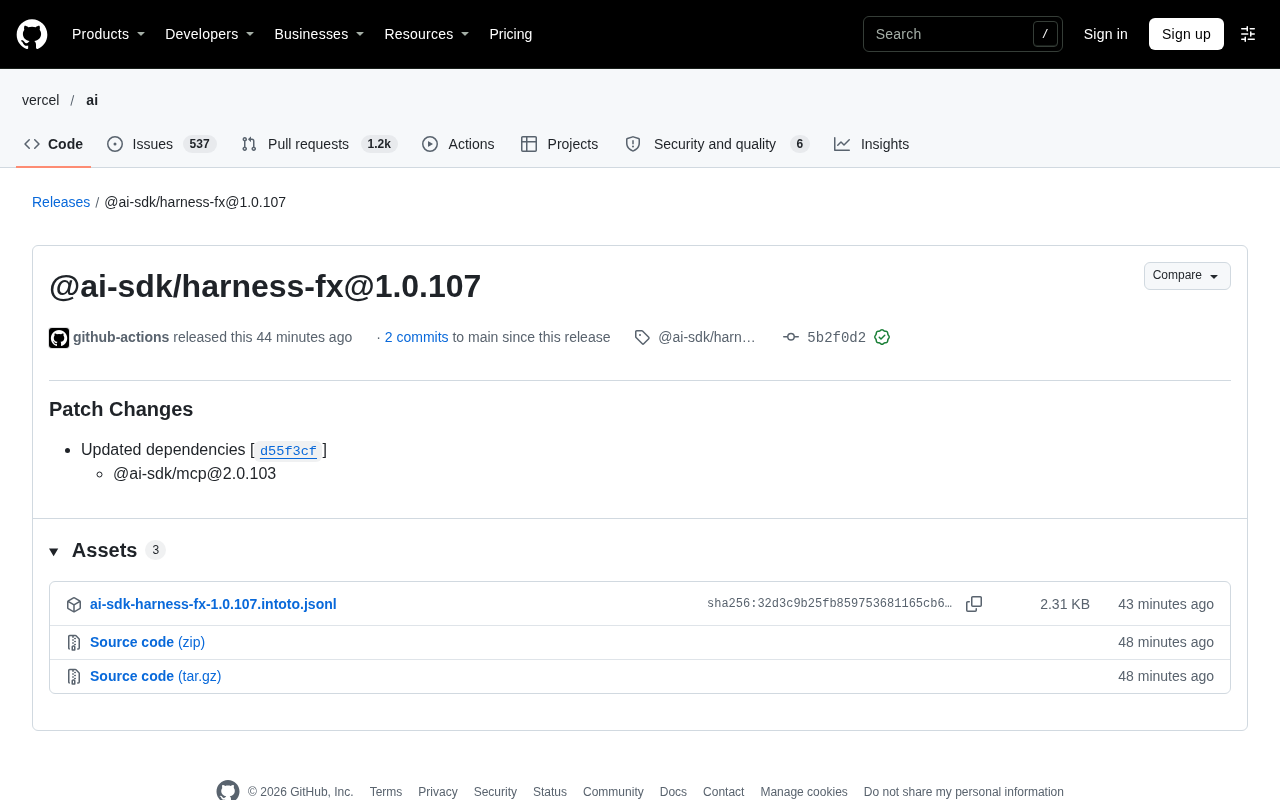
@ai-sdk/harness-fx 1.0.107 released, updating dependency @ai-sdk/mcp to 2.0.103. Learn about this patch update, its impact on AI SDK developers, and upgrade advice.