Gleap Launches Kai Resolve: An AI Support Agent That Can Read Code

Gleap launches Kai Resolve, using read-only, multi-source data cross-diagnosis for tickets docs can't answer.
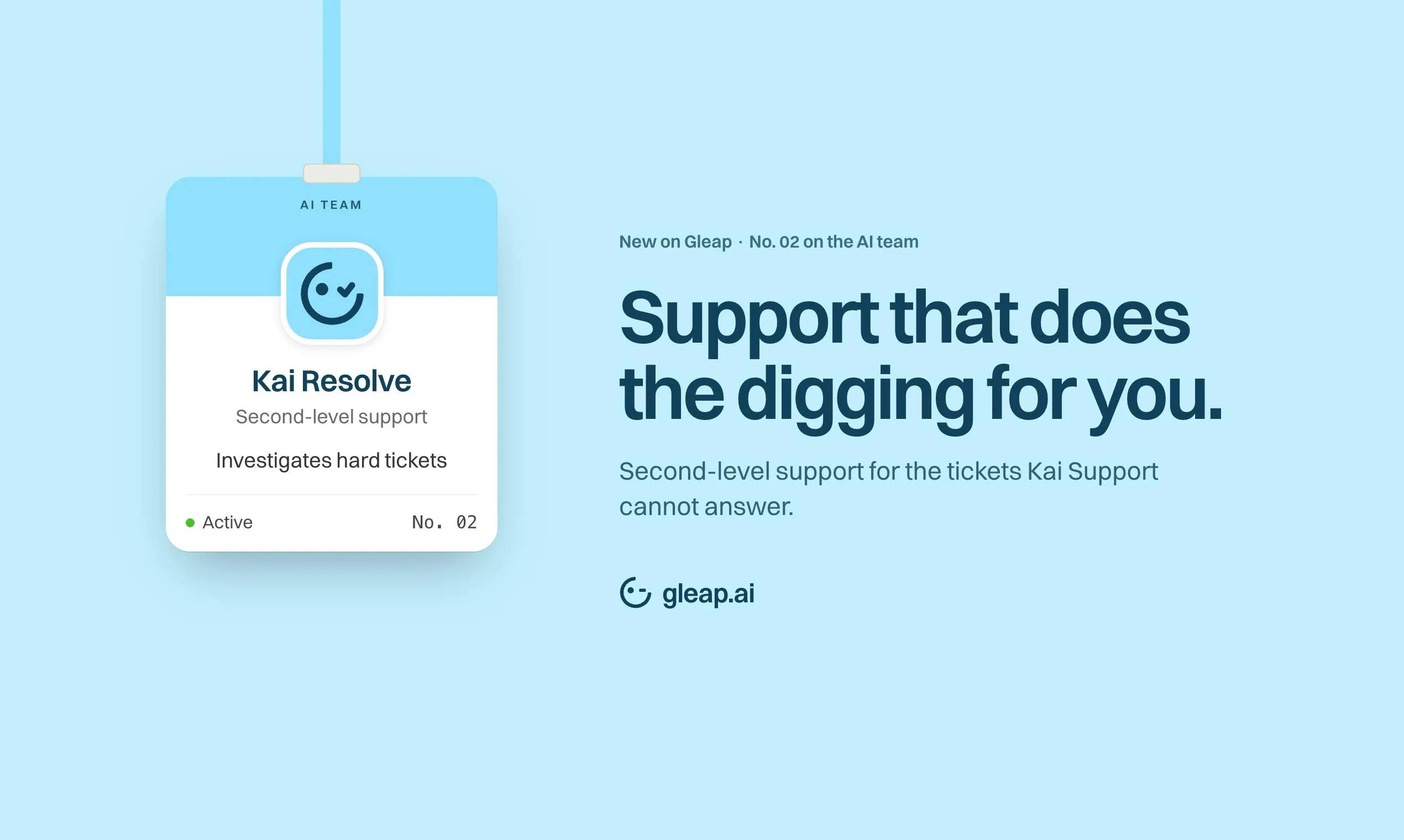
Gleap launched Kai Resolve on Product Hunt, an AI support agent for complex tickets help docs can't answer. It reads screen recordings, logs, account data, and code in read-only mode, cross-referencing them to either answer customers directly or escalate with diagnostics. Confirmed bugs become coding tasks for engineering review, not automatic fixes. The article analyzes read-only limitations, undisclosed accuracy, and target users: technical SaaS teams.
Title
Gleap Launches Kai Resolve: An AI Support Agent That Can Read Code
Meta Description
Gleap releases Kai Resolve, an AI customer support agent that reads screen recordings, logs, account data, and code to tackle tickets documentation can't answer, turning confirmed bugs into reviewable coding tasks.
Article Content
Customer support ticketing systems are undergoing a quiet transformation. Traditional AI support tools mostly stay at the level of knowledge base retrieval and scripted responses, and they're helpless when a problem falls outside the documentation. Kai Resolve, a new product Gleap launched on Product Hunt, attempts to break through this limitation—it doesn't just read docs, it also reads screen recordings, logs, account data, and even your code.
From "Answering Questions" to "Digging Into Problems"
Kai Resolve's positioning is clear: it specializes in tickets that "documentation can't answer." According to its Product Hunt page, this AI agent accesses screen recordings, logs, account data, and code repositories in read-only mode. After cross-referencing multiple information sources, it either gives the customer an answer directly or escalates to a human with diagnostic conclusions in hand.
This shift in thinking is worth noting. Most support AI assumes "the answer is already written in the help docs," while Kai Resolve assumes "the real answer is hidden in how the system behaves." Screen recordings reconstruct the user's action path, logs reveal backend anomalies, account data confirms the user's state, and code is used to determine whether the problem lies in the product logic itself. Only by piecing these four types of information together can you give a well-grounded response to a complex ticket.
Gleap itself is a vendor of customer support ticketing and user feedback tools, and Kai Resolve is an extension of its product line in the AI agent direction. Its results on Product Hunt—102 votes, 20 comments, and a #3 ranking for the day—show that this direction genuinely strikes a chord with some teams.
Confirmed Bugs Become Reviewable Coding Tasks
The most interesting part of the Kai Resolve workflow is the "confirmed bugs converted into coding tasks" step. When the AI determines through log and code cross-referencing that a ticket points to a real defect, it generates a coding task for the engineering team to review, rather than pushing a fix straight to production.
This design is fairly restrained from an engineering standpoint. Letting AI read code already requires a trust boundary; letting it modify code is a risk of an entirely different magnitude. Limiting the output to "diagnosed tasks pending review" preserves the AI's efficiency in aggregating information while leaving decision-making to humans. For small teams with tight engineering resources, a ticket that automatically organizes reproduction steps and includes log snippets and relevant code locations is far more useful than "the user says it's broken."
A "coding task" here refers to a structured engineering to-do item, typically containing a problem description, reproduction steps, relevant log snippets, suspected faulty code locations, and priority suggestions—similar in form to a Jira ticket or GitHub Issue. Unlike an AI directly submitting a patch (Pull Request), generating a task pending review confines the AI's output to the "diagnosis and organization" stage, while engineers still judge and write the fix. This human-in-the-loop design avoids two types of risk: first, the AI modifying the wrong code based on incorrect log associations; second, automated changes introducing regression defects. The cost is that human effort is still required, but it saves the time of gathering context from scratch—especially valuable for intermittent bugs that are hard to reproduce.
Where Is the Trust Boundary for AI Support Agents?
Kai Resolve emphasizes "read-only" access, and this constraint is not mentioned casually. Support AI comes into contact with production logs, real users' account data, and corporate code repositories, and any write permission implies a potential attack surface. Read-only mode lowers the floor for worst-case scenarios, but it doesn't eliminate trust concerns: logs and account data themselves contain sensitive information, and how the AI agent stores, transmits, and retains this content is a detail buyers will inevitably press on.
Another point to watch is diagnostic accuracy. Correlating logs and code is very clean in the ideal case, but real-world system logs are often noisy, inconsistently formatted, and misaligned in timestamps. The Product Hunt description of Kai Resolve doesn't provide accuracy figures, and actual performance needs to be validated in real ticket flows.
Read-only access, in security engineering, refers to an access control mode in which a subject is granted only read permission and cannot create or modify any data. Its core value is narrowing the attack surface: even if the agent is hit by a prompt injection attack or makes a logic error, it cannot directly tamper with production data. But read-only doesn't mean risk-free—logs often contain user identifiers, request parameters, and even token fragments; account data involves personal privacy; and code repositories may expose secrets and business logic. As a result, when enterprises evaluate such agents, they typically also ask whether data leaves their own environment during model inference, whether it's used for training, how long it's retained, and whether private deployment or data anonymization is supported. These requirements are directly tied to compliance frameworks such as GDPR and SOC 2, and often determine purchasing decisions more than "is it read-only."
Who Should Use This Kind of Tool
Judging by its product form, Kai Resolve targets SaaS teams with technically savvy customers and relatively high ticket complexity. For consumer-facing products, most issues can be resolved through a help center, and code-level diagnosis isn't needed; for developer tools or B2B platforms, users reporting problems often bring scenarios like "I called the API and got a 500," which require checking logs—exactly where Kai Resolve shines.
It could also change how support and engineering collaborate. In the past, support was the middleman, passing users' vague descriptions to engineering, who then had to come back asking for logs and reproduction steps. If the AI agent can prepare all the diagnostic materials when escalating a ticket, that chain becomes much shorter. Of course, the premise is that the diagnosis is reliable enough—otherwise engineering has to investigate all over again, and the time saved is given right back.
Kai Resolve is currently offered through Gleap's channels, and specific pricing and onboarding details should be found on the official website. For technical teams whose response times are being slowed by complex tickets, this "support AI that digs into problems" deserves a spot on the evaluation list.
One-line Summary
Gleap launches Kai Resolve, using read-only, multi-source data cross-diagnosis for support tickets documentation can't answer.
Paragraph Summary
Gleap launched Kai Resolve, an AI support agent, on Product Hunt, specializing in complex tickets that help documentation can't answer. It accesses screen recordings, logs, account data, and code repositories in read-only mode, and after cross-referencing, either answers the customer directly or escalates to a human with diagnostics. Confirmed bugs become coding tasks for engineering review rather than automatic fixes, reflecting a restrained trust-boundary design. The article analyzes the risks and limitations of read-only mode, the open question of undisclosed diagnostic accuracy, and its target users: technical SaaS teams with high ticket complexity. The product received 102 votes and ranked #3 for the day.
Related articles

Fifty Years Studying Power: Robert Caro's Writing and Insights on Power
Robert Caro reflects on 50 years studying power: Lyndon Johnson's persuasion and leverage, Robert Moses's transformation from idealist to ruthless builder, the dilemmas of large-scale construction, and his methods of compressing themes and solitary focus in biography writing.

Can a $20,000 Robot Do Your Chores? The Test Results Are Surprising
A YouTube test video shows how a $20,000 robot responds to commands like washing dishes, turning off lights, taking out trash, and feeding the dog. This article analyzes its real capability boundaries, the state of voice interaction technology, and how far household robots are from mainstream adoption.
The Complete Guide to Running AI Models Locally: Inference Engines and Tool Stack Explained
A systematic breakdown of the complete local LLM tool stack: from PyTorch and GGML compute libraries to llama.cpp, vLLM, SGLang inference engines and Ollama, LM Studio wrapper layers, with benchmark data on performance differences and selection logic.