GLEE Competition: Build a Negotiation AI Agent and Sprint Toward NeurIPS 2026

GLEE Competition challenges developers to build negotiation AI Agents with a path to NeurIPS 2026 publication.
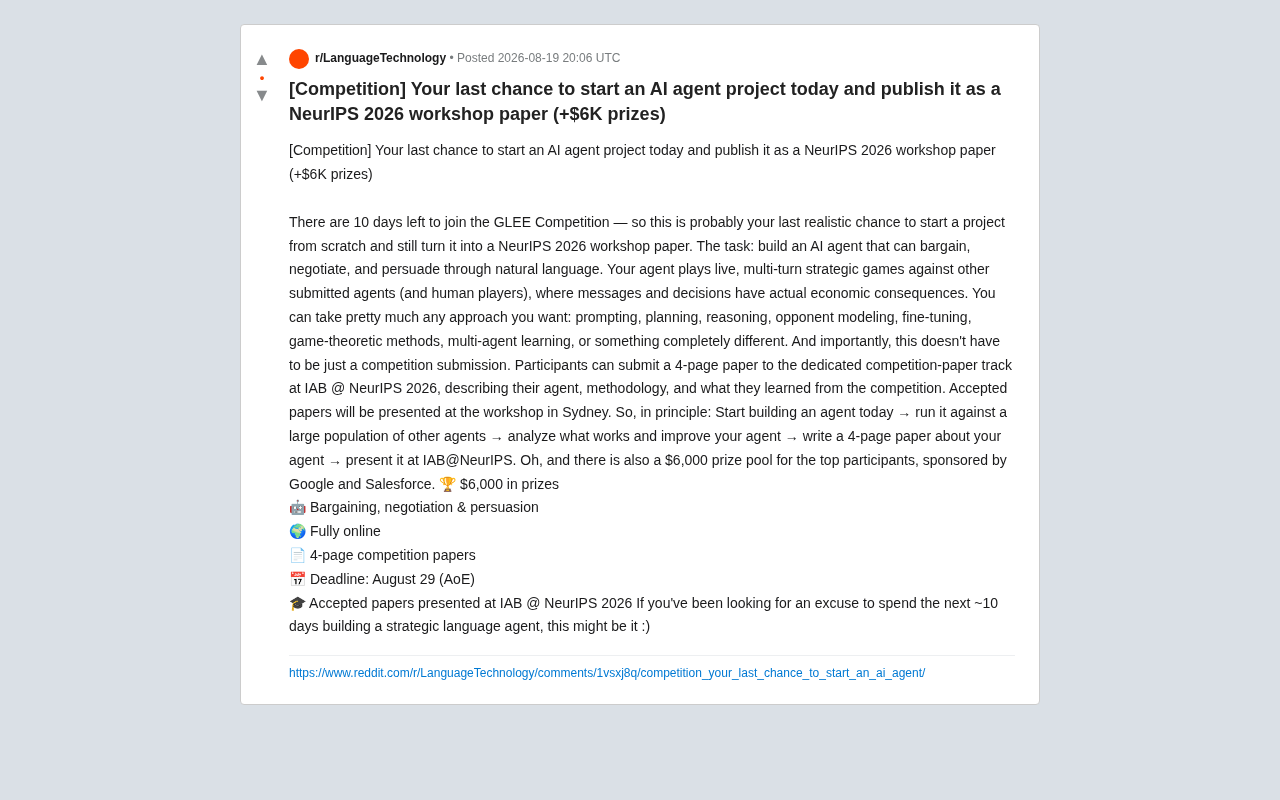
The GLEE Competition invites researchers to build AI Agents capable of bargaining, negotiating, and persuading in dynamic adversarial games against other Agents and humans. With completely open technical approaches, a clear path to NeurIPS 2026 workshop publication, $6,000 in prizes sponsored by Google and Salesforce, and only 10 days until the deadline, it represents a unique opportunity at the intersection of game theory, multi-agent learning, and LLMs.
A Competition About "AI That Can Talk Its Way Through Anything"
As large language model capabilities continue to break new ground, AI Agent boundaries are expanding from "completing tasks" to "strategic bargaining and persuasion." Recently, a challenge called the GLEE Competition has attracted widespread attention in the AI research community. According to a related Reddit post, the competition's core task is singular: build an AI Agent capable of bargaining, negotiating, and persuading.
Interestingly, there are only about 10 days left until the registration deadline (August 29th AoE), meaning this may be the "last realistic opportunity" to start a project from scratch and turn it into a NeurIPS 2026 workshop paper.
GLEE Competition's Core Mechanism: Agents Competing in Real Strategic Games
Dynamic Adversarial Play, Not Static Benchmarking
Unlike many static benchmarks, what makes GLEE unique is its dynamic adversarial mechanism. Submitted AI Agents compete in real-time against other participating Agents (and even human players) across multiple rounds of strategic games.
Traditional AI benchmarks (such as GLUE, SuperGLUE, MMLU, etc.) typically score models on fixed datasets with predetermined questions and standard answers. While such static evaluation facilitates horizontal comparison, it fails to capture a fundamental characteristic of the real world: opponents dynamically adjust their strategies based on your behavior. GLEE's dynamic adversarial mechanism is closer to the self-play approach from the AlphaGo era, but extends the game scenario from the board to natural language communication. This requires Agents to possess not only language understanding and generation capabilities but also real-time strategic reasoning under incomplete information.
More critically, every message and every decision in these games carries real economic consequences. This means Agents can't just "talk a good game" — they must actually maximize value at the negotiation table. This setup dramatically increases the task's realism and difficulty, closely mirroring real-world scenarios like business negotiations, price bargaining, and persuasion.
Completely Open Technical Approaches
For researchers and developers, perhaps the most attractive aspect of this competition is its openness. The organizers impose no restrictions on technical approaches — participants can use virtually any method:
- Prompting: Guiding model behavior through carefully crafted prompts
- Planning & Reasoning: Giving Agents multi-step reasoning capabilities
- Opponent Modeling: Predicting and exploiting opponents' behavioral patterns
- Fine-tuning: Customizing models for negotiation tasks
- Game-theoretic Methods: Incorporating classical game theory frameworks
- Multi-agent Learning: Learning optimal strategies through group interactions
Opponent Modeling, rooted in game theory and multi-agent systems research, centers on inferring an opponent's strategy type, preferences, or intentions by observing their past behavior, enabling better decision-making. In AI, typical approaches include Bayesian opponent modeling (updating beliefs about opponent types through probabilistic reasoning), sequence model-based behavior prediction (e.g., using Transformers to model opponent action history), and Theory of Mind methods. In negotiation scenarios, the challenge of opponent modeling lies in the fact that opponents may deliberately hide their true intentions or employ deceptive strategies, requiring the model to distinguish between "what the opponent says" and "what the opponent actually wants."
This openness makes the competition suitable for both engineering-oriented developers and theory-focused researchers — even encouraging "entirely new and different approaches."
From GLEE Competition to NeurIPS Paper: A Complete Path
A Clear Academic Output Pipeline
A major highlight of the GLEE Competition is that it's not merely a "leaderboard" contest — it provides a complete path from practice to academic publication. Participants can submit a 4-page paper to a dedicated competition paper track at IAB @ NeurIPS 2026, describing their Agent design, methodology, and insights gained from the competition.
NeurIPS (Neural Information Processing Systems) is one of the most prestigious academic conferences in machine learning, attracting tens of thousands of researchers globally each year. Its main conference paper acceptance rate typically hovers around 20%-25%, making competition extremely fierce. While workshop papers are shorter (usually 4-6 pages) with relatively flexible review standards, they still carry significant academic visibility and citation value under the NeurIPS brand. For PhD students and early-career researchers, workshop papers are often an important stepping stone into top academic circles and an efficient way to validate new ideas and gather peer feedback. The IAB (Intelligent Agent Benchmarking) workshop focuses on agent evaluation and represents an important academic community in this field.
The entire process can be summarized as:
- Build a negotiation AI Agent → Construct your strategic language agent from scratch
- Enter large-scale adversarial play → Have it compete against numerous other Agents
- Analyze and iterate → Observe which strategies work and continuously optimize
- Write a 4-page paper → Summarize your methods and findings
- Take the NeurIPS stage → Accepted papers will be presented at the workshop in Sydney
For researchers and students hoping to make their mark at a top AI conference, the value of this path is clear — as a top-tier machine learning conference, NeurIPS workshop papers carry considerable academic weight.
Prizes and Backing: Sponsored by Google and Salesforce
Beyond academic value, this competition offers tangible material incentives. The total prize pool reaches $6,000, awarded to top-ranking participants, sponsored by tech giants Google and Salesforce.
Having major industry backing not only enhances the competition's credibility but also reflects the industry's serious interest in "negotiation AI Agents" as a direction. Google and Salesforce's sponsorship is no coincidence. Salesforce, as the world's largest CRM (Customer Relationship Management) platform, has core business scenarios — sales negotiations, customer retention, contract bargaining — that are natural deployment scenarios for negotiation AI. Google, meanwhile, continues to explore commercialization paths for Agent capabilities within its Gemini ecosystem. According to McKinsey estimates, B2B pricing and negotiation optimization alone involves trillions of dollars in annual global transaction value. An AI Agent capable of autonomously conducting price negotiations, even if it achieves only a 1%-2% improvement in average deal prices, would create astronomical economic value. Additionally, negotiation AI has broad application potential in supply chain management, real estate transactions, legal mediation, and other fields.
Why Negotiation AI Agents Deserve Attention
From a broader perspective, the "bargaining, negotiation, and persuasion" capabilities that GLEE focuses on touch precisely on a key shortcoming in current AI Agent development. Today's large models excel at unidirectional task execution, but still have significant room for improvement in scenarios requiring multi-turn strategic interaction, dynamic game play, and intent inference.
Combining game theory, multi-agent learning, and large language models is a frontier direction being explored jointly by academia and industry. Classical game theory provides mature mathematical frameworks — Nash equilibrium, Pareto optimality, mechanism design — for analyzing strategic interactions, but traditional methods typically assume limited and clearly defined action spaces. The introduction of large language models expands the action space to a virtually infinite natural language expression space, which brings both richer strategic expression capabilities (such as ambiguous commitments, implications, emotional manipulation) and enormous theoretical challenges for equilibrium analysis. Current frontier research includes: using LLMs for zero-shot game reasoning, combining reinforcement learning with language models to train negotiation strategies, and exploring whether LLMs can spontaneously develop cooperative behavior in repeated games.
This type of research not only advances Agent technology but also helps us understand AI's behavioral boundaries and potential risks in complex social interactions — for example, could an AI that's too skilled at persuasion be misused for manipulation and deception? How can we ensure negotiation AI adheres to ethical constraints while pursuing value maximization? These questions will become increasingly urgent as the technology progresses.
Conclusion
For developers and researchers looking for a reason to dedicate the next ten days to building a strategic language Agent, the GLEE Competition offers a rare opportunity: low-barrier technical freedom, a real adversarial environment, a clear paper publication path, plus $6,000 in prizes and major industry backing.
With only about 10 days until the deadline, this may be the last chance to start from scratch and potentially take the NeurIPS 2026 stage. Interested readers should act quickly.
Related articles

Workbuddy for Absolute Beginners: How a Desktop AI Agent Fits Into Real Workflows
A beginner's guide to the Workbuddy desktop AI agent: installation, claiming credits, file management, and building automated workflows—compared with CodeX for fit and cost, helping professionals shift from AI question-askers to AI managers.

OpenAI's New Agent Stack: Computer Use, Decisions API, and Ultra-Fast Workflows
OpenAI Dev Day unveiled a new agent stack: Computer Use outperforms humans, Decisions API delivers ultra-low-latency classification via Luna, Agents API opens the same Computer Use capabilities, and GPT-6.1 Sol costs only one-seventh of Astra. Core updates, benchmark data, and developer insights.

Liang Wenfeng Open-Sources DeepInfo Inference Framework, Takes On U.S. Ban
DeepSeek open-sources its DeepInfo inference framework after its models, featuring GPU/CPU cross-pipelining, small-model prediction with large-model verification, and full Huawei Ascend and NVIDIA chip support—facing the U.S. federal ban head-on. This article analyzes its significance for AI deployment and open-source strategy.