Glif's New Trick: Hundreds of AI Models on One Stage, One-Click Marketing Content
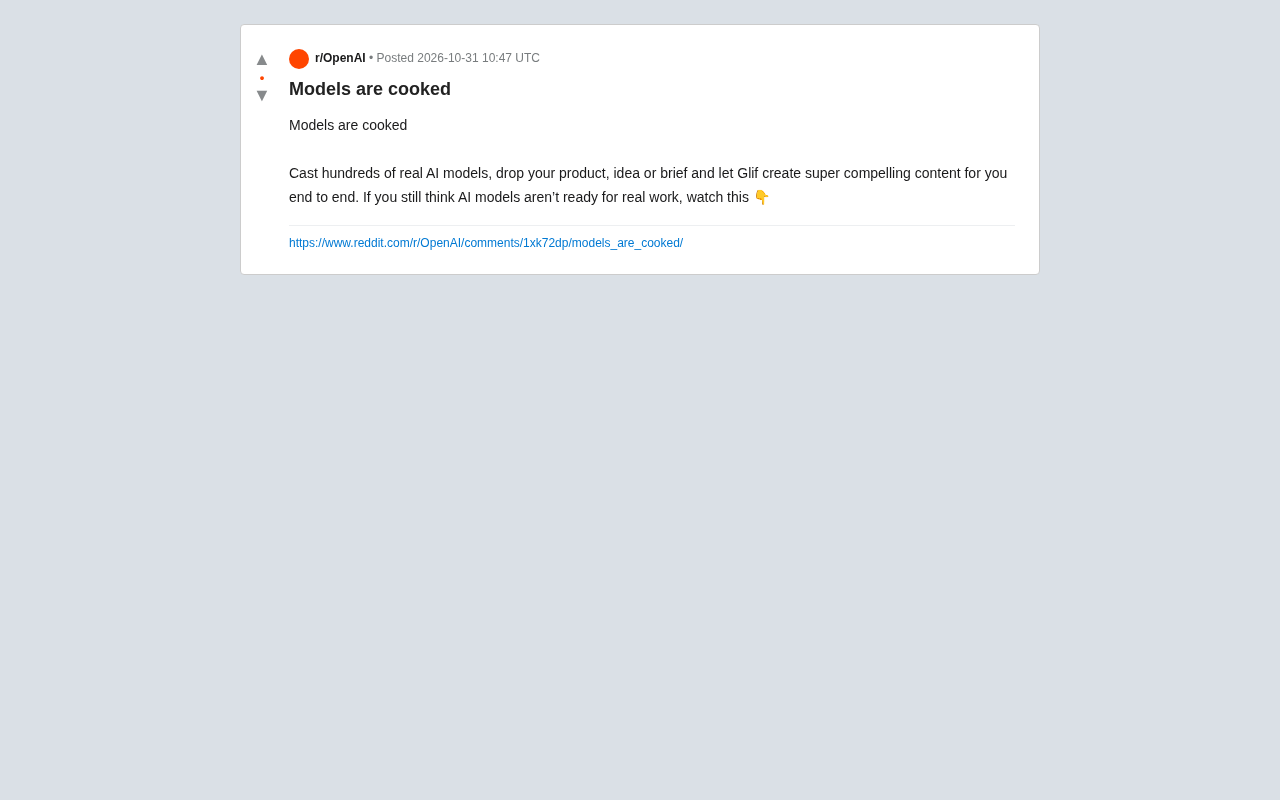
Glif orchestrates hundreds of real AI models to generate content end to end, sparking the 'models are cooked' discussion.
The tool Glif, introduced in the hot Reddit post 'Models are cooked,' orchestrates hundreds of real AI models so users can input product info or a creative brief and complete content ideation, asset generation, and final output end to end. The article argues its core value is automating the cumbersome 'choose models, switch platforms, tune parameters' workflow, shifting competition from single-point tools to multi-model orchestration. For marketing teams and independent creators, this lowers engineering costs and the production barrier, letting individuals do work previously outsourced; but content quality consistency and brand tone still need human review. 'Models are cooked' is more a product manifesto than an industry verdict; creative strategy and final judgment still depend on humans, and tools should be leverage, not a replacement for thinking.
Recently, a Reddit post titled "Models are cooked" has drawn attention. The post introduces a tool called Glif: users simply input product information, creative ideas, or a brief, and it can call on hundreds of real AI models to generate highly compelling content end to end. The post declares: "If you still think AI models aren't ready for real work, take a look at this 👇."
Core Mechanism: Turning "Choosing a Model" into an "Automated Pipeline"
Glif's approach differs from single-model applications. Rather than packaging one model as a universal key, it orchestrates hundreds of real models simultaneously. After users input a product description or creative brief, the system automatically completes the entire process—from content ideation and asset generation to final output.
This end-to-end "models as labor" model compresses workflows that previously required repeated manual trial and error and cross-platform switching into a single submission. For scenarios requiring high-frequency output of visual and copy content—such as marketing, e-commerce, and independent developers—this means the barrier to content production is significantly lowered.
Model Orchestration is the key technical context for understanding Glif. It refers to a scheduling layer that dynamically selects and chains multiple specialized models to complete composite tasks based on task type, input content, and quality requirements, rather than relying on a single general-purpose model to do everything. Common practices include: using a routing module to determine whether to call a text-to-image, text-to-video, or language model; using a workflow engine to define the sequence dependencies and parameter passing between steps; and using a result evaluation stage to decide whether to retry or switch models. Compared with "one model to rule them all," orchestration's advantage is that each stage can use the strongest specialized model available at the time; the downside is that latency, cost, and consistency control become more complex. Glif's claim to orchestrate hundreds of real models is essentially productizing this orchestration layer.
Why "Models Are Cooked": The Leap from Demos to Real Output
The keyword in the original post is "real work." The context for this claim is that early AI demo videos were often criticized as "cherry-picked samples," whereas Glif emphasizes that it orchestrates real models and delivers end to end.
The direct change brought by this end-to-end capability is that users no longer need to act as "prompt engineers" agonizing over which model to use and how to combine parameters—they can focus on their product and creative ideas themselves. The creator's role shifts from "operating tools" to "defining requirements."
End-to-End generation in the context of AI products refers to a complete chain from raw input (such as a one-sentence product description) directly to a usable finished product (such as a package of image and text assets), without requiring users to manually switch tools or transfer files in between. Its difference from "single-point generation" is that single-point tools handle only one link in the chain, and users still have to assemble things themselves; an end-to-end system encapsulates ideation, generation, selection, and layout. The benefits of end-to-end are a low barrier to use and reproducible workflows, but it also means troubleshooting is harder when something goes wrong, and users have less control over intermediate steps. Therefore, such products usually need to offer "intervention points" such as partial regeneration and parameter fine-tuning in order to hold up in real workflows.
Impact on Content Creators and Marketing Teams
Competition among single-point tools is giving way to competition in orchestration capability. Whoever can make multiple models collaborate to complete complex tasks is closer to real business needs.
For small and medium-sized teams, the appeal of this model lies in eliminating the engineering cost of building multi-model workflows; for individual creators, it means they can independently accomplish work that previously required an outsourced team. However, the consistency of content quality and control over brand tone in end-to-end generation still require human review.
Prompt Engineer was once a representative role in the early generative AI boom, responsible for designing, testing, and optimizing input prompts for specific models to obtain stable outputs. With the rise of multi-model orchestration tools, this role is being partially absorbed into product logic: the system has built-in prompt templates and automatic rewriting for different models, so users only need to describe their requirements. This brings a real change—the skill threshold shifts from "knowing each model's temperament" to "understanding business and aesthetic judgment." For teams, this means a shift in hiring and training priorities; for individuals, it means focusing energy on requirement definition, result review, and brand consistency control rather than memorizing each model's parameter preferences.
A Rational View: What It Can and Cannot Do
"Models are cooked" is more of a product manifesto than an industry verdict. Multi-model orchestration lowers the technical barrier to content production, but creative strategy, user insight, and final judgment still depend on humans. Treating tools as leverage rather than a shortcut to replace thinking is the reasonable stance for dealing with the influx of such tools.
The discussion sparked by Glif may signal that AI applications are moving from "single-model showmanship" to a new stage of "multi-model collaborative delivery"—what truly deserves attention is whether these tools can be reliably integrated into everyday production workflows.
One-line Summary
Glif can orchestrate hundreds of real AI models to generate content end to end, sparking the "models are cooked" discussion.
Paragraph Summary
The tool Glif, introduced in the hot Reddit post "Models are cooked," focuses on orchestrating hundreds of real AI models simultaneously; users only need to input product information or a creative brief to complete content ideation, asset generation, and final output end to end. The article argues that its core value lies in automating the cumbersome workflow of "choosing models, switching platforms, and tuning parameters," shifting the competitive focus from single-point tools to multi-model orchestration capability. For marketing teams and independent creators, this lowers engineering setup costs and the technical barrier to production, enabling individuals to accomplish work that previously required outsourcing; however, consistency of content quality and control over brand tone still require human review. The article emphasizes that "models are cooked" is more of a product manifesto than an industry verdict—creative strategy and final judgment still depend on humans, and tools should serve as leverage rather than a replacement for thinking.
Related articles

Using and Topping Up Claude in China: Three Methods Compared and a Guide to Avoiding Account Bans
A guide to using and topping up Claude in China: compare direct overseas credit card payment, US Apple ID and Android Google Play in-app purchases, and self-service website top-up by barriers, cost, and suspension risk, plus five habits to reduce the chance of a ban.

From ChatGPT Content Restrictions to Eval, Observability, and Guardrail in Practice
Through a hands-on e-commerce order Agent, this article explains the engineering logic behind ChatGPT content restrictions and how Eval, Observability, and Guardrail work together to prevent same-name user data leaks and prompt injection risks.

DeepSeek Open-Sources Super-Agent: An Architecture Deep Dive into the Router and Worker Design of an Always-On Coding Assistant
DeepSeek open-sources the always-on coding agent dsh-superagent, using a separated Router-Worker architecture that balances continuous operation and permission control. This article analyzes its design approach, what the code actually delivers, and the safety debate surrounding autonomous coding assistants, helping developers decide whether it is worth learning from.