GLM 5.1 Flagship Model Tested at 400 TPS — From Sketch to Complete App in Two Minutes

Zhipu's GLM 5.1 achieves 400 Token/s full-power flagship model ultra-fast inference
Zhipu released the GLM 5.1 High Speed API, achieving 400 tokens per second output speed while maintaining flagship-level model capabilities — claimed to be the world's fastest. The breakthrough lies in inference system-level engineering optimization rather than model compression. In real-world testing, the model restored sketches into complete applications within two minutes and even generated a full game with complex puzzle logic from scratch, demonstrating a new paradigm where speed and capability coexist.
When a Full-Power LLM Hits 400 Token/s
In the AI large model space, there's long been an unwritten rule: pursuing extreme response speed usually means switching to lightweight smaller models — speed and capability are hard to achieve simultaneously. However, Zhipu's newly released GLM 5.1 High Speed API breaks this curse — not only maintaining flagship-level full capabilities, but pushing output speed straight to 400 tokens per second, claimed to be the fastest API among all global model providers.
What does this mean? In the time it takes you to blink once (about 0.3 seconds), it has already written 120 tokens. This isn't just a speed improvement — it transforms AI programming from "waiting for results" to "instant feedback."
Industry Context for Token/s Speed Metrics
A token is the basic unit that large language models use to process text. Typically, one English word equals about 1-2 tokens, and one Chinese character equals about 1-2 tokens. Token/s (tokens generated per second) is the core metric for measuring model inference speed. Looking at industry history, early GPT-3.5's API output speed was approximately 30-50 token/s, GPT-4 was around 15-30 token/s, and mainstream open-source models on consumer GPUs typically achieve 20-80 token/s. 400 token/s means outputting approximately 200 Chinese characters or about 300 English words per second — equivalent to 3-5 times the speed of a human speed-reader. This number is especially rare among full-power flagship models (typically with 70 billion+ parameters).
Why Speed and Capability Are Hard to Achieve Together
The large model field has long been governed by "Scaling Laws": the larger the model's parameter count, the stronger its capabilities, but inference latency also increases and costs rise. To pursue speed, the industry typically adopts the following compromises: first, using Distillation techniques to compress large models into smaller ones, retaining partial capabilities but losing reasoning depth; second, using Quantization techniques to reduce parameter precision, trading accuracy for speed; third, directly deploying smaller parameter models (such as 7B or 13B scale). All these approaches inevitably sacrifice model performance on complex reasoning, long-context understanding, and code generation tasks. GLM 5.1 High Speed's claim of achieving 400 token/s without reducing model capability means its breakthrough lies in inference system-level engineering optimization, not model compression itself.
Real-World Test: From Sketch to Complete App in Just Two Minutes
To verify whether model quality degrades at this speed, a content creator conducted a series of extreme tests. The first test involved drawing an extremely abstract sketch using the system's built-in paint tool and feeding it directly to GLM 5.1.
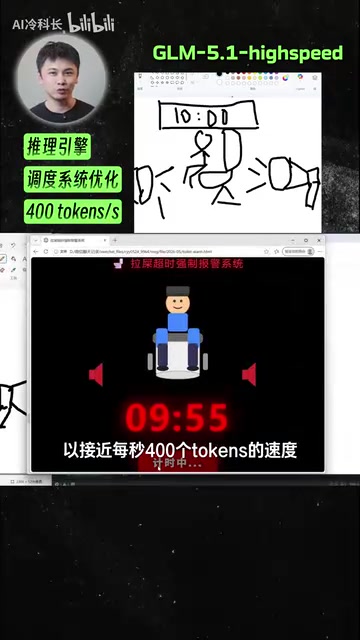
The results were surprising: through optimization of the underlying inference engine and scheduling system, the model restored the sketch into a runnable page at nearly 400 tokens per second. From submitting the requirement to completing page development took just over one minute. Whether it was a "Boss Alert Alarm" or a "Mandatory Bathroom Alert System," everything was fully implemented within two minutes.
Technical Paths for Inference Engine Optimization
Improving large model inference speed typically relies on system-level optimization across multiple layers. At the hardware level, using higher-bandwidth HBM memory (such as H100's 3.35TB/s bandwidth) and dedicated AI chips can significantly reduce memory bottlenecks. At the algorithm level, Speculative Decoding — where a small model predicts drafts and a large model batch-verifies them — can boost throughput by 2-3x. At the scheduling level, Continuous Batching and PagedAttention (pioneered by the vLLM framework) can dramatically improve GPU utilization and reduce memory fragmentation. At the parallelism strategy level, coordinated optimization of Tensor Parallelism and Pipeline Parallelism can maximize multi-GPU inference efficiency. The "underlying inference engine and scheduling system optimization" mentioned by GLM 5.1 High Speed represents the comprehensive application of these technical paths.
Ultimate Challenge: Generating a Complete Puzzle Game from Zero
An even more convincing test was developing a complete puzzle game. The test conditions were extremely demanding: zero coding background, with only a collection of scattered image assets.

Code Generation Capabilities Demonstrated by GLM 5.1
- Autonomous Logic Design: Conceived an entire set of puzzle logic based on file names, instantly outputting a complete PRD document
- Engine Built from Scratch: Acting as lead programmer, building a Canvas engine and preloading mechanism from zero
- Massive Code Output: Nearly a thousand lines of code poured out like a waterfall — finished in the time it takes to grab a drink of water
- Automatic Code Review: After writing, it ran its own code review, discovered a logic flaw in the item system, and immediately fixed it on the spot

Technical Complexity of Canvas Engine and Game Development
HTML5 Canvas is a 2D graphics rendering API natively provided by browsers and one of the core technologies for developing web games. Building a Canvas game engine from scratch requires handling multiple complex subsystems: the render loop (60fps refresh via requestAnimationFrame), Sprite management and layer sorting, collision detection algorithms, resource preloading and caching mechanisms, State Machine management for game logic flow, and event systems for handling user interaction. For puzzle games, additional implementation of an inventory system, item combination logic, scene transition animations, and save mechanisms is required. Nearly a thousand lines of code covering all the above modules — with the ability to automatically discover and fix item logic flaws — demonstrates the model's systematic thinking capability on complex engineering tasks, rather than simple code snippet stitching.
How Complex Are the Puzzle Mechanics Designed Autonomously by AI?
The most impressive aspect was the complexity of the game mechanics autonomously designed by the AI. This puzzle game, adapted from the film A Love Letter to A-Mao, contains multi-layered nested puzzle logic:
- Cross-item Combination Mechanics: You need to use candy and a water cup to pry open a drawer to obtain reading glasses
- State-stacking Puzzles: The attic is covered in dust — select the palm-leaf fan and fan three times consecutively; with each fan, one layer of dust clears, and on the third stroke, sunlight floods in
- Narrative Integration: After the dust clears, it seamlessly transitions into a flashback sequence
- Hidden Easter Eggs: The initials of the male and female protagonists' names are secretly carved into the old pagoda tree

From sorting out layer rendering and designing puzzle logic to mechanisms fitting together perfectly plus automatic debugging — the entire workflow was executed in one seamless flow.
The Technical Essence: The Just-in-Time AI Programming Era Has Arrived
The core technical breakthrough behind GLM 5.1 High Speed lies in underlying inference engine optimization. When a full-power flagship model is brought to this terrifying output speed, intelligence for the first time possesses "Just-in-Time" capability for AI programming.
Related articles
 Product Reviews
The Programmer's Desk Setup Guide: Building a Workspace That Feels Like Home
Discover how programmers build productive, comfortable workspaces. From multi-monitor setups to ergonomic design, explore the desk philosophy that drives focus and flow.
 Product Reviews
Qoder vs Cursor Real-World Comparison: Which $20/Month AI IDE Is Better?
Hands-on comparison of Qoder vs Cursor AI IDEs: Agent autonomy, human interaction count, and architecture decisions. Qoder needed only 2 interactions vs Cursor's 8.
 Product Reviews
Cursor Cloud Agent Demo: Eliminating Bottlenecks Across the Entire Software Development Lifecycle
Deep analysis of Cursor's Cloud Agent demo showing how cloud VMs, automated test artifacts, and a full-chain control plane systematically eliminate human bottlenecks across the software development lifecycle.